
Introduction
Building Materials | Choosing building materials is one of the most important decisions when constructing a new house, renovating an existing property, or improving a building. The wrong materials can lead to unnecessary expenses, moisture problems, frequent repairs, and disappointing results. The right choices help create a safe, durable, comfortable, and attractive property without wasting money.
Brendan Active Property Care provides a starting point for exploring practical property care, construction planning, and home improvement guidance. Understanding building materials is an essential part of that process because every construction decision affects the building’s performance, maintenance needs, and long-term value.
This guide explains the main types of building materials, their advantages and limitations, how to compare their quality and costs, which materials suit different parts of a house, and the mistakes to avoid before purchasing. You’ll also learn how to plan quantities, manage deliveries, and make informed decisions that match your construction requirements.
1. What Are Building Materials and Why Do They Matter?
Building materials are natural or manufactured products used to construct, protect, and finish buildings. They include structural materials such as concrete and steel, wall materials such as bricks and blocks, and finishing products such as paint, tiles, glass, insulation, and waterproofing systems.
Each material has a specific purpose. Some carry loads, some protect against weather, and others improve comfort or appearance. The overall performance of a building depends on choosing suitable products and installing them correctly.
For example, concrete can provide structural strength, but it needs an appropriate mix, placement, curing, and reinforcement when specified by the design. Similarly, attractive tiles won’t perform well if they’re installed over an unstable surface or an unsuitable waterproofing system.
The right building materials help achieve several goals:
- Structural safety: Provide the required strength and stability.
- Durability: Resist wear, moisture, weather, and other relevant conditions.
- Comfort: Improve indoor temperature control, sound insulation, and usability.
- Protection: Help manage water, wind, heat, and fire risks.
- Appearance: Create the desired architectural style and finish.
- Cost control: Reduce avoidable waste, repairs, and premature replacement.
Material selection should begin before construction starts. Changing specifications after work has begun can affect budgets, schedules, labor requirements, and compatibility with materials already installed.
2. What Are the Main Types of Building Materials?
The most common building materials include cement, concrete, bricks, concrete blocks, steel, timber, stone, glass, roofing products, insulation, and finishing materials. Most residential buildings use several of these together because no single material provides every property required for a complete structure.
Cement and Concrete
Cement and concrete are closely related, but they are not the same product. Cement is a binding ingredient that reacts with water. Concrete is made by combining cement, water, fine aggregate, coarse aggregate, and, when required, suitable admixtures.
Concrete is commonly used for foundations, slabs, columns, beams, floors, driveways, and other structural or external applications. Its suitability depends on the design, exposure conditions, mix specifications, and installation quality.
Advantages
- Provides high compressive strength when correctly designed.
- Can be formed into different shapes.
- Offers durability in suitable exposure conditions.
- Works effectively with reinforcing steel in engineered structures.
Limitations
- Requires proper placement and curing.
- Poor workmanship can cause cracking or reduce durability.
- Structural concrete may require careful reinforcement and quality control.
- Cement production has a significant environmental impact.
Professional advice: Never judge concrete quality by appearance alone. The specified mix, water content, reinforcement, curing conditions, and workmanship all influence performance.
Bricks and Concrete Blocks
Clay bricks are manufactured from shaped clay, while concrete blocks are produced using cementitious mixtures and aggregates. Both are widely used for walls, partitions, and selected structural masonry applications.
| Feature | Clay bricks | Concrete blocks |
|---|---|---|
| Common application | Walls, facades, partitions | Walls and partitions |
| Typical unit size | Smaller | Often larger |
| Installation | More units may be needed | Larger units can cover more area |
| Main advantage | Traditional appearance and versatility | Efficient coverage and varied block designs |
| Main consideration | Dimensions, absorption, strength | Density, strength, dimensions |
The correct choice depends on the building design, local construction methods, wall loads, moisture exposure, and thermal requirements.
Before purchasing, inspect samples for consistent dimensions and visible defects. Ask for relevant strength and water absorption information where applicable. Avoid assuming that a brick is suitable simply because its color looks uniform.
Steel and Reinforcement Bars
Steel is used in structural frames, reinforcement, roof systems, staircases, and connections. Reinforcing bars help concrete resist tensile forces that it cannot efficiently resist on its own.
Steel provides high strength relative to its size and can support a wide range of structural designs. However, the correct grade, dimensions, connection details, corrosion protection, and installation method are essential.
Steel can corrode when exposed to moisture and aggressive conditions. It also loses strength at elevated temperatures, so suitable fire protection may be required.
Never substitute reinforcement grades or bar sizes without approval from the responsible structural professional. A cheaper alternative is not acceptable if it fails to meet the project’s design requirements.
Timber and Engineered Wood
Timber is used for roof structures, doors, window frames, flooring, cabinets, and decorative finishes. Engineered wood products, including plywood and structural timber products, provide additional options for specific applications.
Timber is relatively easy to work with and can create a warm, natural appearance. Its suitability depends on the grade, moisture content, intended load, exposure, and required protection.
Benefits: Timber can be lightweight, versatile, and attractive.
Drawbacks: It may be affected by moisture, insects, fungi, and fire if the product and protection system are unsuitable.
Keep timber protected from rain during storage and installation. In areas exposed to dampness, use appropriate products and construction details to prevent persistent moisture accumulation.
Natural Stone
Granite, limestone, sandstone, marble, and other natural stones are used for flooring, wall cladding, steps, countertops, and outdoor paving.
Stone can offer excellent wear resistance and a distinctive appearance, but its properties vary considerably. Some varieties are porous, some react to certain cleaning chemicals, and some finishes become slippery when wet.
Before buying stone, confirm its suitability for the intended location. Examine samples under realistic lighting and ask about sealing, cleaning, installation, and maintenance requirements.
Glass, Windows, and Doors
Glass brings daylight into buildings and supports ventilation, visibility, and architectural design. Window and door systems also affect security, noise control, heat gain, and air leakage.
Tempered glass is designed to break differently from ordinary glass, while laminated glass uses an interlayer that helps hold broken pieces together. Insulated glazing uses multiple panes separated by a sealed space to reduce heat transfer.
These products serve different purposes and are not interchangeable. Select glazing according to the location, safety requirements, climate, and applicable building regulations.
Roofing Materials
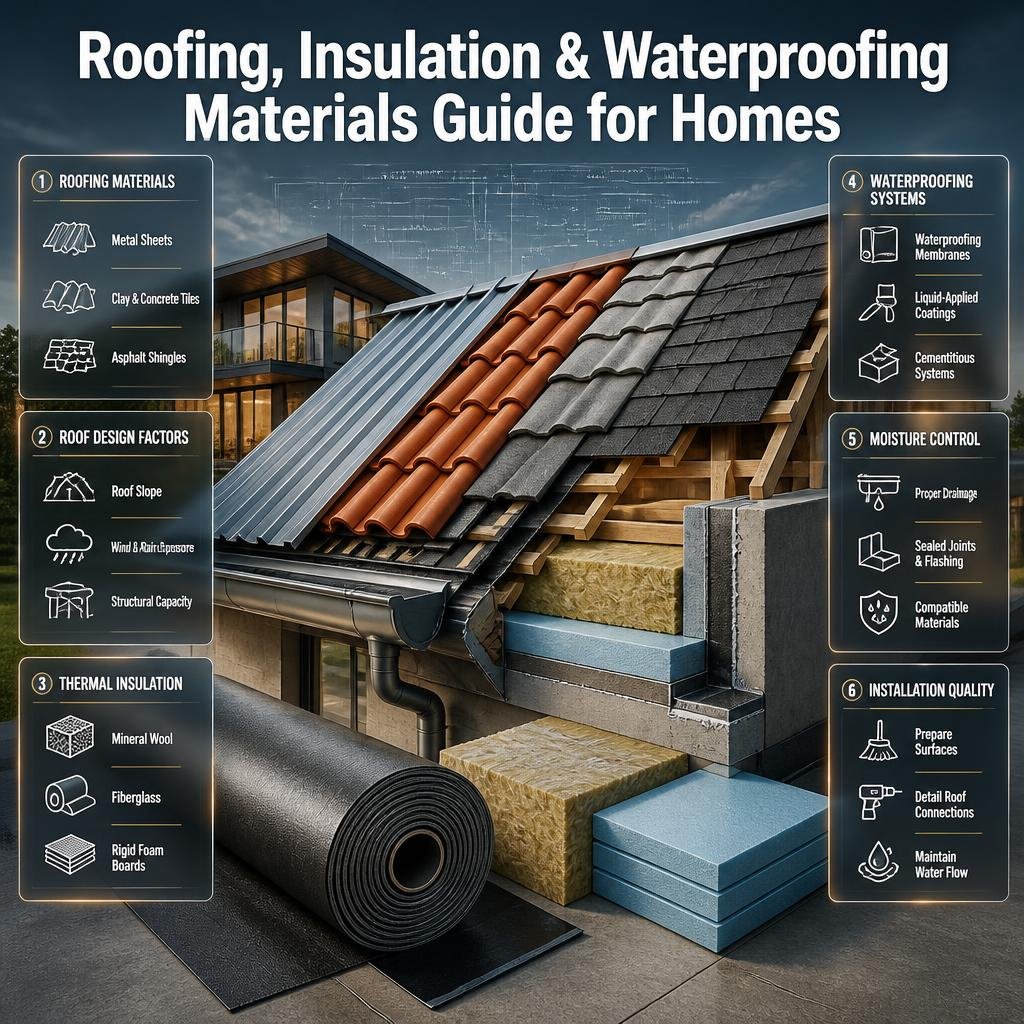
Common roofing options include metal sheets, clay tiles, concrete tiles, asphalt shingles, and waterproofing membranes for suitable roof designs.
| Roofing material | Main benefit | Important consideration |
|---|---|---|
| Metal sheets | Relatively lightweight | Heat, noise, corrosion, and fastening |
| Clay tiles | Traditional appearance | Weight and supporting structure |
| Concrete tiles | Durable roof covering | Structural loading and installation |
| Asphalt shingles | Adaptable appearance | Climate suitability and expected service life |
| Roofing membranes | Useful for many low-slope roofs | Drainage, seams, and workmanship |
The best roofing material depends on roof slope, rainfall, wind exposure, drainage, structural capacity, insulation, and maintenance access. A roof covering alone cannot compensate for poor flashing or inadequate drainage.
Insulation and Waterproofing
Insulation slows heat transfer, helping maintain comfortable indoor temperatures and potentially reducing energy consumption. Common options include mineral wool, fiberglass, rigid foam boards, and other products designed for specific building assemblies.
Waterproofing products help prevent water from entering vulnerable areas. These include membranes, liquid-applied coatings, cementitious systems, and suitable flashing materials.
Insulation is commonly used in roofs and exterior walls, while waterproofing is particularly important in bathrooms, foundations, balconies, and roofs.
Expert tip: Treat moisture control as a complete system. Drainage, surface preparation, joints, flashing, compatible products, and installation quality are just as important as the waterproofing material itself.
Finishing Materials
Finishing materials include plaster, paint, tiles, wall panels, flooring, adhesives, sealants, and decorative coatings. They affect the building’s appearance, cleanability, wear resistance, and everyday usability.
A bathroom needs moisture-appropriate finishes and supporting systems. Busy entrances need durable flooring, while exterior paint must withstand local weather conditions.
Choose finishes only after checking the underlying surface. Premium paint cannot solve persistent dampness, and expensive tiles cannot correct an unstable substrate.
3. How Do You Choose the Right Building Materials?
The right building materials meet the project’s structural, environmental, functional, and budget requirements. Start with the design, then compare product specifications, durability, installation requirements, availability, and ongoing maintenance.
Step 1: Identify the Purpose
Determine what each material must do before comparing products.
Ask:
- Is the material structural or decorative?
- Will it be exposed to rain, sunlight, or moisture?
- Must it resist heavy use, impact, or heat?
- Will another product cover it after installation?
A structural timber beam and a decorative wood panel may look similar but have very different requirements. Their specifications must not be treated as interchangeable.
Step 2: Consider Climate and Exposure
Heat, humidity, rainfall, strong winds, coastal salt, and temperature changes affect material performance.
In hot climates, roof insulation and solar heat control can help improve comfort. In damp conditions, moisture management and corrosion protection deserve particular attention.
Choose products for the actual conditions they will face rather than relying on general claims that they work everywhere.
Step 3: Verify Technical Quality
Compare the specifications that matter for the application. Depending on the product, these may include strength, water absorption, thermal performance, fire classification, dimensions, grade, and compatibility with other materials.
Request relevant test documentation and confirm compliance with applicable standards. A product’s suitability should be established through specifications rather than packaging claims alone.
Step 4: Compare Total Costs
The purchase price is only one part of the cost. Transportation, unloading, storage, labor, equipment, cutting waste, protective treatments, maintenance, and eventual replacement can change the final expense.
For help estimating the full project budget, review How to Plan a Construction Budget and Construction Cost Breakdown Explained.
Step 5: Check Suppliers and Availability
Locally available products may be easier to deliver and replace. However, availability should never replace quality requirements.
Before ordering, confirm the product grade, dimensions, quantity, delivery schedule, damage policy, and availability of matching products for future repairs.
For visible finishes such as tiles, stone, and paint, examine samples before committing to a large order.
Step 6: Arrange Proper Storage
Cement can be damaged by moisture, timber can warp, metal can corrode, and decorative finishes can be scratched or contaminated.
Prepare a suitable storage area before delivery. Follow the manufacturer’s instructions, protect vulnerable materials from weather, and arrange deliveries to match the construction schedule.
For broader project preparation, use the Home Renovation Planning Checklist.
4. What Factors Affect Building Material Costs?

Building material costs depend on quality, raw material prices, transportation, availability, labor, project size, and installation complexity. A low purchase price does not necessarily mean a lower total project cost.
Material Grade
Higher-grade products may cost more because of their performance, manufacturing process, or testing requirements. However, premium products are not necessary for every application.
Choose the grade that meets the design and expected use. Avoid paying extra for features that provide no meaningful improvement.
Transportation and Delivery
Heavy materials such as bricks, aggregates, and concrete products can be expensive to transport. Difficult site access and multiple deliveries may increase the cost.
Compare delivered prices rather than advertised prices alone. Confirm whether unloading and handling are included.
Cutting Waste and Breakage
Tiles, timber, stone, and roofing sheets may require extra quantities for cuts and installation waste. The appropriate allowance depends on the material, layout, and installation method.
Calculate quantities from measurements and drawings instead of applying the same waste percentage to every product.
Installation and Maintenance
Some products require specialized installers or additional surface preparation. Others need periodic sealing, painting, or protective treatment.
Compare three cost stages:
- Initial cost: Purchase, delivery, and installation.
- Ongoing cost: Cleaning, inspections, maintenance, and repairs.
- Replacement cost: Removal and replacement at the end of the useful life.
For an additional budgeting perspective, read How to Plan a Construction Budget Before Work Begins.
5. Which Building Materials Are Best for Different Parts of a House?
The best material depends on the function, exposure, design, and expected use of each part of the building. A suitable combination usually performs better than choosing a product simply because it is popular or inexpensive.
| Building area | Common material options | Main priority |
|---|---|---|
| Foundation | Designed concrete and reinforcement | Soil conditions, loads, durability |
| External walls | Bricks, blocks, engineered wall systems | Stability, moisture, thermal performance |
| Internal partitions | Masonry or suitable lightweight systems | Privacy, weight, sound control |
| Roof | Metal sheets, tiles, membranes | Weather protection and drainage |
| Floors | Concrete base, tiles, timber, resilient flooring | Wear, slip resistance, load capacity |
| Bathrooms | Waterproofing, suitable tiles, compatible grout | Water management and safety |
| Windows | Appropriate glazing and frame systems | Safety, ventilation, heat gain |
| Interior walls | Plaster, paint, wall coverings | Surface quality and cleaning |
| Outdoor paving | Concrete pavers, stone, suitable concrete | Drainage and traction |
For example, a bathroom floor requires more than attractive tiles. It needs an appropriate substrate, suitable waterproofing, correct drainage, and a finish that offers adequate slip resistance.
An external wall also needs more than structural strength. Its design should account for rain, heat, joints, openings, and any required insulation or protective finishes.
6. What Are the Most Common Building Material Mistakes?
Many construction problems begin with purchasing decisions. Mistakes often happen when buyers focus on appearance, compare only prices, or order materials before confirming the design.
Buying Before Finalizing the Design
Why it happens: Buyers want to begin quickly or take advantage of discounts.
Why it’s harmful: Design changes can make purchased products unsuitable or create shortages.
How to avoid it: Confirm drawings, measurements, specifications, and construction sequencing before placing major orders.
Choosing the Cheapest Product
Why it happens: Initial prices are easier to compare than long-term expenses.
Why it’s harmful: Unsuitable materials may require more repairs, additional labor, or early replacement.
How to avoid it: Compare equivalent grades and installed costs. Never compromise essential structural or safety requirements.
Ignoring Waterproofing
Why it happens: Waterproofing becomes hidden after construction, so it may receive less attention than visible finishes.
Why it’s harmful: Water penetration can damage finishes, corrode metal, and contribute to mold growth or deterioration.
How to avoid it: Include suitable drainage, flashing, damp protection, and waterproofing in the design. Inspect concealed work before covering it.
Ordering Incorrect Quantities
Why it happens: Measurements are estimated rather than calculated.
Why it’s harmful: Shortages delay work, while excess materials tie up money and may deteriorate in storage.
How to avoid it: Calculate quantities from accurate dimensions and allow for realistic cutting waste. Verify the delivery against the order.
Mixing Incompatible Products
Why it happens: Materials are selected separately without checking compatibility.
Why it’s harmful: Unsuitable combinations can lead to poor bonding, staining, cracking, or premature failure.
How to avoid it: Check manufacturer instructions for adhesives, sealants, coatings, substrates, and curing requirements.
Storing Materials Incorrectly
Why it happens: Deliveries arrive before suitable storage is available.
Why it’s harmful: Weather, moisture, contamination, and poor handling can damage products before installation.
How to avoid it: Prepare a protected storage area and follow product-specific handling instructions.
Common mistake: Never assume that a material suitable for one building will automatically work in another. Climate, structural design, exposure, and installation methods can change its performance.
7. What Professional Advice Helps You Choose Better Materials?
Professionals select building materials by matching their properties to the building’s requirements and considering how products will perform together. They assess design, installation, maintenance, and potential failure before making a recommendation.
Prioritize Structural Safety and Weather Protection
Structural stability, foundations, drainage, roof integrity, and moisture control should take priority over decorative finishes.
Paint colors and decorative tiles can be changed later. Correcting a structural defect or hidden water problem may require extensive work.
Consult a qualified architect or structural engineer when decisions affect load-bearing elements, structural integrity, or regulatory compliance.
Evaluate Complete Building Systems
A wall may include masonry, mortar, insulation, plaster, paint, and details around doors and windows. A roof may include the covering, supporting structure, fasteners, flashing, drainage, and insulation.
Ask how the complete assembly will perform under local conditions. This helps identify missing components before construction begins.
Inspect Samples and Approve Finishes
Request samples of tiles, stone, flooring, and paint. Examine them under the lighting conditions in which they’ll be used.
Check color, texture, dimensions, edge quality, and cleaning requirements. For large projects, approve a representative sample or mock-up before ordering the full quantity.
Maintain Purchase Records
Keep a record of product names, grades, quantities, suppliers, delivery dates, batch details, warranties, and installation instructions.
These records help with maintenance, replacement purchases, quality checks, and resolving disputes about supplied materials.
Buy for the Intended Service Life
Choose materials according to their expected use and maintenance requirements. A busy entrance may justify more durable flooring, while a low-visibility utility area may not need an expensive decorative finish.
For more project guidance, see How to Choose Building Materials and Build or Renovate.
8. How Can You Organize Construction and Property Maintenance?
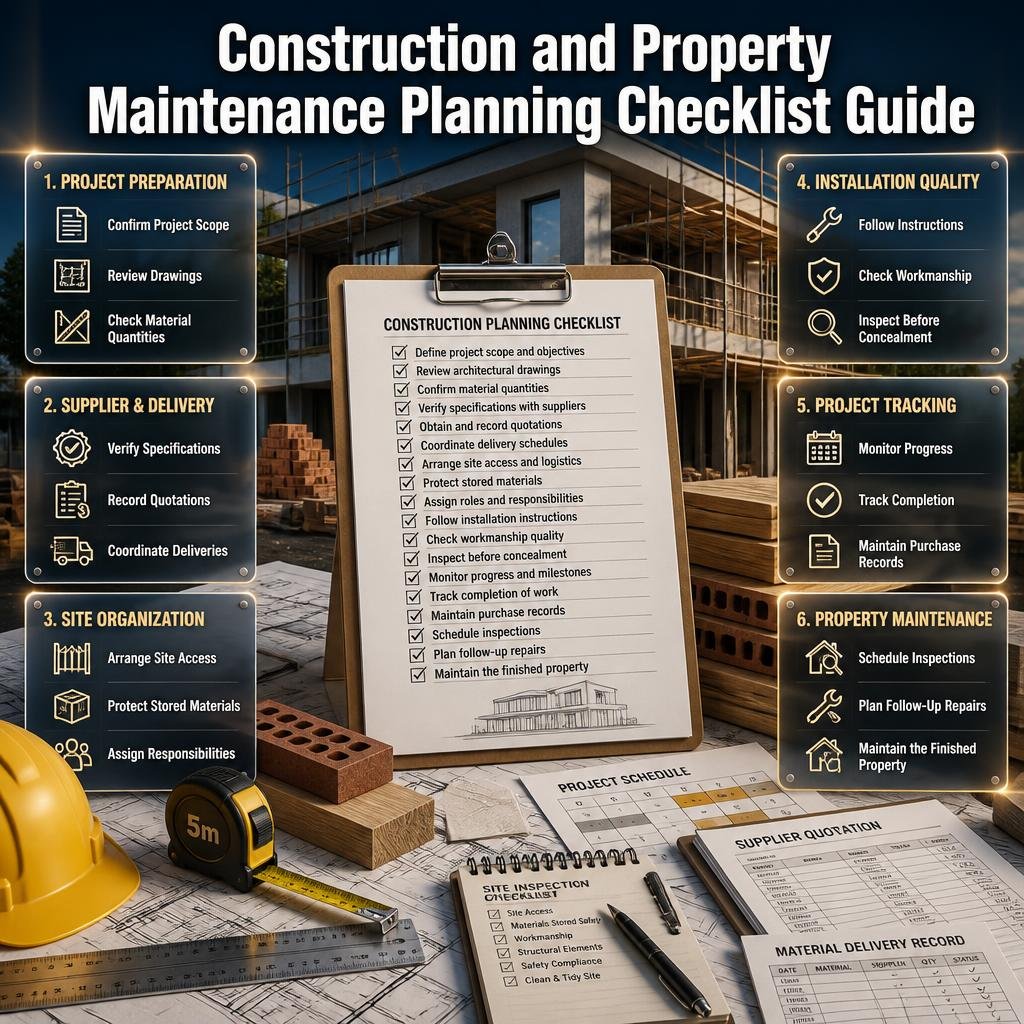
Material selection is only one part of successful construction. The work also requires coordination, appropriate installation, regular inspections, and a plan for maintaining the finished property.
Prepare a Construction Checklist
Before work starts, confirm the scope, drawings, quantities, delivery dates, storage arrangements, and responsibilities of the people involved.
A useful checklist should cover:
- Approved material specifications.
- Supplier quotations and purchase records.
- Site access and delivery arrangements.
- Storage and protection requirements.
- Installation instructions and quality checks.
- Inspection points before work becomes concealed.
- A schedule for completion and follow-up maintenance.
For practical preparation, review the Home Renovation Planning Checklist and Common Home Repairs and Improvements.
Plan for Future Maintenance
Materials last longer when underlying problems are identified early. Roofs, exterior finishes, drainage systems, sealants, and exposed metal components may require periodic inspection.
Use Seasonal Property Maintenance to help organize recurring checks. For wider maintenance needs, the Property Care and Care of Property guides can support a more organized approach.
Routine household tasks also matter after construction. Refer to Home Maintenance, Repairs and Home Improvements, Outdoor and Garden Care, and Cleaning and Organization for related property care topics.
Use Construction Guidance When Planning Complex Work
Larger projects benefit from a clear sequence that connects design, budgeting, material procurement, installation, and inspection.
The Construction Guide provides a relevant starting point for organizing construction tasks and understanding the decisions involved.
When a project requires temporary accommodation or travel to another location, arrange those logistics separately from material procurement. Useful resources include Plan a Journey, How to Plan a Trip Budget, and How to Plan a Trip Budget Before You Book.
For itinerary preparation, see How to Plan a Travel Itinerary and How to Plan a Travel Itinerary Without Overplanning. If accommodation is required, How to Choose the Right Hotel Location may help. People preparing for overseas travel can also consult the First-Time International Travel Checklist.
These travel resources are relevant when project arrangements involve travel; they are separate from the technical requirements for selecting construction materials.
How Do You Choose the Best Building Materials for a House?
Choosing the best building materials starts with understanding the building’s structural requirements, local climate, available budget, and long-term maintenance needs. Materials should be selected according to their intended use rather than appearance or price alone. For example, roofing materials need to withstand local weather, while flooring should offer suitable durability and slip resistance for the room where it will be installed.
Before purchasing, compare product specifications, quality certifications where applicable, supplier reliability, installation requirements, and expected service life. Structural materials should always meet the approved design requirements.
Important points to consider:
Select materials suitable for the building’s location and environmental conditions.
Compare quality and total installed cost instead of purchase price alone.
Check compatibility between materials used in the same building system.
Consult a qualified professional for structural and safety-related decisions.
Which Building Materials Are the Most Durable and Cost-Effective?
Concrete, quality masonry, appropriately protected steel, suitable roofing products, and well-selected finishes can provide long service lives when correctly specified and installed. However, durability depends on the material’s quality, exposure conditions, workmanship, and maintenance. A product that performs well in a dry interior may deteriorate more quickly when exposed to persistent moisture or harsh weather.
Cost-effectiveness means balancing the initial purchase and installation expenses against maintenance, repairs, energy performance, and eventual replacement. A cheaper product may cost more over time if it needs frequent repairs, while an expensive product may offer little additional value if its premium features are unnecessary.
How to make a cost-effective choice:
Compare equivalent material grades and specifications.
Evaluate transportation, installation, and maintenance expenses.
Consider expected service life and replacement difficulty.
Prioritize durability in high-use and weather-exposed areas.
Avoid paying extra for features that do not improve the intended application.
How Can You Reduce Building Material Costs Without Compromising Quality?
Reducing building material costs requires careful planning, accurate quantity calculations, and sensible purchasing decisions. The most effective savings often come from preventing waste, avoiding last-minute design changes, comparing supplier quotations, and coordinating deliveries. Cutting essential material specifications or skipping necessary waterproofing can create much larger expenses later.
Start by finalizing the building design and preparing a detailed material list. Compare quotations for equivalent products, including delivery and handling charges. Buy quantities according to the construction schedule, and arrange appropriate storage to protect materials from moisture, damage, and theft.
Practical ways to control costs:
Prepare a detailed bill of quantities before ordering.
Compare multiple quotations for the same specifications.
Plan cutting layouts to reduce unnecessary waste.
Coordinate deliveries with the construction schedule.
Check quantities and product condition when materials arrive.
Keep a contingency allowance for unexpected expenses.
What Building Materials Are Best for Hot and Humid Climates?
Buildings in hot and humid climates need materials and construction systems that manage heat, moisture, ventilation, and weather exposure. Suitable roof insulation, solar heat control, moisture-resistant finishes, correctly detailed waterproofing, and appropriate exterior coatings can help improve comfort and durability. The best combination depends on the local climate, building orientation, design, and construction methods.
For example, a roof with suitable insulation and reflective properties may reduce heat entering the building. In bathrooms and other wet areas, compatible waterproofing systems and adequate ventilation help limit moisture-related problems. Exterior metal components may also need appropriate corrosion protection in humid or aggressive environments.
Key selection considerations:
Choose insulation according to the roof or wall assembly.
Use suitable waterproofing in areas exposed to water.
Select exterior finishes designed for local weather conditions.
Provide effective drainage and ventilation where appropriate.
Check material compatibility to prevent trapped moisture and premature deterioration.
What Are the Most Common Mistakes to Avoid When Buying Building Materials?
The most common mistakes include choosing products based only on price, purchasing before finalizing the design, ordering incorrect quantities, ignoring technical specifications, and storing materials improperly. These decisions can cause construction delays, unnecessary expenses, poor finishes, and long-term maintenance problems.
A professional purchasing process begins with approved drawings and clearly defined specifications. Buyers should verify material grades, dimensions, delivery conditions, and relevant test documentation before placing an order. Materials should then be inspected on arrival and stored according to the manufacturer’s instructions.
Mistakes to avoid:
Buying structural products without checking approved specifications.
Assuming visual appearance guarantees quality.
Ignoring waterproofing and moisture-control requirements.
Mixing incompatible adhesives, coatings, or construction products.
Ordering excessive quantities without considering storage conditions.
Accepting damaged or incorrect deliveries without documenting the problem.
Professional recommendation: Treat material selection as part of the complete construction plan. Careful purchasing, correct installation, and regular maintenance work together to improve building performance and reduce avoidable costs.
Conclusion: Choosing the Right Building Materials
Choosing the right building materials is one of the most important decisions in any construction or renovation project. The quality of materials affects structural strength, durability, energy efficiency, maintenance requirements, appearance, and the overall cost of a building. Rather than selecting products based on price alone, homeowners and builders should consider how each material performs under the project’s specific conditions.
A successful project begins with a clear plan, accurate measurements, a realistic budget, and a proper understanding of the building’s requirements. Compare material specifications, check product quality, consider local weather conditions, and purchase from reliable suppliers. It is also important to follow applicable building codes and consult qualified professionals when selecting materials for structural or safety-critical applications.
Before making your final decisions, remember these essential principles:
- Prioritize quality and safety: Choose materials that meet relevant standards and suit their intended purpose.
- Balance cost with long-term value: Consider durability, installation expenses, maintenance, and expected lifespan.
- Plan purchases carefully: Calculate quantities accurately and allow for reasonable waste without overbuying.
- Consider environmental conditions: Select materials appropriate for local temperatures, moisture levels, and weather exposure.
- Coordinate every stage: Ensure materials are compatible with the design, construction method, and finishing requirements.
Ultimately, the best building materials are those that provide the right balance of strength, performance, affordability, and long-term reliability. With informed decisions and careful planning, you can build or renovate with greater confidence, avoid unnecessary expenses, and create a property that remains functional, comfortable, and dependable for years to come.