Introduction
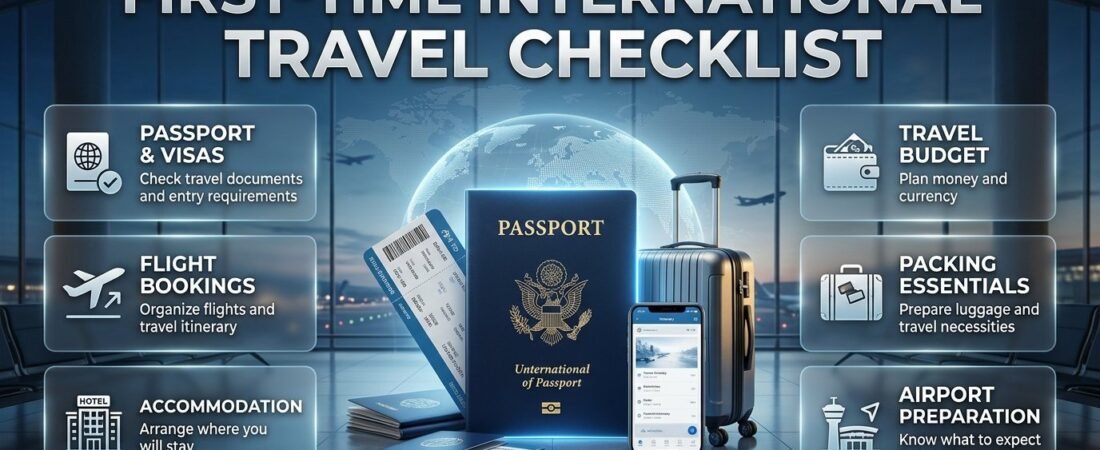
First-Time International Travel Checklist | Planning your first trip abroad can feel exciting until you realize how many things need attention. You must check your passport, understand visa requirements, book flights, arrange accommodation, organize your money, prepare your luggage, and learn what to expect at the airport. Missing even one important detail can create unnecessary stress before your journey begins.
A well-organized First-Time International Travel Checklist makes these responsibilities easier to manage. Instead of trying to remember everything at once, you can follow a clear plan from the early preparation stage to your arrival at your destination.
Whether you are traveling for a holiday, visiting relatives, attending an event, or exploring another country for the first time, this guide explains what to prepare, when to prepare it, and how to avoid common mistakes. You will also learn how to manage travel documents, choose practical accommodation, prepare a realistic budget, pack efficiently, navigate airports, and stay organized throughout your journey.
For more practical planning resources, visit the Brendan Active Property Care homepage, where you can explore guides designed to help you organize everyday responsibilities and plan projects more effectively.
1. Why Do First-Time International Travelers Need a Checklist?
A first-time international travel checklist is a structured list of tasks that helps you prepare for an overseas journey without overlooking essential requirements. It covers documentation, bookings, money, luggage, safety, transportation, and arrival arrangements. By completing these tasks in a logical order, you can reduce uncertainty, manage your budget, and avoid preventable travel problems.
Traveling internationally is different from taking a domestic trip because you may need to satisfy immigration requirements, follow foreign customs regulations, manage currency exchange, and navigate unfamiliar transportation systems.
You may also encounter different languages, local laws, weather conditions, and payment practices. Preparing for these differences before departure gives you more time to enjoy your trip.
What problems can a travel checklist prevent?
A useful checklist helps you identify problems while there is still time to resolve them.
For example, discovering that your passport does not meet your destination’s validity requirements several weeks before departure gives you time to investigate renewal options. Discovering the same problem at the airport may prevent you from traveling.
Similarly, checking your baggage allowance before packing helps you avoid unexpected charges. Confirming your accommodation’s check-in arrangements reduces the risk of arriving late without knowing how to access your room.
Your checklist should help you answer five important questions:
- Are all my travel documents valid and complete?
- Have I confirmed every important booking?
- Do I have enough money and suitable payment methods?
- Am I carrying everything necessary for the trip?
- Do I know what to do if my plans change?
How should you organize your checklist?
Divide your preparation into manageable stages rather than treating every task as equally urgent.
| Preparation stage | Main responsibilities |
|---|---|
| Several weeks or months before departure | Passport, entry requirements, flights, accommodation, insurance |
| Two weeks before departure | Budget, transportation, medication requirements, itinerary |
| One week before departure | Packing, mobile connectivity, document backups |
| Twenty-four to forty-eight hours before departure | Flight status, baggage limits, check-in, final document review |
| Departure day | Airport transfer, check-in, security, boarding |
| Arrival day | Immigration, customs, baggage collection, transportation |
The exact schedule depends on your destination and circumstances. Passport applications, visas, and other official processes can take longer than expected, so begin these tasks as early as possible.
Practical tip: Keep your checklist in one place. A notebook, a document on your phone, or a simple digital task list can work well. The best system is one you can review easily and update whenever your plans change.
2. How Should You Check Your Passport and International Travel Documents?
Your passport and entry documents should be the first items you verify when preparing for international travel. Check the expiration date, physical condition, personal details, and destination-specific requirements before making nonrefundable commitments. Depending on your nationality and itinerary, you may also need a visa, electronic travel authorization, transit permission, or supporting documents.
Passport preparation checklist
Complete these checks before moving on to other preparations.
- Confirm that your passport will remain valid for the required period.
- Check whether your destination requires a particular amount of remaining validity.
- Make sure your passport is not damaged.
- Check whether sufficient blank pages are required.
- Confirm that the name on your flight booking matches your passport.
- Review the passport requirements of every country on your itinerary.
- Store a secure copy of your passport details separately.
- Find out how to contact the relevant authorities if your passport is lost.
Some destinations require a passport to remain valid for several months beyond the planned departure date. Other destinations use different rules, and the calculation may depend on your entry date, departure date, or residence status.
Never assume that a passport valid on your departure day automatically meets every entry requirement.
What other travel documents might you need?
Your document requirements depend on your destination, nationality, reason for travel, and length of stay.
Possible documents include:
- A valid passport.
- A visa or electronic travel authorization.
- Flight booking confirmations.
- Accommodation details.
- Evidence of onward or return travel.
- Travel insurance information.
- Prescription documentation for certain medicines.
- Proof of sufficient funds, where required.
- Parental consent documents when applicable.
- Documents related to study, work, or other specific travel purposes.
You may not need every item on this list. Confirm which documents apply to your individual circumstances rather than carrying unnecessary paperwork.
How can you keep documents organized?
Use a dedicated travel-document folder or organizer. Keep your passport secure but accessible when required, and store digital copies in a protected account.
You can also download essential confirmations to your phone so they remain accessible without an internet connection.
A printed copy of important information may be useful as a backup. However, photocopies and screenshots do not replace original documents when airlines or immigration authorities require them.
Common mistake: Waiting until the final week to check passport requirements. If you need a replacement passport or additional authorization, you may not have enough time to complete the process.
3. How Can You Confirm Visa and Entry Requirements?
Visa and entry requirements determine whether you can legally travel to and enter your destination under the conditions that apply to you. Requirements vary according to nationality, passport type, travel purpose, length of stay, and sometimes previous travel or residence circumstances. Check the rules for every country you will visit or transit through.
Create a destination requirements checklist
Before departure, confirm the following:
- Whether you need a visa.
- Whether an electronic travel authorization is required.
- Whether you need permission for a connecting country.
- Whether your passport must meet additional validity requirements.
- Whether onward travel or accommodation evidence is required.
- Whether there are health or vaccination requirements.
- Whether you must complete an arrival declaration.
- Whether any restrictions apply to your planned activities.
Visa-free travel does not necessarily mean that you can enter without meeting other conditions. Likewise, holding a visa does not automatically guarantee admission at the border.
What should you know about transit requirements?
A connecting flight can introduce additional requirements. Some itineraries involve changing terminals, collecting checked baggage, checking in again, or passing through immigration.
Whether you need transit permission depends on the countries involved, your nationality, your travel documents, and whether you remain in the international transit area.
Check these details before booking flights with connections. Do not rely only on the length of your layover to determine whether the itinerary is practical.
How should you handle changing entry rules?
Use current information from the relevant government or immigration authority. Recheck important requirements before departure because rules and application procedures can change.
If your situation is unusual, contact the appropriate embassy, consulate, or immigration authority for clarification.
Expert tip: Save the date when you checked your entry requirements. This gives you a useful reminder to verify the information again shortly before departure.
4. How Do You Book International Flights Without Avoidable Problems?
A suitable international flight should fit your budget, schedule, baggage needs, and connection requirements. Compare the complete cost rather than choosing the lowest advertised fare. Consider airport location, transfer time, baggage charges, ticket conditions, and the consequences of delays before confirming your booking.
What should you compare before booking?
Check these details for every flight option:
- Departure and arrival airports.
- Departure and arrival dates.
- Local departure and arrival times.
- Number and length of connections.
- Cabin baggage and checked baggage allowances.
- Seat selection charges, if relevant.
- Change, cancellation, and refund conditions.
- Airport transfer arrangements.
- Whether the itinerary uses one booking or separate tickets.
Flight times are usually displayed in local time. When comparing arrival times, account for time-zone differences and overnight travel.
For example, a flight leaving late in the evening may arrive the following calendar day even if the journey itself is relatively short.
Are cheaper connecting flights always better?
No. A lower fare may involve a long layover, a distant airport, additional baggage charges, or separate tickets.
If you book separate tickets, a delay on the first flight may cause you to miss the second flight without the same protection you might have under a single booking.
A longer connection can offer more flexibility, particularly when immigration, baggage collection, or another check-in is necessary.
Choose a connection that gives you enough time for the actual airport procedures involved. Avoid assuming that every transfer can be completed quickly.
What should you do after booking?
Save your confirmation and review the passenger details carefully.
Check the airline’s rules for online check-in, baggage, boarding deadlines, and travel documents. If the airline changes your schedule, review the new arrangements and confirm whether they affect your connections or accommodation.
Keep your booking reference accessible, but avoid sharing it publicly because reservation details may contain personal information.
5. How Do You Choose Accommodation for Your First Overseas Trip?
Good accommodation should provide a suitable location, clear booking conditions, reliable access, and facilities that meet your needs. Compare the total price, transport options, reviews, cancellation policy, and arrival arrangements before booking. The cheapest room may not be the most economical option if reaching it requires expensive or inconvenient transportation.
What should you check before reserving a hotel?
Review the following details:
- Exact address and neighborhood.
- Distance from the airport or main transport connections.
- Access to the places you intend to visit.
- Recent reviews and property information.
- Check-in and check-out times.
- Late-arrival procedures.
- Payment and deposit requirements.
- Cancellation conditions.
- Available facilities.
- Contact details for the accommodation provider.
Consider your actual travel plans when choosing a location. Staying near a major transport connection may be more convenient than choosing accommodation far from the places you intend to visit.
For more detailed advice, use the How to Choose the Right Hotel Location guide.
Should you pay for accommodation in advance?
That depends on the booking conditions, your budget, and how certain your plans are.
A prepaid reservation may offer a lower price, but it can be less flexible if your plans change. A refundable reservation may cost more while providing greater flexibility.
Read the conditions carefully before paying. Check whether taxes, deposits, or additional charges are included in the advertised total.
How should you prepare for arrival?
Save the property’s address, confirmation number, contact details, and check-in instructions.
If you expect to arrive late, contact the property beforehand to confirm access arrangements. If you are using a transfer service, confirm where the driver will meet you and how you will identify the vehicle.
Practical tip: Keep your accommodation address available offline. You may need it when your phone has no mobile signal or you cannot immediately access your booking account.
6. How Can You Prepare a Realistic International Travel Budget?
An international travel budget should include the entire journey, not just flights and accommodation. Account for meals, local transportation, activities, insurance, mobile connectivity, baggage fees, and unexpected expenses. A realistic budget helps you decide what you can afford before departure and reduces the risk of running short of money abroad.
What expenses should you include?
Start with these categories:
| Budget category | Examples |
|---|---|
| Travel | Flights, airport transfers, train tickets |
| Accommodation | Hotel, guesthouse, taxes, deposits |
| Food | Meals, drinks, snacks |
| Local transport | Public transport, taxis, rental vehicles |
| Activities | Attractions, tours, admission fees |
| Communication | Roaming, SIM cards, eSIM plans |
| Preparation | Insurance, necessary travel equipment |
| Personal spending | Shopping, gifts, optional activities |
| Emergency reserve | Unexpected transport, delays, urgent expenses |
Estimate the cost of each category using the length of your trip and the activities you have planned.
Do not base your entire budget on the cheapest possible prices. Allow for realistic spending, particularly when you arrive late, need an unexpected taxi, or have to change an arrangement.
For a step-by-step budgeting method, read the How to Plan a Trip Budget guide.
How much emergency money should you keep?
There is no single amount that suits every traveler. Your reserve should reflect the destination, trip length, insurance coverage, access to funds, and the potential cost of changing your plans.
Keep emergency money separate from your normal daily spending. A backup card can also be useful if your main payment method is lost or declined.
How can you reduce unnecessary expenses?
Use these practical methods:
- Compare the total price of flights rather than the headline fare.
- Choose accommodation near convenient transport.
- Check baggage allowances before packing.
- Review foreign transaction and ATM fees.
- Plan major activities in advance.
- Set a reasonable daily spending limit.
- Avoid booking optional services you do not need.
- Keep a record of major expenses.
Budgeting should help you make informed choices, not prevent you from enjoying your trip. Identify what matters most to you and spend accordingly.
7. Which Payment Methods Should You Take Abroad?
A reliable international payment plan usually includes a main payment method, a separate backup, and access to emergency funds. Check whether your cards work in your destination, what fees apply, and how to contact your provider if a card is blocked. The right combination depends on local payment practices and your financial circumstances.
Should you carry cash or use a card?
Both can be useful.
Cards are convenient for many purchases and reservations, while cash can help with small transactions or businesses that do not accept cards.
Before departure, check the availability of ATMs, the likely fees, and whether your card requires international transactions to be enabled.
Avoid carrying all your money in one place. Keep backup payment options separate from your main wallet.
What should you know about currency exchange?
Compare the total cost of different exchange options. Consider the exchange rate, service charges, ATM fees, and any foreign transaction fees from your bank.
When a payment terminal asks whether to charge you in your home currency or the destination’s currency, choosing the local currency often avoids the terminal operator’s additional conversion markup. Your bank’s own fees may still apply.
Always review the displayed amount before approving a transaction.
What if your card stops working?
Keep your bank’s official contact details accessible. Learn how to freeze a card through your banking app or other approved method.
If a card is lost or stolen, contact the provider promptly. Use your backup payment method while resolving the issue.
Common mistake: Assuming a card will work everywhere because it works at home. International acceptance, transaction limits, security checks, and ATM availability can vary.
8. What Should You Pack for Your First International Trip?
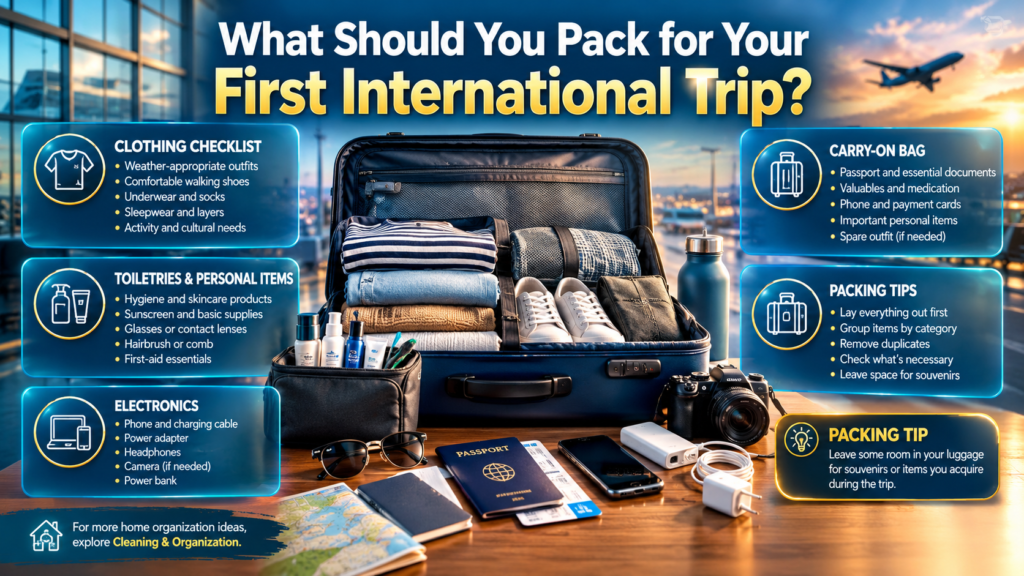
Pack according to the weather, trip length, planned activities, local customs, and airline restrictions. Prioritize items that are essential, difficult to replace, or necessary during the journey. A well-organized suitcase is easier to manage than an overloaded one, particularly when you must move between terminals, public transport, and accommodation.
What belongs on your clothing checklist?
Choose clothing based on the actual forecast and your itinerary.
- Everyday outfits suitable for the expected weather.
- Comfortable walking shoes.
- Underwear and socks.
- Sleepwear.
- A warm layer if temperatures may drop.
- A waterproof layer if rain is likely.
- Clothing appropriate for planned activities.
- Any specific clothing required by local customs or venues.
Consider how often you can wash clothes. A trip with laundry access may require fewer outfits than a journey involving several different activities and locations.
What toiletries and personal items should you pack?
Consider bringing:
- Toothbrush and toothpaste.
- Deodorant and basic hygiene supplies.
- Sunscreen appropriate for your destination.
- Personal skincare products.
- Glasses or contact lenses.
- Hairbrush or comb.
- Personal hygiene products.
- A small selection of useful first-aid supplies.
Check airline rules for liquids and other restricted items before packing toiletries in your cabin bag.
What electronics are worth bringing?
Your electronics checklist may include:
- Phone and charging cable.
- Suitable power adapter.
- Headphones.
- Camera, if needed.
- Compatible charging equipment.
- A power bank that meets airline requirements.
Check the electrical plug type and voltage requirements at your destination. Many modern chargers support a range of voltages, but you should verify the specifications of each device rather than assuming an adapter changes voltage.
What should you keep in your carry-on bag?
Keep your passport, essential documents, valuables, necessary medication, phone, payment cards, and other important personal items with you.
A spare outfit can be useful if checked luggage is delayed. Pack essential items according to security rules and airline requirements.
Never place an item in your carry-on or checked bag without checking the applicable restrictions when it may be regulated.
How can you avoid overpacking?
Lay everything out before placing it in your suitcase. Group items by category and remove duplicates.
Ask yourself whether each item is necessary for a specific activity, whether it can serve more than one purpose, and whether it can be obtained easily at your destination.
For additional household organization ideas that may help before a long trip, explore Cleaning & Organization.
Packing tip: Leave some room in your luggage for souvenirs or items you acquire during the trip. An overfilled suitcase can make the return journey harder to manage.
9. How Should You Handle Medication and Health Preparation?
Health preparation depends on your destination, personal needs, planned activities, and the length of your stay. Check whether vaccinations, preventive measures, or specific documents are recommended or required. Confirm that any medication you intend to carry is permitted in every country you will visit or transit through.
What should you check before departure?
Review these items:
- Any destination-specific health recommendations.
- Required vaccinations or health documentation.
- Rules covering prescription and controlled medicines.
- Medication storage requirements.
- The availability of necessary medical supplies.
- Your travel insurance’s medical coverage.
- Emergency assistance arrangements.
If you use prescription medication, plan how much you will need for the trip and check the rules for carrying it internationally. Keep it in its original packaging when practical, with supporting prescription information where appropriate.
Do not assume that a medicine legally prescribed in your home country is unrestricted elsewhere.
How should you prepare for unexpected illness?
Know how to contact local emergency services and your insurer’s assistance team.
Carry relevant medical information when needed, and make sure essential medication remains accessible during travel. If you have a health condition requiring specific arrangements, seek appropriate professional advice before departure.
A suitable travel insurance policy may help cover eligible medical expenses, emergency assistance, and other specified problems. Check exclusions and coverage limits before purchasing.
10. How Do You Plan Mobile Data and Internet Access Abroad?
Choose a mobile connectivity option before departure so you can access maps, reservations, messages, and transportation information when you arrive. Depending on your phone and destination, you may use international roaming, a local SIM card, an eSIM, or trusted Wi-Fi networks. Compare costs, coverage, activation rules, and data limits before deciding.
What should you do before leaving home?
- Check your mobile provider’s international rates.
- Confirm whether your phone supports an eSIM if you plan to use one.
- Check that your phone is compatible with the intended network.
- Download offline maps for your destination.
- Save accommodation and transport details.
- Download essential documents and tickets.
- Review your account security and recovery options.
Roaming may be convenient, but charges can accumulate depending on your provider and plan. A local SIM or eSIM may be more economical in some destinations, but availability and compatibility vary.
Why should you download information for offline use?
Internet access is not guaranteed everywhere. You might arrive in an area with weak coverage, have difficulty activating a SIM, or need information before connecting to a network.
Offline maps, saved addresses, booking confirmations, and emergency contacts can help you continue with your plans while resolving connectivity problems.
Use public Wi-Fi carefully, especially when accessing sensitive accounts. Prefer trusted networks and secure connections, and avoid sharing passwords or other confidential information unnecessarily.
11. How Can You Arrange Transportation Before and After Your Flight?
Plan how you will reach the airport, move between connecting flights, and travel from your destination airport to your accommodation. Check operating hours, transfer times, booking conditions, luggage requirements, and alternative options. Transportation planning helps you avoid unnecessary waiting, unexpected expenses, and confusion in unfamiliar places.
Before leaving home
Confirm the departure terminal, airport location, and recommended arrival time.
Check whether you need to book a taxi, reserve parking, use public transport, or arrange a lift. Allow extra time for traffic, service disruptions, and other delays.
If someone is taking you to the airport, agree on the pickup time and location in advance.
During an airport connection
Check the following:
- Whether you need to change terminals.
- Whether you must pass through immigration.
- Whether you need to collect and recheck luggage.
- Whether another security screening is required.
- Whether you need to check in again.
- How to reach your next departure gate.
Your requirements depend on the airport, airline, itinerary, and ticket arrangement.
Follow official airport signs and ask airport staff if you are unsure about the route.
After arriving at your destination
Before leaving the airport, confirm how you will reach your accommodation.
Use official taxi facilities, established transportation providers, or other suitable options. Check the fare or booking details before starting the journey.
Save the address of your accommodation and keep your phone charged. If your planned transport is unavailable, use a reliable alternative rather than accepting an unfamiliar offer without checking it.
12. How Should You Prepare for Airport Check-In and Security?
Airport procedures can feel unfamiliar on your first international journey, but they become easier when you know the general sequence. Allow enough time for check-in, baggage drop, security screening, passport control where applicable, and boarding. Follow your airline’s instructions because deadlines and procedures differ by airport and destination.
What should you do before arriving at the airport?
Complete these tasks:
- Check the flight status and departure terminal.
- Review the airline’s check-in deadline.
- Complete online check-in if available.
- Download your boarding pass.
- Confirm your baggage allowance.
- Check restrictions for liquids, batteries, and other items.
- Keep your passport and travel documents accessible.
- Arrange reliable transport to the airport.
Many airlines recommend arriving around three hours before an international flight, but this is not a universal requirement. Use the timing provided by your airline and airport.
What happens after you arrive?
A typical departure may follow this sequence:
Arrival → Check-in or bag drop → Security screening → Passport or exit control, if required → Departure gate → Boarding
At check-in, airline staff may inspect your passport, visa, or other travel documents.
Security screening checks passengers and baggage for restricted items. Follow instructions about removing electronics, liquids, or other belongings where required.
At the gate, monitor departure screens because gate assignments and boarding times can change.
How can you avoid missing your flight?
Do not assume that the scheduled departure time is the final boarding deadline.
Boarding may close before departure, and airlines may refuse late passengers even if the aircraft remains at the gate.
Keep track of the time, listen for announcements, and proceed to your gate early enough to manage unexpected delays.
Practical tip: Once you pass security, identify your departure gate before shopping or getting something to eat. You can then judge how much time you have available.
13. What Should You Know About Immigration and Customs?
Immigration and customs serve different purposes. Immigration authorities determine whether you meet the conditions for entering a country, while customs authorities enforce rules governing goods you bring in or take out. Depending on your itinerary, you may complete these procedures at your destination or at an earlier point in your journey.
How should you prepare for immigration?
Keep your passport and required documents ready.
You may be asked about your travel purpose, planned length of stay, accommodation, onward travel, or available funds. Answer honestly and clearly, and provide supporting documents if requested.
If you do not understand a question, politely ask for clarification.
Follow instructions from border officials and avoid making assumptions about what information is required.
What should you know about customs declarations?
Countries have different rules covering food, plants, animal products, medicines, valuable goods, cash, and other restricted items.
Check what you are allowed to bring into the destination and what must be declared. Some items that are ordinary household products in one country may be prohibited or subject to special conditions elsewhere.
If you are unsure whether an item must be declared, check the official customs guidance before traveling.
What happens after immigration?
Follow signs for baggage collection, customs, and the airport exit.
If your checked luggage does not arrive, report the problem to the airline’s baggage service desk and obtain a reference number before leaving the airport.
Once you have completed the required procedures, follow your planned transport arrangements and travel to your accommodation.
14. How Can You Stay Safe During Your First International Trip?
Good travel safety preparation focuses on awareness, secure belongings, reliable transportation, and access to help. Learn about the destination before departure, understand local laws, and keep important information available even when your phone is offline. You do not need to anticipate every possible problem; you need practical plans for common situations.
What safety steps should you take?
- Share your itinerary with a trusted person.
- Save emergency contact details.
- Learn how to contact local emergency services.
- Keep your passport and payment cards secure.
- Use reputable transport providers.
- Avoid leaving valuables unattended.
- Check local guidance about neighborhoods and transportation.
- Understand your travel insurance’s emergency procedures.
- Keep accommodation details accessible offline.
Your approach should reflect the destination and the activities you intend to undertake. Check current travel advice for any specific restrictions, risks, or precautions.
What should you do if your passport is lost?
Contact the relevant local authorities when appropriate and follow the instructions of your country’s embassy or consulate.
You may need to apply for an emergency travel document or replacement passport. Requirements and processing times vary, so keep a secure copy of your passport details and know how to access your travel insurance information.
If a payment card or phone is also missing, contact the relevant provider to protect your accounts.
How can you protect your belongings?
Use luggage that closes securely and keep essential items under your control.
Avoid displaying large amounts of cash or leaving valuables unattended in public places. When using accommodation safes or other storage facilities, understand their limitations and keep important documents accessible when needed.
Be cautious about unexpected requests for money or personal information, particularly when someone pressures you to act immediately.
15. How Should You Plan Your Travel Itinerary?
A practical itinerary organizes your transportation, accommodation, and activities without making every hour dependent on a strict schedule. It should include the places you want to visit, realistic travel times, opening hours, booking details, and enough flexibility to handle delays or unexpected changes.
What information should an itinerary contain?
Include the following details:
- Travel dates and flight times.
- Accommodation addresses and confirmation numbers.
- Planned transportation between locations.
- Activities requiring reservations.
- Estimated travel times.
- Important opening hours.
- Rest periods and flexible time.
- Emergency contact information.
Keep your first day relatively flexible, particularly if you expect a long flight or a substantial time-zone change.
How can you avoid an overcrowded itinerary?
Group nearby activities together and allow enough time to travel between locations.
Check whether attractions require advance reservations and verify their operating schedules. Avoid planning several important activities immediately after a long transfer.
An itinerary should help you make decisions, not become a source of stress when something changes.
For a more detailed planning process, read the How to Plan a Travel Itinerary guide.
You can also explore the site’s Plan a Journey resource for additional journey-planning ideas.
What should you keep flexible?
Transportation, weather, attraction schedules, and personal energy levels can all affect your plans.
Identify the activities that matter most and leave room to adjust less important ones. If you miss an activity, consider whether it can be moved rather than trying to fit everything into the remaining time.
A balanced itinerary gives you a clear direction while leaving space for the unexpected.
16. What Should You Do During the Final 48 Hours Before Departure?
The last two days before departure should focus on verification rather than major new decisions. Recheck your travel documents, flight details, baggage restrictions, accommodation arrangements, transportation, and access to essential information. Completing these tasks early helps you identify last-minute issues while there is still time to respond.
Final document review
- Confirm passport and entry-document requirements.
- Check flight details and passenger information.
- Download or print essential confirmations.
- Confirm accommodation reservations.
- Save emergency contacts.
- Check travel insurance details.
- Review medication and health preparations.
Final packing review
- Check the weather forecast.
- Review cabin and checked baggage restrictions.
- Confirm that essential medication is accessible.
- Charge your devices.
- Pack suitable clothing and personal care items.
- Keep valuables and documents in your carry-on.
- Remove prohibited or unnecessary items.
Final departure arrangements
- Confirm your route to the airport.
- Check the flight status and terminal.
- Review check-in and boarding deadlines.
- Set an alarm and allow enough time to get ready.
- Arrange care for responsibilities at home.
- Tell a trusted contact when you expect to leave and arrive.
If you are leaving your home empty for an extended period, consider securing doors and windows, arranging for necessary household responsibilities, and asking a trusted person to check on the property when appropriate.
For relevant home-care information, you can review the Home Maintenance guide and the Property Care resource.
Expert tip: Avoid leaving all your packing until the final evening. Completing most tasks earlier allows you to rest and focus on the few details that genuinely need attention.
17. How Can You Prepare Your Home Before Leaving for an International Trip?

Preparing your home is useful when you will be away for several days or longer. The goal is to leave the property secure, deal with essential responsibilities, and reduce the chance of returning to avoidable maintenance or household problems.
What should you check before leaving?
Depending on your living arrangements, consider:
- Securing doors, windows, and other entry points.
- Switching off unnecessary appliances safely.
- Checking that essential household systems are operating as intended.
- Removing perishable food that may spoil.
- Taking out rubbish.
- Arranging care for pets and plants.
- Managing deliveries and mail where necessary.
- Leaving emergency contact information with a trusted person when appropriate.
Do not switch off essential equipment or utilities if doing so could create a safety risk or damage the property. Consider your home’s specific needs and follow the relevant manufacturer’s guidance.
Should you arrange property checks while away?
For a longer absence, a trusted person may be able to check the property periodically, collect deliveries, and identify obvious problems.
The appropriate arrangement depends on the property, the length of your absence, and any responsibilities you have.
For additional guidance, see Care of Property and Outdoor & Garden Care.
If your home requires repairs before you leave, the Common Home Repairs and Improvements guide may help you organize the work.
For larger projects, you can also consult the Construction Guide resource.
How should you handle home improvement projects before travel?
Avoid beginning a major project immediately before departure unless you have enough time to manage the work safely and arrange appropriate supervision.
If renovation or building work is already planned, clarify responsibilities, secure the property, and ensure that any necessary work can continue without depending on your availability.
Helpful resources include Build or Renovate, How to Plan a Construction Budget, and Construction Cost Breakdown Explained.
If you need to prepare for a larger renovation, the Home Renovation Planning Checklist can help you organize tasks.
You can also use How to Choose Building Materials when researching materials for a planned project.
18. What Are the Most Common First-Time International Travel Mistakes?
Many travel problems result from incomplete preparation, incorrect assumptions, or leaving essential tasks until the last minute. Recognizing these mistakes early helps you make better decisions and respond more calmly if your plans change.
Mistake 1: Checking passport requirements too late
Why it happens: Travelers often focus on flight prices and accommodation before checking their documents.
Why it matters: A passport renewal or visa application may take longer than expected.
How to avoid it: Verify document requirements at the beginning of the planning process.
Mistake 2: Assuming every booking includes baggage
Why it happens: Different fares and airlines have different baggage allowances.
Why it matters: You may face additional charges or have to rearrange your luggage.
How to avoid it: Read the conditions for the exact ticket you purchased.
Mistake 3: Underestimating connection times
Why it happens: Travelers compare flight schedules without considering airport procedures.
Why it matters: A connection may require immigration, another security check, or baggage collection.
How to avoid it: Check the transfer requirements and allow a realistic amount of time.
Mistake 4: Depending on a single payment method
Why it happens: Travelers assume their usual card will always work.
Why it matters: A declined, lost, or blocked card may leave you without convenient access to money.
How to avoid it: Carry a separate backup payment method and know how to contact your provider.
Mistake 5: Packing too much
Why it happens: Travelers prepare for every possible situation.
Why it matters: Heavy luggage is difficult to transport and may exceed airline limits.
How to avoid it: Pack according to the weather, itinerary, and actual needs of the trip.
Mistake 6: Ignoring the arrival plan
Why it happens: Travelers concentrate on reaching the destination rather than getting to their accommodation.
Why it matters: You may face confusion, expensive transport, or delays after a tiring flight.
How to avoid it: Save the address, check transport options, and confirm arrival arrangements.
Mistake 7: Failing to review cancellation conditions
Why it happens: Travelers focus on the advertised price.
Why it matters: Changes may result in unexpected costs.
How to avoid it: Compare refundable and nonrefundable options before booking.
Mistake 8: Forgetting offline information
Why it happens: Travelers expect continuous internet access.
Why it matters: Weak coverage or activation problems can make reservations and directions difficult to access.
How to avoid it: Download maps, tickets, accommodation details, and emergency contacts before departure.
Mistake 9: Overloading the first day
Why it happens: Travelers want to make the most of their time abroad.
Why it matters: Delays, fatigue, and unfamiliar surroundings can make a busy schedule difficult.
How to avoid it: Keep arrival day flexible and prioritize essential arrangements.
Mistake 10: Not checking local restrictions
Why it happens: Travelers assume that familiar products and activities are permitted everywhere.
Why it matters: Local laws and customs rules can differ significantly.
How to avoid it: Research relevant restrictions before packing and follow local requirements.
19. What Do Experienced Travelers Recommend for a Smooth First Trip?
The most useful travel habits are usually simple: prepare early, keep essential information accessible, maintain backup options, and avoid making your itinerary unnecessarily complicated.
Keep your essential documents accessible
Use a consistent place for your passport, travel documents, and payment cards. This makes it easier to find what you need at check-in, security, and border control.
Keep secure backups separately so that one lost item does not remove your only access to important information.
Allow extra time for important journeys
Traffic, airport queues, transportation delays, and unfamiliar layouts can affect your schedule.
Plan with a reasonable margin rather than assuming every step will happen exactly on time. This is especially important when catching international flights or making separate-ticket connections.
Prepare for small disruptions
Consider what you would do if your phone lost its connection, your checked bag was delayed, or your original transport arrangement became unavailable.
You do not need a complicated emergency plan. A backup payment method, offline documents, suitable insurance, and accessible contact details can resolve many common problems.
Learn a few useful local expressions
Depending on the destination, learning simple phrases for greetings, directions, assistance, and common requests can make everyday interactions easier.
A translation app can also help, particularly if you download the language information for offline use where available.
Review your plans without becoming overwhelmed
Check important details at sensible intervals rather than repeatedly reviewing every minor decision.
Once a booking or task is confirmed, mark it as complete and move to the next priority. Revisit it if new information becomes available or your circumstances change.
Professional recommendation: The best preparation system is one that reduces the number of decisions you need to make under pressure. Organize essential documents, confirm major bookings, prepare a backup payment method, and keep your first-day plans simple.
20. What Should You Do When You Arrive in Your Destination Country?
Your arrival procedure will depend on the destination and your itinerary, but the priorities remain similar: complete border formalities, collect your belongings, follow customs rules, and reach your accommodation safely.
Follow the arrival process
After landing, follow airport signs for immigration or passport control where applicable.
Have your required documents ready and answer questions clearly. Once you have completed immigration procedures, follow signs for baggage collection and customs.
If you have no checked luggage, follow the airport’s instructions for passengers traveling with cabin baggage only.
Check your luggage before leaving
Confirm that you have collected the correct bag. If your luggage is missing or damaged, contact the airline’s baggage service desk and obtain a reference number.
Keep your baggage tag and any report details because they may be needed when following up with the airline or insurer.
Confirm your transport
Check your planned route to the accommodation before leaving the airport.
Use the agreed pickup point for a prearranged transfer or follow official signs for appropriate public transportation. Confirm important details before entering a vehicle.
If your phone is not working, use your saved address and any available airport assistance to identify a suitable option.
Settle in before exploring
Once you reach your accommodation, confirm the check-in arrangements, secure your belongings, and review your plans for the following day.
Let your trusted contact know you have arrived safely.
If you need to purchase essential supplies, identify nearby shops or services and check their opening hours.
Allow yourself time to rest after a long journey. A calm arrival gives you a better start than trying to complete too many activities immediately.
21. What Is the Best Way to Use This International Travel Checklist?
The checklist is most effective when you adapt it to your own destination rather than treating every item as universally required. Your nationality, travel purpose, airline, accommodation, trip length, and planned activities all influence what you need to prepare.
Start by marking each task as essential, applicable, or unnecessary for your circumstances.
For example, a traveler staying in one hotel may need little transportation planning beyond airport transfers. Someone visiting several cities will need a more detailed transport and accommodation schedule.
Similarly, a traveler carrying prescription medicine should investigate medication rules, while someone visiting a destination with specific vaccination requirements may need additional health preparation.
Create your personal departure checklist
Before departure, confirm the following categories.
Documents and entry requirements
- Passport validity verified.
- Visa or authorization confirmed where required.
- Transit rules reviewed.
- Supporting documents prepared.
Bookings and itinerary
- Flights confirmed.
- Baggage allowance checked.
- Accommodation confirmed.
- Airport transportation arranged.
- Important activities and transfers organized.
Money and safety
- Travel budget prepared.
- Payment methods checked.
- Backup payment method available.
- Insurance details accessible.
- Emergency contacts saved.
Packing and communication
- Clothing selected for the weather.
- Essential medication packed appropriately.
- Electronics and adapters prepared.
- Offline maps and documents downloaded.
- Baggage restrictions reviewed.
Departure and arrival
- Flight status checked.
- Check-in completed where available.
- Airport transfer confirmed.
- Accommodation address saved.
- Arrival contact informed of your plans.
For more planning and household guidance, visit the Brendan Active Property Care homepage and explore the resources relevant to your preparations.
What Documents Do You Need for Your First International Trip?
For many international flights, arriving around three hours before departure is a useful starting point. However, the right arrival time depends on your airline’s instructions, airport procedures, baggage arrangements, travel season, and destination. First-time travelers should check the airline’s recommended arrival time and leave additional time for traffic or other delays.
Before leaving for the airport:
Check your flight status, departure terminal, and check-in deadline.
Complete online check-in if available and download your boarding pass.
Confirm your cabin and checked baggage allowances.
Allow time for baggage drop, security screening, and passport control where applicable.
Check your gate information regularly because boarding gates can change.
Professional tip: Do not plan to arrive at the gate at the scheduled departure time. Boarding often closes before departure, and airlines may refuse late passengers even when the aircraft has not yet left. Allow enough time to complete every required airport procedure without rushing.
How Much Money Should You Budget for Your First International Trip?
Your international travel budget should cover transportation, accommodation, meals, local travel, activities, insurance, communication, and unexpected expenses. The amount you need depends on the destination, length of stay, travel style, and planned activities. Calculate your expected costs before departure instead of relying on a general daily estimate that may not suit your circumstances.
Include these expenses in your travel budget:
Flights and accommodation: Include baggage charges, taxes, deposits, and relevant booking fees.
Daily expenses: Estimate spending on meals, drinks, attractions, and local transportation.
Payment costs: Check foreign transaction fees, ATM charges, and currency conversion rates.
Emergency reserve: Set aside money for unexpected transport, delays, or other urgent needs.
Backup payments: Carry a separate payment method in case your main card is lost or declined.
Professional tip: Compare the total cost of your trip rather than focusing only on the cheapest flight or hotel. Check whether your destination requires evidence of sufficient funds for entry, and make sure your budget remains accessible through reliable payment methods.
What Should You Pack in Your Carry-On Bag for International Travel?
Your carry-on bag should contain the essential items you’ll need during the flight and anything important that would be difficult to replace if your checked luggage were delayed. Keep travel documents, valuables, necessary medication, payment cards, and your phone accessible. Check your airline’s baggage policy and airport security rules before packing, as restrictions vary.
Carry-on packing checklist:
Passport, required travel documents, and boarding pass.
Wallet, payment cards, and emergency contact details.
Phone, charging cable, and a compliant power bank.
Essential medication in suitable packaging, with supporting documents when needed.
A change of clothes and basic personal hygiene items, if space allows.
Offline copies of accommodation details, tickets, and important reservations.
Professional tip: Keep essential medication and valuables in your personal item rather than checked luggage, subject to applicable safety and security requirements. Review restrictions on liquids, batteries, and other regulated items before departure. Avoid placing every important document or payment method in one location.
How Can You Prepare for Your First International Trip to Avoid Common Travel Problems?
The most effective way to reduce travel problems is to prepare early, verify important information, and maintain backup arrangements. Many beginner difficulties result from overlooked entry requirements, unrealistic connection times, missing reservations, or dependence on a single payment method. A structured checklist helps you identify these risks before they disrupt your journey.
Complete these preparations before departure:
Verify passport validity, visa requirements, and transit rules for every country on your itinerary.
Confirm flights, accommodation, baggage limits, and transportation arrangements.
Arrange suitable travel insurance and understand its exclusions.
Download offline maps, tickets, reservations, and emergency contact details.
Prepare a backup payment method and check international banking fees.
Review local customs, laws, health guidance, and restrictions on medication or personal items.
Share your itinerary with someone you trust and confirm your arrival arrangements.
Professional tip: Conduct a final review 24–48 hours before departure. Check your flight status, terminal, travel documents, luggage, and airport transportation. Leave flexibility in your first day’s schedule so that delays, fatigue, or unfamiliar surroundings do not create unnecessary pressure.
The goal is not to plan for every possible situation. It is to prepare for the most important requirements, keep essential information accessible, and have practical alternatives when something changes.
Conclusion
Your first international trip becomes much easier when you prepare in advance, organize your documents, plan your budget, and understand the requirements of your destination. A well-prepared traveler is better equipped to manage airport procedures, avoid unnecessary expenses, and handle unexpected changes with confidence. Instead of leaving everything until the last minute, create a checklist and complete each task step by step before departure.
Before you travel, make sure your passport is valid, check visa and entry requirements, confirm your flight and accommodation details, arrange suitable travel insurance, and keep important documents accessible. Pack according to your destination’s climate and activities, prepare a reliable way to access money, and save essential contact information for emergencies. These practical steps can help reduce travel stress and make your journey more comfortable.
Most importantly, remain flexible and allow yourself time to adjust to a new environment. Delays, unfamiliar transport systems, and changes in plans can happen, but careful preparation makes them easier to manage. Use this First-Time International Travel Checklist as a guide, review your arrangements before departure, and focus on enjoying the experience. With the right preparation and a realistic plan, your first international adventure can become a rewarding experience and a strong foundation for future travels.