
Introduction
How to Plan a Travel Itinerary | Planning a trip should be exciting, but the process can quickly become stressful when you have multiple destinations, limited time, different transportation options, and a budget to manage. You might spend hours researching attractions and booking accommodation, only to discover that your daily schedule is unrealistic or that travelling between places takes longer than expected. Learning how to plan a travel itinerary helps you avoid these problems and enjoy a more organized journey. At Preppy Room, our focus is on practical ideas and helpful guides, and this travel planning resource follows the same principle: making everyday decisions easier through clear, useful advice.
A successful travel itinerary is more than a list of places to visit. It connects your travel dates, accommodation, transportation, activities, meals, and spending plan into a schedule that works in real life. Whether you’re arranging a short weekend escape, a family holiday, a solo adventure, or a journey across several countries, a thoughtful itinerary helps you use your time wisely without making the experience feel rushed.
This complete guide explains how to choose a destination, research attractions, organize daily activities, calculate travel times, manage expenses, prepare for unexpected changes, and create an itinerary that suits your personal travel style. You’ll also learn about common planning mistakes, practical examples, and simple ways to keep your travel information organized.
What Is a Travel Itinerary?
A travel itinerary is an organized outline of your journey that explains where you’re going, when you’ll travel, what you’ll do, and how you’ll move between destinations. Depending on the trip, it can include transportation reservations, accommodation details, sightseeing activities, restaurant plans, estimated costs, and important booking information.
The level of detail depends on the journey. A weekend break may need only a simple daily schedule, while an international trip involving several cities may require detailed transportation arrangements and confirmed reservations.
The purpose isn’t to control every minute of your holiday. Instead, an itinerary helps you make important decisions before departure so you can spend less time solving logistical problems and more time enjoying your destination.
Why Is Travel Itinerary Planning Important?
A well-prepared itinerary provides direction and helps you understand what is realistically possible during your available travel time.
Its main benefits include:
- Better time management: Organize attractions by location and reduce unnecessary journeys.
- Budget awareness: Estimate major expenses before committing to activities.
- Improved organization: Keep bookings, addresses, dates, and transport information together.
- Reduced uncertainty: Identify important requirements before arriving.
- Greater flexibility: Prepare alternatives when weather, transportation, or opening hours change.
- More enjoyable experiences: Prioritize activities that genuinely match your interests.
For example, a traveller spending three days in a city may organize the first day around historic landmarks, the second around museums and cultural experiences, and the third around local markets and relaxed exploration. This structure creates a clear plan while leaving room for spontaneous discoveries.
Step 1: Decide Where You Want to Go and When

The first step in planning a travel itinerary is choosing a destination that matches your available time, budget, interests, and travel preferences.
Before researching individual attractions, determine the general experience you want. Some travellers prefer beaches and outdoor activities, while others enjoy historic cities, food experiences, shopping districts, or peaceful countryside locations.
Your destination should suit the amount of time you have available. A location requiring two days of transportation may not be the best choice for a three-day break unless the journey itself is part of the experience.
Consider Your Travel Dates Carefully
Travel dates affect transportation prices, accommodation availability, weather conditions, and the number of visitors at popular attractions.
Before confirming your dates, consider:
- How many days you can comfortably spend away.
- Whether the destination has seasonal weather concerns.
- Whether major festivals or public holidays will affect availability.
- Whether attractions operate on your planned dates.
- Whether transport schedules change during the season.
- Whether your group has any scheduling restrictions.
Check arrival and departure times before counting your usable sightseeing days. Arriving late at night and departing early in the morning can reduce a four-day booking to fewer than three full days of exploration.
Pro Tip: Begin with the dates you can realistically travel, then select activities that fit those dates. This prevents you from building an itinerary around experiences you cannot comfortably fit into the trip.
Match the Destination to Your Available Time
A nearby destination may be ideal for a weekend, while a multi-city international journey generally benefits from a longer stay.
Consider the time required to reach the destination, transfer between locations, check into accommodation, and return home. The journey should leave enough time to experience the places you want to visit.
If you’re still deciding between different travel options, begin with the broader planning principles in the Plan a Journey guide.
Step 2: Establish a Realistic Travel Budget
A travel itinerary becomes much easier to organize when you know how much money you can comfortably spend.
Your budget influences the length of your trip, accommodation choices, transportation methods, and activities. Establishing a spending limit early helps you avoid committing to expensive arrangements before understanding the overall cost.
What Expenses Should Your Travel Budget Include?
A practical travel budget should cover all major expenses, not just flights and accommodation.
| Expense category | What to consider |
|---|---|
| Transportation | Flights, trains, buses, taxis, parking, or fuel |
| Accommodation | Hotels, guesthouses, or other lodging |
| Meals | Breakfast, lunch, dinner, drinks, and snacks |
| Activities | Tours, attraction tickets, and admission fees |
| Local travel | Public transport, transfers, and occasional taxis |
| Travel essentials | Insurance, connectivity, and necessary documents |
| Additional expenses | Laundry, tips, shopping, and other purchases |
| Emergency reserve | Unexpected costs and reasonable contingency funds |
Estimate each category separately before calculating the total.
Use this formula:
Total trip budget = Transportation + Accommodation + Food + Activities + Other expenses + Emergency reserve
For example, imagine a four-day trip with estimated transportation costs of $180, accommodation costs of $240, food costs of $120, activities costing $80, and miscellaneous expenses of $40.
The estimated total is $660 before adding an emergency reserve. These figures are illustrative rather than current market prices.
How Can You Keep Your Itinerary Within Budget?
Start by identifying essential expenses, such as transportation and accommodation. Then determine how much remains for meals, attractions, and optional experiences.
You can control spending by:
- Comparing accommodation options in convenient locations.
- Using public transportation where practical.
- Grouping nearby attractions to reduce transport costs.
- Including free museums, parks, walking routes, and cultural experiences.
- Comparing ticket packages with individual admission prices.
- Keeping optional shopping and expensive activities within a defined limit.
A detailed spending plan is especially useful when several people share expenses. Decide in advance how accommodation, meals, and transport will be divided to avoid confusion during the trip.
For a more detailed budgeting process, use the site’s How to Plan a Trip Budget guide.
Common Mistake: Choosing activities without checking their combined cost can leave too little money for everyday necessities. Review the total cost whenever you add a reservation or change your schedule.
Step 3: Research Your Destination Before Building the Schedule

Once your destination and budget are established, research the places you want to visit and the experiences available during your stay.
Start with major attractions, historic landmarks, museums, scenic areas, local markets, parks, and activities connected to your interests. Then investigate practical details such as opening hours, ticket prices, expected visit duration, accessibility, and reservation requirements.
Reliable planning requires more than reading general recommendations. A place mentioned in an old travel article may have different opening hours, changed admission arrangements, or temporary access restrictions.
Verify essential details through official attraction websites and current transportation information before making commitments.
Create a Priority List
Organize possible activities into three categories.
Must-see experiences: Places or activities that are central to your trip.
Optional experiences: Interesting attractions that fit into the schedule if time permits.
Backup activities: Alternative experiences you can enjoy if the weather changes or a planned attraction becomes unavailable.
This simple system prevents your itinerary from becoming a list of activities that must all be completed.
For example, if visiting a particular museum is the main purpose of your journey, give it a suitable time slot and check its opening schedule first. Add nearby cafés, landmarks, or shopping areas around that main activity rather than allowing optional stops to interfere with it.
Research Practical Travel Details
For every major attraction, try to establish:
- Its exact location and nearest transport connections.
- Opening and closing times.
- Whether advance booking is necessary.
- How long a typical visit may take.
- Whether queues or security checks are likely.
- Whether the attraction suits everyone in your group.
- What alternatives are available nearby.
Expert Tip: Research what you need to know to make a decision, not every detail available online. Once an attraction is suitable, its schedule is verified, and its cost is understood, move on to the next planning task.
Step 4: Group Attractions by Location
Geographic planning is one of the simplest ways to make a travel itinerary more efficient.
Instead of crossing a city repeatedly, organize nearby attractions into the same day or part of the day. This can reduce transportation expenses, minimize wasted time, and make your schedule easier to follow.
Imagine visiting a city with three main areas: a historic district, a museum quarter, and a waterfront.
| Day | Main area | Possible activities |
|---|---|---|
| Day 1 | Historic district | Landmarks, old streets, and local cafés |
| Day 2 | Museum quarter | Museums, galleries, and nearby restaurants |
| Day 3 | Waterfront | Scenic walks, markets, and relaxed evening activities |
This arrangement is generally more practical than visiting one location in each area every day.
However, don’t assume that attractions close together on a map are automatically easy to reach. Rivers, limited road access, traffic, public transport routes, and pedestrian restrictions can affect actual journey times.
How to Choose the Best Order
Start by identifying the activity with the most restrictive timing, such as a timed-entry attraction or a guided tour. Place that activity first, then organize flexible experiences around it.
Consider the following factors:
- Opening and closing times.
- Distance between locations.
- Transportation availability.
- Expected time at each attraction.
- Meal and rest breaks.
- The location of your accommodation.
Quick Tip: Use a map to visualize the route before confirming your daily schedule. If the route repeatedly moves between distant areas, reorganize the activities.
Step 5: Book Transportation and Accommodation

Transportation and accommodation are two of the most important parts of itinerary planning because they influence both cost and available sightseeing time.
Compare options based on their total cost, convenience, reliability, and suitability for your schedule.
Plan Your Main Transportation
Depending on your destination, you may need flights, trains, buses, rental vehicles, airport transfers, or local public transportation.
Before confirming a booking, check:
- Departure and arrival times.
- Journey duration and transfer requirements.
- Baggage allowances and additional fees.
- Airport or station locations.
- Late-night transport availability.
- Cancellation and change policies.
- The time required to reach your next activity.
For a connecting journey, avoid assuming that every transfer will work perfectly. Allow enough time to collect luggage, change platforms, complete necessary procedures, or travel between stations.
Choose Accommodation That Supports Your Itinerary
An inexpensive hotel far from your activities may cost more overall if you spend extra money and time travelling every day.
Compare the accommodation price with its location, transport connections, check-in arrangements, safety information, and cancellation conditions.
For example, paying slightly more for accommodation near a cluster of attractions might reduce taxi expenses and allow you to return for a rest during the afternoon.
However, a central location isn’t always the best choice. If your itinerary focuses on an area outside the city centre, staying nearby may be more convenient.
Common Mistake: Booking non-refundable accommodation before confirming travel dates can create avoidable expenses when plans change. Review the cancellation conditions and make sure the dates match your transport arrangements.
Step 6: Build a Realistic Daily Itinerary
A daily itinerary transforms your research into a practical schedule. It should explain what you plan to do, approximately when you’ll do it, how you’ll get there, and how much time you need.
The most useful schedule is detailed enough to guide your day but flexible enough to accommodate normal delays.
Example of a One-Day Travel Itinerary
| Time | Planned activity | Planning consideration |
|---|---|---|
| 8:00 AM | Breakfast | Choose somewhere convenient |
| 9:00 AM | Main attraction | Allow time for entry and security |
| 11:30 AM | Nearby landmark | Check walking or transport time |
| 1:00 PM | Lunch | Leave enough time to eat |
| 2:30 PM | Museum or local experience | Confirm opening hours |
| 4:30 PM | Rest or café break | Avoid unnecessary fatigue |
| 6:00 PM | Market or scenic area | Check closing times |
| 7:30 PM | Dinner | Reserve if necessary |
This is an example, not a schedule that every traveller should follow. Actual timings depend on the destination, attraction duration, transport connections, and personal preferences.
How Many Activities Should You Schedule Each Day?
The right number depends on the type of experience you’re planning.
A relaxed city break might accommodate two or three substantial activities. A walking tour through a compact historic district may include several smaller stops, while a full-day excursion may leave little time for anything else.
Estimate how long each activity will take, including travel, waiting, meals, and breaks. Only add another stop when it fits comfortably.
Use a Main-Activity-First Method
Choose one important experience for each day, then build the rest of the schedule around it.
This method helps you decide what to keep when the day becomes busy. If a museum visit is essential, nearby optional activities should not threaten its time slot.
Pro Tip: Keep arrival and departure days relatively light. Transport delays, luggage, check-in procedures, and fatigue can make tightly scheduled activities difficult to manage.
Step 7: Calculate Travel Times and Allow for Delays
An itinerary can appear perfect on paper but become frustrating when travel times are underestimated.
Check realistic door-to-door journey times instead of considering only the distance between two attractions. Include walking, transfers, parking, traffic, queues, and any entry procedures that affect your schedule.
For flights, consider the entire airport process rather than just the time spent in the air. Travelling to the airport, check-in, security, boarding, baggage collection, and onward transportation all require time.
Build a Practical Time Buffer
A time buffer is additional time between activities that protects your schedule against ordinary delays.
The amount you need depends on the journey and the consequences of being late. A short walk between nearby attractions may need little additional time, while a long journey before a timed reservation requires more careful planning.
For example, avoid scheduling a distant sightseeing activity immediately before a non-refundable tour. A delayed bus or unexpected traffic could cause you to miss the reservation.
Expert Tip: Test your schedule against a realistic delay. If a minor disruption would ruin the entire day, move optional activities or increase the time between commitments.
Step 8: Check Reservations, Documents, and Travel Requirements
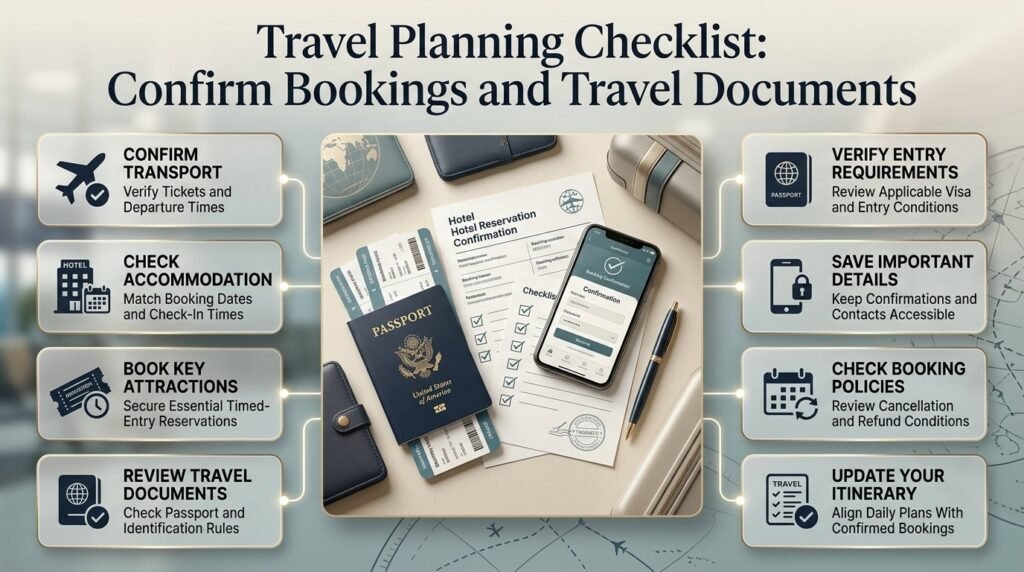
Before finalizing your itinerary, identify the activities and arrangements that require advance confirmation.
Popular tours, special exhibitions, major attractions, and certain transportation services may have limited availability. Confirm booking requirements, entry conditions, identification rules, and cancellation policies through official providers.
For international travel, check passport validity, visa requirements, entry conditions, and relevant travel insurance arrangements well before departure.
Keep your booking references, accommodation addresses, transport confirmations, and important contact details in an accessible place. An offline copy can be useful when mobile data or Wi-Fi is unavailable.
Essential Pre-Travel Checklist
- Confirm transportation reservations.
- Verify accommodation dates and check-in times.
- Book essential timed-entry attractions.
- Check relevant visa and entry requirements.
- Review baggage and identification rules.
- Save booking confirmations and emergency contacts.
- Check cancellation and refund conditions.
- Make sure your daily schedule reflects the confirmed bookings.
Review this checklist again before departure, especially if you’ve made changes to your itinerary.
Step 9: Plan Meals, Rest, and Personal Time
Meals and rest periods are essential parts of a practical travel schedule, not empty spaces to fill with additional activities.
When travellers plan only sightseeing, they often underestimate the time needed to find food, travel to restaurants, wait for tables, and recover after long walks.
Research dining options near your planned activities, but avoid treating every meal as a fixed appointment unless a reservation is necessary.
If you have dietary requirements or specific accessibility needs, check whether suitable options are available before arriving.
Keep Your Daily Schedule Comfortable
Allow enough time for:
- Breakfast before morning activities.
- Lunch between major sightseeing stops.
- Rest after long journeys or walking tours.
- Dinner near your evening destination.
- Personal needs and unexpected delays.
Consider the needs of everyone travelling. Children, older adults, and people who need additional rest may benefit from shorter activity periods and more convenient transportation.
Quick Tip: Schedule a relaxed period after a demanding activity instead of immediately adding another major attraction. This helps keep the entire trip enjoyable.
Step 10: Prepare Backup Plans and Keep Your Itinerary Flexible
No itinerary can guarantee that everything will go according to plan. Weather changes, transport cancellations, unexpected closures, and personal circumstances may require adjustments.
A backup plan helps you respond without losing an entire day or making rushed decisions.
For every important outdoor activity, consider an indoor alternative. For a major attraction that closes unexpectedly, identify another interesting place nearby. If transportation is disrupted, know which alternative routes are practical.
How to Adapt When Plans Change
Follow a simple process:
- Identify which activities are affected.
- Check whether reservations can be changed or refunded.
- Prioritize any remaining time-sensitive commitments.
- Choose a realistic alternative based on location and cost.
- Update the itinerary so everyone knows the revised plan.
Avoid trying to complete every original activity after a delay. Removing one optional stop is often better than rushing through the remainder of the day.
A flexible itinerary should protect the experiences that matter most while making it easy to adjust everything else.
Step 11: Organize Your Travel Information in One Place
Once the itinerary is complete, organize your information so that you can use it quickly while travelling.
A spreadsheet, document, notes application, or digital itinerary planner can all work well. Choose a format that suits your trip and is easy to update.
Include the date, activity, location, estimated duration, transportation method, booking reference, expected cost, and any relevant notes.
For a multi-city journey, create a separate section for each destination. Keep accommodation details and transport confirmations close to the relevant dates so that you don’t need to search through unrelated information.
Digital or Paper Itinerary: Which Is Better?
| Format | Advantages | Limitations |
|---|---|---|
| Digital itinerary | Easy to update, search, and share | May depend on device battery or connectivity |
| Paper itinerary | Accessible without a device | Changes require manual updates |
| Spreadsheet | Useful for budgets and multi-day schedules | Can become difficult to read if overcrowded |
| Travel planning app | May combine maps, bookings, and schedules | Features and offline access vary |
A digital itinerary with an offline backup is a practical option for many travellers.
Protect your personal information and avoid sharing sensitive booking references or detailed travel arrangements publicly.
Step 12: Review and Finalize Your Itinerary Before Departure
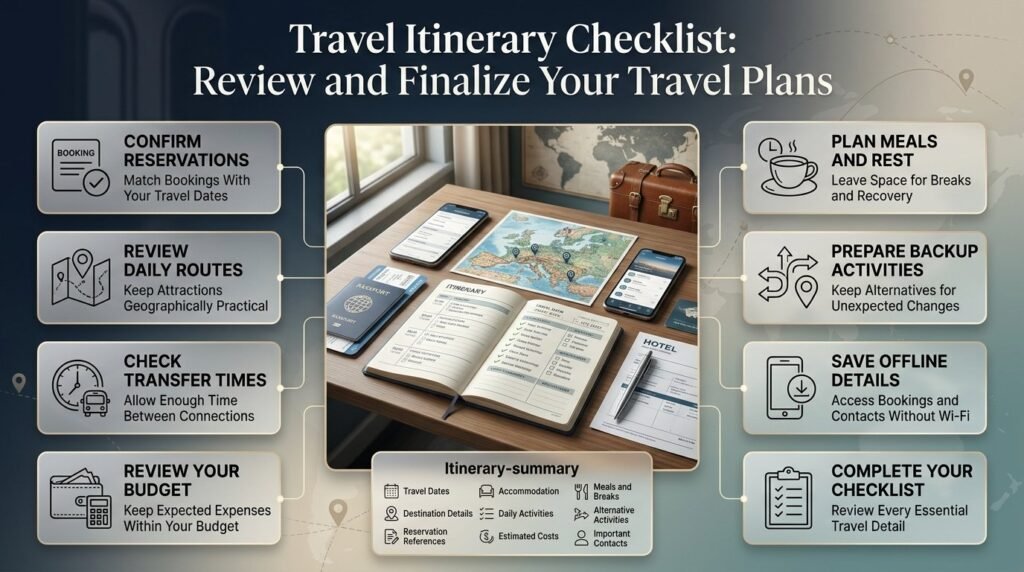
The final review is your opportunity to catch problems before they affect the trip.
Check that transportation bookings match your accommodation dates, that attraction reservations fit your daily schedule, and that you have allowed sufficient time for transfers.
Review current opening hours, weather conditions, and transportation information where these details could affect your plans.
Make sure the itinerary is realistic for the people travelling and that your estimated costs remain within your budget.
Final Itinerary Review
Ask yourself:
- Have I prioritized the experiences that matter most?
- Are the daily routes geographically practical?
- Have I allowed enough time for transportation?
- Are essential reservations confirmed?
- Does the budget cover expected expenses?
- Is there time for meals and rest?
- Do I have backup activities?
- Can I access important information offline?
If the answer to any important question is no, make the necessary adjustment before departure.
What Should a Complete Travel Itinerary Include?
A complete travel itinerary contains the information you need to manage your journey without becoming unnecessarily complicated.
| Detail | Purpose |
|---|---|
| Travel dates | Organizes the overall schedule |
| Destination details | Clarifies where you’re going |
| Transportation | Helps manage journeys and connections |
| Accommodation | Provides location and check-in information |
| Daily activities | Establishes priorities and timing |
| Estimated costs | Supports budget control |
| Reservation references | Makes confirmed bookings easier to retrieve |
| Meals and breaks | Keeps the schedule realistic |
| Alternative activities | Provides options when plans change |
| Important contacts | Keeps essential information accessible |
A weekend trip may need only a basic schedule, while an international journey involving multiple cities benefits from more detailed arrangements.
The right level of detail is the amount that helps you travel confidently without creating unnecessary administrative work.
Common Travel Itinerary Planning Mistakes to Avoid
Understanding common mistakes can help you create a more practical schedule before committing to bookings.
Trying to Visit Too Many Attractions
Why it happens: Travellers want to make the most of their time and worry about missing important experiences.
Why it’s harmful: Constant movement creates fatigue and leaves little time to appreciate individual attractions.
How to avoid it: Choose your essential experiences first. Add optional stops only when the schedule has enough room.
Underestimating Transportation Time
Why it happens: Travellers calculate journey duration using distance alone.
Why it’s harmful: Transfers, traffic, queues, and waiting can cause missed reservations and unnecessary stress.
How to avoid it: Check realistic journey times and include suitable buffers around important commitments.
Ignoring Small Expenses
Why it happens: Major costs receive more attention than everyday spending.
Why it’s harmful: Local transport, meals, admission fees, and additional purchases can push the trip beyond the original budget.
How to avoid it: Estimate all major expense categories and review the budget whenever plans change.
Forgetting Opening Hours
Why it happens: Travellers assume attractions will be open on any day they arrive.
Why it’s harmful: Closures and restricted entry times can disrupt an entire day’s schedule.
How to avoid it: Verify current details through official sources before departure and recheck essential arrangements when necessary.
Making No Allowance for Rest
Why it happens: Filling every hour can appear more efficient.
Why it’s harmful: Fatigue makes travel less enjoyable and leaves little room for delays.
How to avoid it: Include meal breaks, quiet periods, and realistic activity durations.
Depending on a Single Plan
Why it happens: Travellers expect every booking and activity to proceed as scheduled.
Why it’s harmful: Weather disruptions or cancellations can leave a major gap in the itinerary.
How to avoid it: Prepare alternative activities and understand the flexibility of important reservations.
Booking Without Checking Cancellation Policies
Why it happens: Travellers focus on securing a low price or preferred option.
Why it’s harmful: Changing dates may result in additional costs or non-refundable losses.
How to avoid it: Review the cancellation terms and confirm the rest of your arrangements before committing to restrictive bookings.
Expert Advice for Creating a Better Travel Itinerary
Experienced trip planners focus on priorities, realistic timing, and flexibility rather than trying to include every possible attraction.
Plan Around Your Main Experiences
Choose the experiences that give your trip its purpose. These might include a guided tour, a cultural event, a scenic excursion, or a visit to a particular landmark.
Arrange flexible activities around those priorities. This makes it easier to adjust your plans without losing the main reason for travelling.
Avoid Overcomplicating Travel Days
Moving between destinations often involves packing, checking out, transportation, luggage handling, and checking in again.
Treat these as genuine travel commitments rather than assuming that the day will be available for sightseeing. If time remains, choose a nearby and flexible activity.
Consider the Total Cost of Convenience
The cheapest option is not always the best value.
A low-cost hotel with inconvenient transport connections may increase daily expenses. Similarly, a cheaper flight with a long transfer may reduce the time available to explore.
Compare the overall cost, travel time, convenience, and cancellation conditions before deciding.
Keep Important Information Easy to Find
Organize your booking confirmations, addresses, departure times, and essential contact details so that they can be accessed quickly.
For longer journeys, make sure each traveller understands the main schedule and knows where to find the relevant details.
Balance Planning With Spontaneity
A detailed itinerary can provide confidence, but it should not prevent you from enjoying unexpected opportunities.
Leave room to explore a local market, spend longer at an interesting museum, or take a break when you need one. The schedule should support your travel experience, not become a source of pressure.
How Travel Planning Connects With Other Practical Planning Skills
Travel often involves coordinating several responsibilities before departure. Thinking ahead about those responsibilities can make the journey smoother, particularly when you’ll be away from home for an extended period.
For example, travellers preparing for a long absence may need to organize routine property tasks, arrange access for necessary maintenance, or make sure important household responsibilities are covered.
If you own or manage a property, the site’s Property Care resources can help you think through general maintenance responsibilities. The Care for a Property guide provides broader information about maintaining a home and planning essential tasks.
Before an extended trip, you may also find it useful to review Home Maintenance and Outdoor & Garden Care so that relevant household responsibilities are not overlooked.
If repairs need attention before you leave, the guide to Common Home Repairs and Improvements can help you identify practical tasks that may require advance planning.
For a more organized household, Cleaning & Organization offers relevant guidance on preparing and maintaining living spaces.
These topics are separate from itinerary scheduling, but they can support a more organized departure when home responsibilities form part of your travel preparations.
How Do You Plan a Travel Itinerary Step by Step?
Planning a travel itinerary starts with understanding your travel goals, available time, and budget. Begin by choosing your destination and dates, then research the attractions and experiences you want to enjoy. Once you have a shortlist, organize nearby places together, check transportation options, and create a daily schedule that includes realistic travel times, meals, and breaks. Confirm essential reservations before departure and keep alternative activities available in case your plans change.
A well-organized itinerary should make your journey easier rather than fill every hour with activities. Focus on the experiences that matter most and build the remaining schedule around them.
Important planning points:
Choose your destination, dates, and travel priorities.
Set a realistic budget before making reservations.
Group attractions by location to reduce unnecessary travel.
Check opening hours, transportation schedules, and booking requirements.
Leave enough time for meals, rest, and unexpected delays.
What Should Be Included in a Travel Itinerary?
A useful travel itinerary should include all the information needed to manage your trip without repeatedly searching through emails, booking confirmations, or travel notes. At a minimum, record your travel dates, transportation arrangements, accommodation details, daily activities, estimated costs, and important reservation references. For international travel, include relevant document requirements and essential contact information.
The level of detail depends on the type of journey. A weekend getaway may need a simple schedule, while a multi-destination holiday requires more detailed arrangements for connections, check-in times, and transfers. Keeping everything organized in one place makes it easier to follow your plans and respond to changes.
Essential itinerary details:
Travel dates, destinations, and accommodation addresses.
Flight, train, bus, or other transportation information.
Daily activities, estimated durations, and locations.
Booking confirmations and reservation references.
Estimated expenses and emergency budget allowance.
Alternative activities and important contact details.
How Do You Plan a Travel Itinerary on a Budget?
Planning a travel itinerary on a budget requires estimating your major expenses before deciding which activities to include. Start by setting a spending limit, then calculate transportation, accommodation, meals, local travel, entrance fees, and other expected costs. Reserve part of your budget for unexpected expenses so that a minor disruption doesn’t affect your essential travel arrangements.
Once you understand your available budget, compare accommodation locations, consider public transportation, and prioritize attractions that offer the experiences you value most. Free walking routes, parks, public cultural spaces, and selected museums can help you enjoy a destination without paying for every activity. Review your estimated spending whenever you add a reservation or change your schedule.
Practical ways to manage travel costs:
Compare the total cost of accommodation, including transport to attractions.
Group nearby activities to reduce local transportation expenses.
Research free and low-cost experiences before departure.
Check ticket prices and reservation conditions in advance.
Track expected spending and maintain a contingency reserve.
How Many Activities Should You Include in a Daily Travel Itinerary?
The number of activities you should include depends on the destination, transportation requirements, length of each visit, and pace you prefer. For a relaxed sightseeing day, two or three substantial activities may be enough. A compact destination with attractions close together may allow more stops, while a full-day excursion or intercity journey may leave little time for additional experiences.
The most common planning mistake is counting attractions without calculating the time required to reach and enjoy them. Every activity may involve travel, waiting, meals, or entry procedures. Instead of filling the schedule, identify one main experience for the day and add nearby activities only when there is enough time.
How to create a realistic daily schedule:
Prioritize one or two essential experiences.
Estimate the full duration of each activity.
Include transportation and waiting time.
Schedule meals and rest breaks.
Keep optional activities flexible if the day runs late.
How Can You Make a Travel Itinerary Flexible Without Missing Important Attractions?
A flexible travel itinerary combines confirmed priorities with activities that can be moved or replaced when circumstances change. Start by identifying the experiences you don’t want to miss, especially those requiring advance reservations. Arrange flexible sightseeing, shopping, and casual exploration around those commitments. This allows you to preserve the most important parts of your trip without becoming stressed when delays or unexpected opportunities arise.
Before departure, identify alternative attractions near your planned locations and check whether essential bookings can be changed or cancelled. During the trip, review upcoming arrangements and adjust optional activities when necessary. If weather or transportation disrupts your plans, focus on the remaining priorities instead of trying to complete every original activity.
Simple ways to keep your itinerary adaptable:
Leave some unscheduled time during the day.
Identify indoor alternatives for outdoor activities.
Avoid placing important reservations too close together.
Understand cancellation and rescheduling policies.
Keep a shortlist of nearby attractions as backup options.
Prioritize memorable experiences over completing a long checklist.
Conclusion: How to Plan a Travel Itinerary
Planning a successful travel itinerary is about more than listing destinations and booking activities. It involves understanding your travel goals, setting a realistic budget, choosing suitable accommodation, organizing transportation, and arranging activities in a practical order. A well-planned itinerary helps you make better use of your time, manage expenses, and enjoy your trip without feeling rushed or overwhelmed.
Start by deciding what you want to experience, researching your destination, and prioritizing the attractions that matter most to you. Then organize your daily schedule around travel times, opening hours, meal breaks, and opportunities to rest. Keep your budget realistic, prepare for unexpected changes, and leave some free time for spontaneous discoveries. These simple steps can make your journey more comfortable and enjoyable.
Remember that the best travel itinerary is not necessarily the busiest one. It is a flexible plan that matches your interests, available time, and financial situation. Whether you are planning a weekend getaway, a family holiday, or a longer international journey, thoughtful preparation can help you travel with greater confidence and fewer last-minute problems.
Before departure, review your reservations, transportation arrangements, important documents, packing list, and emergency plans. With a clear schedule and room for adjustments, you can focus less on managing logistics and more on creating meaningful travel experiences. Start planning early, prioritize what matters most, and build an itinerary that makes every part of your journey worthwhile.