Introduction
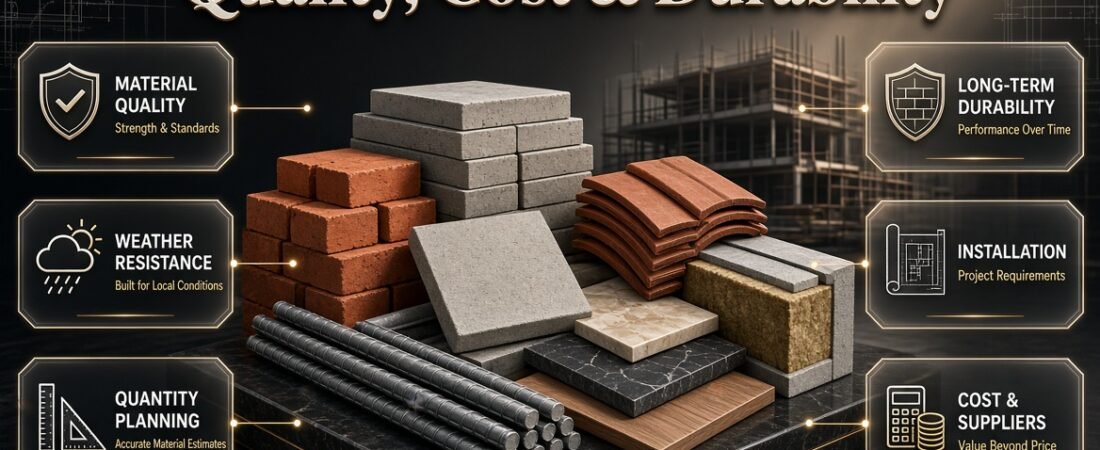
How to Choose Building Materials | Choosing building materials is one of the most important decisions you’ll make when building a new home or renovating an existing property. A material may look attractive in a showroom, but will it withstand local weather, meet your project’s requirements, and remain affordable to maintain over the years? These are the questions worth answering before spending your construction budget.
Learning how to choose building materials helps you compare quality, durability, installation requirements, and long-term value instead of making decisions based on price alone. Whether you’re selecting bricks, cement, reinforcement steel, roofing, flooring, insulation, or finishing products, every choice should serve a clear purpose.
The challenge is that building materials differ in performance, and no single product is ideal for every project. A suitable material for an outdoor wall may be inappropriate for a bathroom, while an attractive roofing product might require a supporting structure that your building cannot accommodate.
This guide from Brendan Active Property Care explains how to evaluate construction materials step by step. You’ll learn how to assess quality, compare suppliers, estimate quantities, manage costs, avoid common mistakes, and select materials that suit your property’s needs. The goal is to help you make informed decisions before construction begins and protect your investment throughout the building’s useful life.
Why Is Choosing the Right Building Material Important?
Building materials influence a property’s safety, durability, comfort, appearance, and maintenance requirements. The wrong choice can create problems that are expensive or difficult to correct after construction is complete.
For example, a wall finish that cannot tolerate repeated moisture exposure may deteriorate quickly in a damp area. Similarly, a roofing product selected without considering wind loads, drainage, or thermal performance may not provide the protection your home needs.
Choosing suitable materials helps you:
- Meet structural and building-code requirements.
- Improve resistance to weather, moisture, and everyday wear.
- Control construction and future maintenance expenses.
- Support comfortable indoor temperatures.
- Achieve a consistent architectural design.
- Reduce unnecessary waste and premature replacement.
- Make future repairs easier through sensible product selection.
The most expensive product isn’t automatically the best choice. A moderately priced material that meets the required specifications, is installed correctly, and remains readily available for maintenance may offer better overall value than a premium product that doesn’t suit your property.
Professional tip: Evaluate safety and suitability first, quality second, and appearance and price afterward. This order helps prevent attractive finishes or short-term savings from distracting you from essential requirements.
What Factors Should You Consider Before Selecting Building Materials?
Before comparing brands or visiting suppliers, identify the conditions your materials must handle. This makes the selection process more practical and reduces the risk of purchasing unsuitable products.
1. Understand Your Project Requirements
Start by defining the purpose of the construction or renovation work. A new house, a bathroom upgrade, an outdoor wall, and a roof replacement have different technical requirements.
Structural materials must follow the approved design, while decorative products can often be selected according to appearance, maintenance needs, and budget, provided they meet relevant safety requirements.
Write down the essential requirements for each area:
- Intended function and location.
- Structural or performance specifications.
- Exposure to heat, moisture, sunlight, or heavy use.
- Desired appearance and finish.
- Available budget and installation costs.
- Expected maintenance and replacement needs.
For instance, selecting bathroom tiles involves more than matching their colour to the walls. You’ll also need to consider slip resistance, water exposure, substrate preparation, grout, and the waterproofing system beneath the finish.
When a project includes several different types of work, a structured Build or Renovate plan can help you organize decisions before ordering materials.
2. Set a Realistic Construction Budget
Your budget determines what you can afford, but the initial purchase price should never be the only factor.
The total cost of a building material may include transportation, unloading, preparation, installation, protective treatments, waste, maintenance, and eventual replacement. Comparing only the prices displayed by suppliers can therefore produce misleading results.
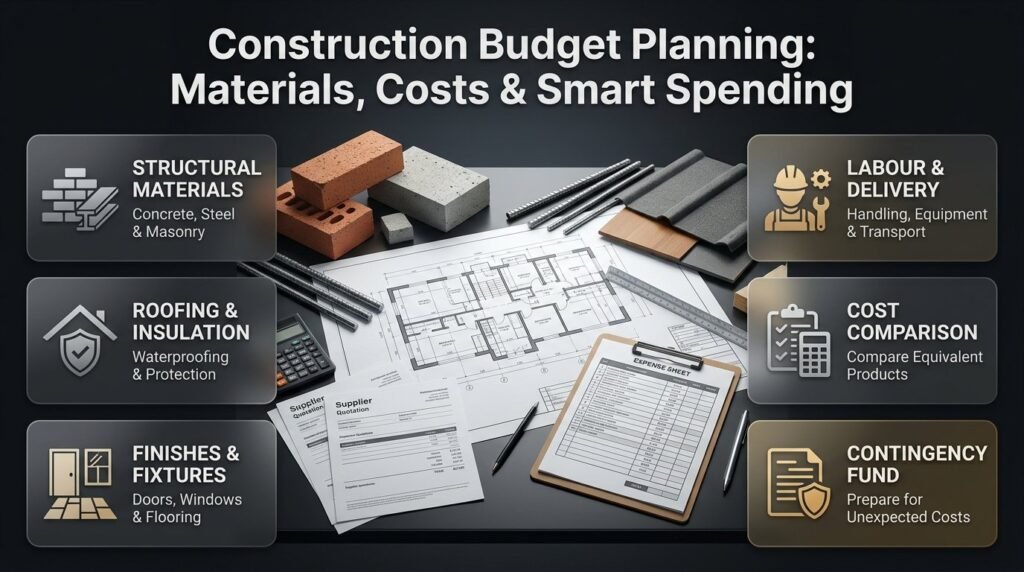
Separate your budget into categories such as:
- Structural materials, including concrete, steel, and masonry.
- Roofing, waterproofing, and insulation.
- Doors, windows, flooring, and wall finishes.
- Plumbing and electrical installation materials.
- Labour, delivery, handling, and equipment.
- Inspection, testing, and contingency expenses.
Request written quotations that specify the product grade, dimensions, quantity, and delivery conditions. Make sure the products being compared actually meet equivalent requirements.
Use How to Plan a Construction Budget to organize expected costs before purchasing supplies. For a more detailed view of individual expenses, consult Construction Cost Breakdown Explained.
Common mistake: Spending heavily on decorative finishes early in the project and then discovering that essential waterproofing, insulation, or structural work has been underfunded.
3. Consider the Local Climate
Climate has a significant effect on the performance and service life of construction materials.
In hot regions, roofing, insulation, shading, glazing, and wall design influence indoor temperatures. In areas with frequent rainfall, moisture management, drainage, exterior finishes, and roof detailing become particularly important.
Humidity can affect timber, coatings, adhesives, and other moisture-sensitive products. Coastal conditions may increase corrosion risks for certain metal components. Freezing conditions, where relevant, can affect materials exposed to repeated freeze-thaw cycles.
Before choosing a product, ask:
- Is it suitable for the expected temperature range?
- Can it tolerate the property’s moisture exposure?
- Does it require protective coatings or special installation?
- Is it compatible with the building’s ventilation and drainage design?
- Can it withstand expected wind or weather loads?
In hot climates, a reflective roof finish may help reduce solar heat absorption when correctly selected for the roof assembly. However, its benefits depend on insulation, ventilation, roof construction, and local conditions.
Always evaluate the complete building system rather than expecting one product to solve every environmental problem.
4. Check Strength, Quality, and Durability
Structural materials must satisfy the specifications established by the building design and applicable regulations. Concrete, reinforcement steel, structural timber, and load-bearing masonry cannot be selected safely through appearance alone.
Check the relevant product grades, dimensions, manufacturing information, and quality documentation. Where required, obtain test reports or arrange inspections through qualified professionals.
For non-structural materials, assess the conditions they will experience. Flooring in a busy entrance needs different performance characteristics from decorative flooring in a lightly used bedroom.
Durability depends on more than the material itself. Correct installation, compatible components, suitable environmental protection, and regular maintenance all contribute to performance.
For structural elements, consult the responsible engineer before changing any specified material, grade, reinforcement size, or construction detail.
5. Evaluate Maintenance Requirements
Some materials need more routine attention than others. Timber may require suitable protective treatments, exposed metal may need corrosion protection, and exterior finishes may need periodic inspection and renewal.
Consider the practical implications before purchasing:
- How frequently will the material need inspection?
- Can routine cleaning be completed easily?
- Are replacement parts and matching products available?
- Will maintenance require specialist equipment or labour?
- Can damaged sections be repaired without replacing the entire system?
A durable material that can be maintained using locally available supplies may be more practical than a specialized product with limited replacement options.
Maintenance planning should begin before construction rather than after problems appear. A sensible Home Maintenance routine can help protect building components after the project is finished.
6. Match Materials to the Design
Materials should complement the building’s architecture without compromising their intended function.
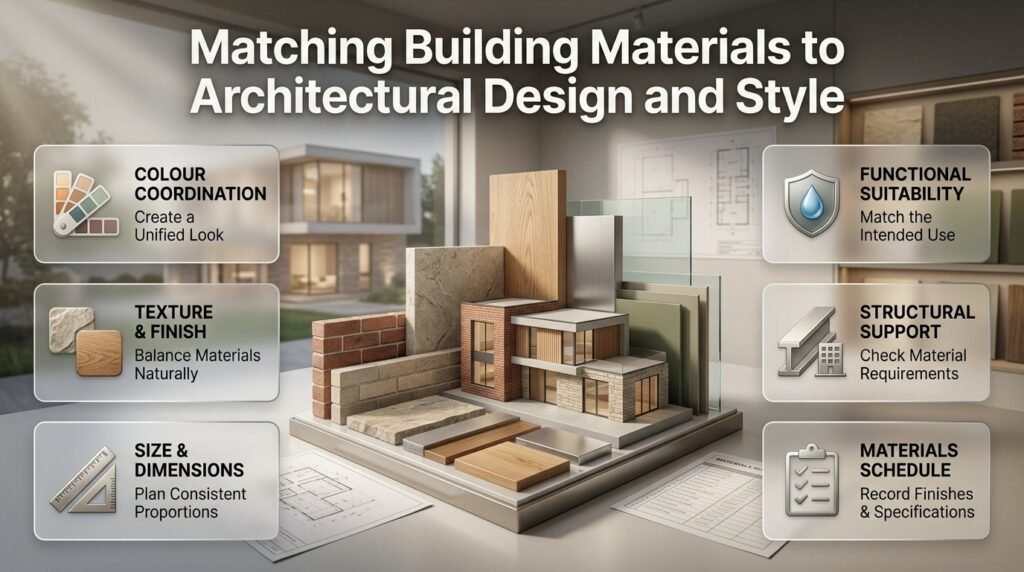
Brick, stone, timber, metal, concrete, glass, and manufactured finishes each create different visual effects. Their colours, textures, dimensions, and surface treatments influence the overall appearance.
However, appearance should not override practical requirements. A decorative finish may be unsuitable for a wet area, and a heavy cladding material may require additional structural support.
Prepare a materials schedule that records the product, finish, size, specification, quantity, and location. Review samples together so that flooring, walls, windows, and other elements work as a coordinated design.
This simple step helps avoid mismatched finishes, unnecessary substitutions, and expensive last-minute decisions.
Which Building Materials Are Commonly Used in Home Construction?
Understanding the main categories of building materials helps you ask better questions and compare suitable options.
Cement and Concrete
Cement is a binding ingredient used in concrete and mortar. Concrete is a mixture of cementitious materials, water, and aggregates, with other ingredients included where specified.
Concrete is commonly used for foundations, slabs, beams, columns, and other structural applications. Its performance depends on the approved mix design, material quality, placement, compaction where required, curing, and workmanship.
When evaluating concrete-related materials, check the project specifications, supplier documentation, delivery arrangements, and required quality-control procedures.
Do not assume that adding more cement automatically produces better concrete. Incorrect proportions, poor curing, unsuitable water content, and inadequate workmanship can all affect performance.
Bricks and Concrete Blocks
Bricks and blocks are used in many types of walls and partitions. Their suitability depends on strength, dimensions, density, water absorption, thermal performance, and intended application.
Before purchasing, inspect samples for visible damage and irregular dimensions. Ask whether the products meet the specifications required for the wall design.
Also consider mortar compatibility, wall detailing, moisture protection, and installation quality. Even good masonry units can perform poorly when joints, drainage, or damp-proofing are incorrectly handled.
Reinforcement Steel
Reinforcement steel provides tensile resistance in reinforced concrete. It must match the grade, diameter, quantity, spacing, and placement shown in the approved structural drawings.
Check product identification and the relevant quality documentation. Follow the specified storage, handling, inspection, and testing requirements.
Do not substitute a different steel grade or bar size simply because it is cheaper or more readily available. Such changes require approval from the responsible structural engineer.
Roofing Materials
Roofing materials protect the building from rain, wind, sunlight, and other environmental exposure. Options may include metal sheets, clay or concrete tiles, and other approved roofing systems.
Compare the following characteristics:
- Suitability for the roof slope and structural design.
- Resistance to expected wind and weather conditions.
- Waterproofing and drainage requirements.
- Insulation and thermal performance.
- Installation complexity and maintenance.
- Availability of matching replacement components.
Metal roofing may offer a relatively lightweight solution, but fastening, corrosion protection, thermal movement, and insulation require attention. Tiles can provide a durable finish, but their weight and supporting structure must be suitable.
Choose a complete roofing system rather than selecting sheets or tiles without considering the underlay, flashing, fixings, drainage, and ventilation details.
Flooring and Wall Finishes
Flooring options include ceramic tiles, porcelain tiles, natural stone, timber, laminate, and other manufactured products.
The right choice depends on traffic, moisture exposure, cleaning requirements, comfort, and appearance. Wet areas need suitable slip resistance and a correctly designed waterproofing system.
Wall finishes also require careful selection. Paint, plaster, panels, and decorative coatings should be appropriate for the substrate and environmental conditions.
Before purchasing, confirm that adhesives, primers, grout, sealants, and installation methods are compatible with the selected finish.
Windows and Doors
Windows and doors affect daylight, ventilation, weather protection, security, and energy performance.
Compare frame material, glazing, seals, hardware, dimensions, and installation requirements. Consider how the products will perform under local heat, rain, dust, and wind conditions.
A high-quality window may still allow water or air leakage if the opening is poorly prepared or the frame is incorrectly installed. Proper sealing and installation are therefore essential.
Insulation and Waterproofing
Insulation can reduce unwanted heat transfer and improve indoor comfort when selected and installed correctly. The appropriate material depends on the climate, building assembly, moisture conditions, fire requirements, and local regulations.
Waterproofing products protect vulnerable areas such as roofs, bathrooms, balconies, and foundations. The right solution depends on the substrate, water exposure, movement, drainage, and intended use.
Neither insulation nor waterproofing should be treated as an optional decorative upgrade where the design requires it. Problems hidden behind finished surfaces can be difficult and expensive to repair.
How to Compare Different Building Materials
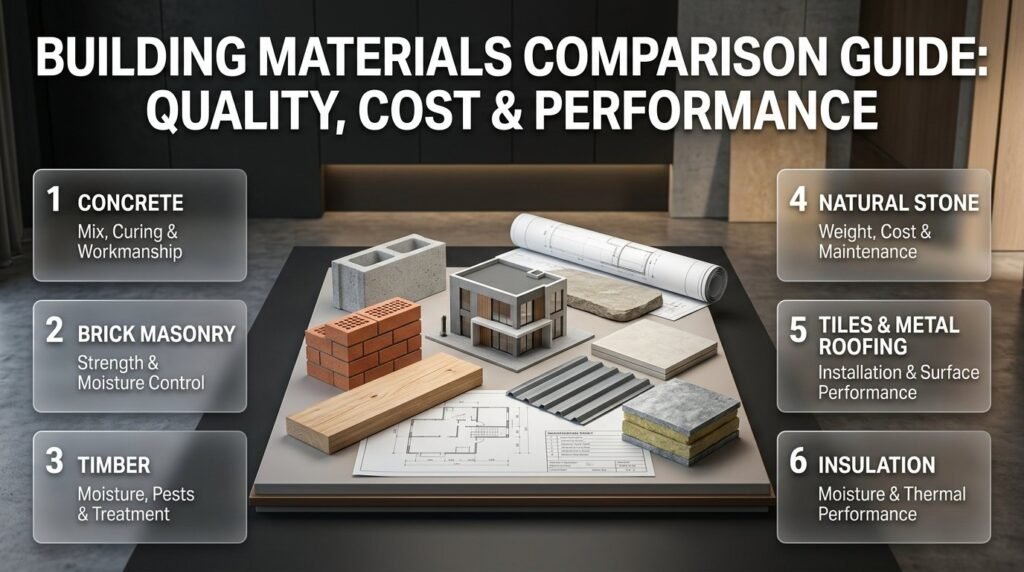
A comparison table helps you evaluate the factors that matter instead of relying on brand recognition or a supplier’s recommendation.
| Material category | Potential advantages | Main considerations |
|---|---|---|
| Concrete | Versatile and suitable for many structural applications | Mix design, curing, testing, and workmanship |
| Brick masonry | Durable and familiar construction method | Strength, dimensions, mortar, and moisture management |
| Timber | Adaptable and visually attractive | Moisture, pests, treatment, and intended use |
| Natural stone | Distinctive appearance and potential durability | Weight, cost, installation, and maintenance |
| Ceramic or porcelain tiles | Wide range of finishes and practical cleaning | Slip resistance, substrate, adhesive, and grout |
| Metal roofing | Lightweight options and efficient installation | Corrosion, fastening, noise, and thermal design |
| Insulation | Can improve thermal comfort and efficiency | Moisture, fire performance, and assembly compatibility |
The best option is the one that meets the project’s requirements while offering an acceptable balance of cost, service life, and maintenance.
How to Choose Building Materials Step by Step
A consistent selection process helps you avoid rushed purchases and expensive corrections.
Step 1: Define the Scope of Work
Identify exactly what the project includes. Separate structural work, exterior protection, internal finishes, and optional decorative improvements.
Record the requirements for each component and confirm which decisions need professional approval.
For a renovation, inspect the existing building before choosing new products. Hidden moisture, damaged substrates, uneven surfaces, or structural problems may affect which materials can be installed successfully.
Step 2: Review Drawings and Specifications
Use the approved architectural and structural drawings to identify dimensions, material grades, installation details, and performance requirements.
If the specification is unclear, ask the responsible professional to explain it before placing an order.
This is especially important for concrete, steel, load-bearing walls, fire protection, and waterproofing. A supplier’s standard product is not automatically suitable for the intended application.
Step 3: Research Suitable Products
Shortlist products that meet the required technical standards and environmental conditions.
Review their technical datasheets, installation instructions, warranties, and maintenance recommendations. Where applicable, verify relevant certification and testing information.
For large purchases, request samples or arrange a product inspection. Samples help you assess finish and appearance, while technical documents establish whether the product meets its specified requirements.
Step 4: Compare Supplier Quotations
Request written quotations from reputable suppliers. Make sure each quotation describes the same or equivalent product specification.
Compare:
- Unit price and total quantity.
- Delivery and unloading charges.
- Product grade and dimensions.
- Availability and lead time.
- Return or replacement conditions.
- Warranty and technical support.
- Payment terms and applicable taxes.
A low quotation may exclude necessary accessories or delivery charges. Ask for clarification before comparing totals.
Step 5: Calculate Quantities Accurately
Accurate quantity calculations reduce shortages, overordering, and waste.
For a rectangular floor, use:
Area = Length × Width
For example, a room measuring 5 metres by 4 metres has a floor area of 20 square metres.
The quantity of flooring purchased will usually need an additional allowance for cutting and breakage. The appropriate allowance depends on tile size, room layout, installation pattern, and the manufacturer’s or installer’s guidance.
For concrete, masonry, steel, roofing, and complex projects, use the appropriate measurement method and approved drawings. A quantity surveyor or qualified estimator can help with larger projects.
Step 6: Inspect Materials Before Acceptance
Check the delivered products against the purchase order.
Confirm the product description, quantity, dimensions, labels, batch information where applicable, and visible condition. Document shortages or damage and follow the supplier’s reporting procedures.
Remember that visual inspection cannot establish every quality characteristic. Materials requiring formal testing must be assessed according to the project’s inspection plan.
Step 7: Arrange Proper Storage
Materials can deteriorate before installation if they are stored incorrectly.
Keep cement dry and protected according to the manufacturer’s instructions. Store tiles carefully to prevent breakage, and protect timber from unsuitable moisture conditions. Handle reinforcement steel and other metal products according to the project’s storage and quality requirements.
Plan deliveries around the construction schedule so that materials do not remain exposed or obstruct work unnecessarily.
Step 8: Verify Installation Quality
Follow the approved installation instructions and arrange inspections at the required stages.
Check concealed work before it becomes inaccessible. Depending on the project, this may include reinforcement, waterproofing, insulation, service penetrations, and other building components.
Keep product records, approved substitutions, inspection reports, and warranties. These documents can help resolve problems and support future maintenance.
How Can You Reduce Building Material Costs Without Sacrificing Quality?
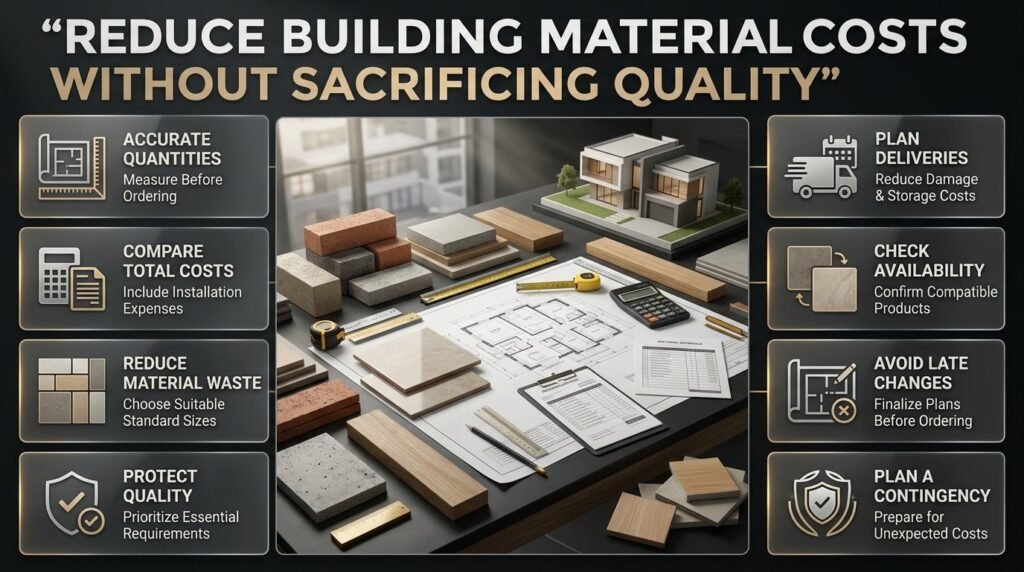
Cost control begins with planning, accurate quantities, and sensible comparisons. Cutting essential quality requirements is not a reliable saving strategy.
Use the following methods:
- Prioritize safety-critical and performance-related requirements.
- Compare complete installed costs rather than individual unit prices.
- Select standard sizes where appropriate to reduce cutting waste.
- Coordinate dimensions before ordering doors, windows, tiles, or panels.
- Schedule deliveries to reduce storage costs and damage.
- Confirm the availability of matching products before committing.
- Avoid unnecessary design changes after purchases have been made.
- Keep a realistic contingency allowance for unexpected conditions.
Consider a flooring project where two products appear to have similar prices. One may require a more expensive adhesive, additional substrate preparation, or specialist installation. The other may be easier to install but require more cutting because of its dimensions.
Comparing the complete installation cost provides a more useful picture than comparing the price per tile alone.
For broader property expenses, Care for a Property can help you consider how routine upkeep and repair planning fit into the long-term ownership picture.
Should You Choose Sustainable Building Materials?
Sustainable materials can help reduce resource use, waste, and environmental impact. Their suitability depends on durability, manufacturing processes, transportation, maintenance, and end-of-life options.
Potential choices include responsibly sourced timber, products with verified recycled content, durable locally available materials, and suitable products that improve building energy performance.
Before choosing a sustainable option, consider:
- Does it meet the project’s safety and technical requirements?
- Is its environmental information supported by credible documentation?
- Will it perform well in the local climate?
- Can it be repaired, reused, or recycled?
- Does it require additional protective treatments?
- Is it available in the quantity needed?
Local products may reduce transport requirements and make future replacement easier, but local origin alone does not prove that a material is environmentally superior.
The most sensible approach is to select products that meet the building’s requirements and perform reliably throughout their expected service life.
Common Building Material Selection Mistakes and How to Avoid Them
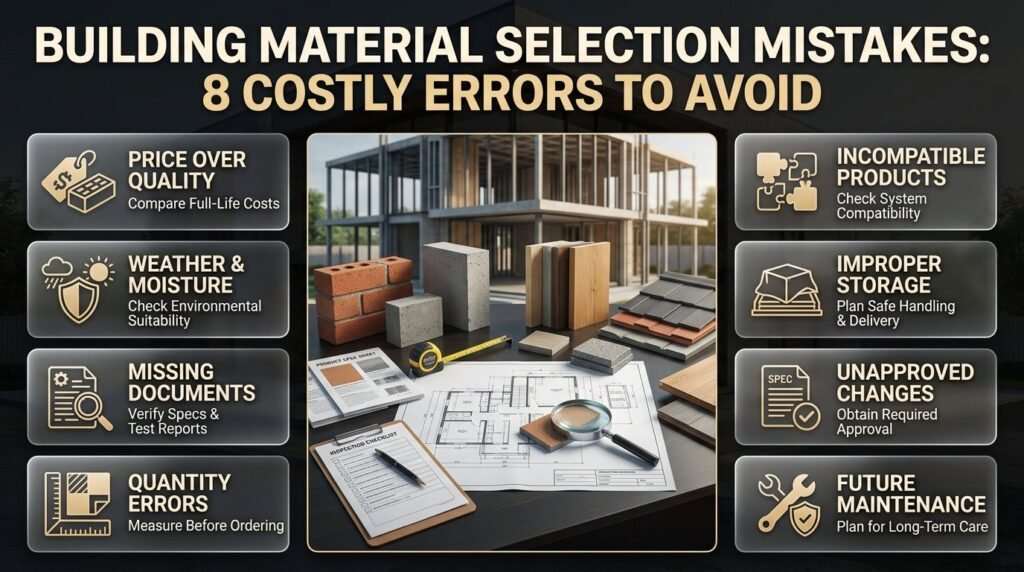
Choosing Materials Only Because They Are Cheap
Why it happens: Buyers focus on immediate savings without comparing specifications.
Why it matters: An unsuitable product may need early replacement or create performance problems.
How to avoid it: Compare equivalent products and assess installation, maintenance, and replacement costs.
Ignoring Moisture and Weather Exposure
Why it happens: Materials are selected according to appearance rather than environmental conditions.
Why it matters: Moisture, heat, sunlight, or corrosion can reduce performance and service life.
How to avoid it: Evaluate the intended location and select an appropriate product and installation system.
Buying Without Checking Documentation
Why it happens: Verbal assurances from suppliers are accepted without verification.
Why it matters: Appearance cannot prove strength, composition, or compliance with technical requirements.
How to avoid it: Request specifications, relevant certificates, test reports, and batch details where applicable.
Ordering Incorrect Quantities
Why it happens: Measurements are rushed or cutting waste is overlooked.
Why it matters: Shortages can delay work, while excess purchases tie up money and storage space.
How to avoid it: Calculate quantities from accurate measurements and have complex estimates reviewed professionally.
Ignoring Compatibility Between Products
Why it happens: Individual products are purchased without considering how they work together.
Why it matters: Incompatible adhesives, coatings, substrates, or waterproofing components may cause installation or performance problems.
How to avoid it: Check manufacturer guidance and confirm that the complete system is suitable for the intended application.
Storing Materials Incorrectly
Why it happens: Delivery planning receives less attention than purchasing.
Why it matters: Products may become damaged, contaminated, or unsuitable before installation.
How to avoid it: Arrange suitable storage, handling, and delivery schedules in advance.
Making Unapproved Substitutions
Why it happens: A specified product becomes unavailable or a cheaper alternative is offered.
Why it matters: The substitute may not meet the same strength, fire, moisture, or compatibility requirements.
How to avoid it: Obtain the required approval from the responsible designer or engineer before changing specified materials.
Forgetting Future Maintenance
Why it happens: Buyers focus on completing the project rather than maintaining the finished property.
Why it matters: Difficult-to-source products or demanding maintenance requirements can increase long-term costs.
How to avoid it: Check replacement availability, cleaning needs, warranties, and maintenance instructions before making a final selection.
For everyday problems discovered after installation, Common Home Repairs and Improvements provides a relevant starting point for understanding the wider maintenance needs of a property.
Expert Advice for Better Material Selection
Professional construction planning involves more than comparing prices. It connects product selection with design, procurement, inspection, installation, and maintenance.
Prepare a Material Schedule
Record each major material’s description, approved specification, quantity, supplier, delivery date, and installation location.
A schedule helps the project team identify missing items and reduces the likelihood of incompatible substitutions.
Approve Finishes Before Bulk Ordering
Check samples under realistic lighting and alongside other selected materials. Confirm colours, dimensions, surface textures, and patterns before ordering large quantities.
Where exact colour matching matters, ask the supplier about batch consistency and replacement availability.
Inspect Work Before It Is Covered
Some of the most important building components become hidden behind plaster, tiles, ceilings, or other finishes.
Arrange inspections at the appropriate stages for reinforcement, waterproofing, insulation, and other concealed work. Follow the project’s approved testing and documentation requirements.
Keep Records for Future Repairs
Store invoices, specifications, warranty information, maintenance instructions, and relevant inspection reports in one organized location.
These records make it easier to identify matching products and understand the original installation when repairs become necessary.
Plan for Maintenance From the Beginning
Choose materials that can be maintained using realistic budgets, skills, and supplies. Schedule routine inspections for vulnerable areas and follow manufacturer guidance for cleaning, protective treatments, and repairs.
Regular Outdoor & Garden Care can also help protect exterior areas, paving, drainage, and other outdoor features that interact with the building.
Similarly, Cleaning & Organization can support practical routines for caring for finished surfaces and keeping indoor spaces manageable.
Coordinate Materials With the Construction Schedule
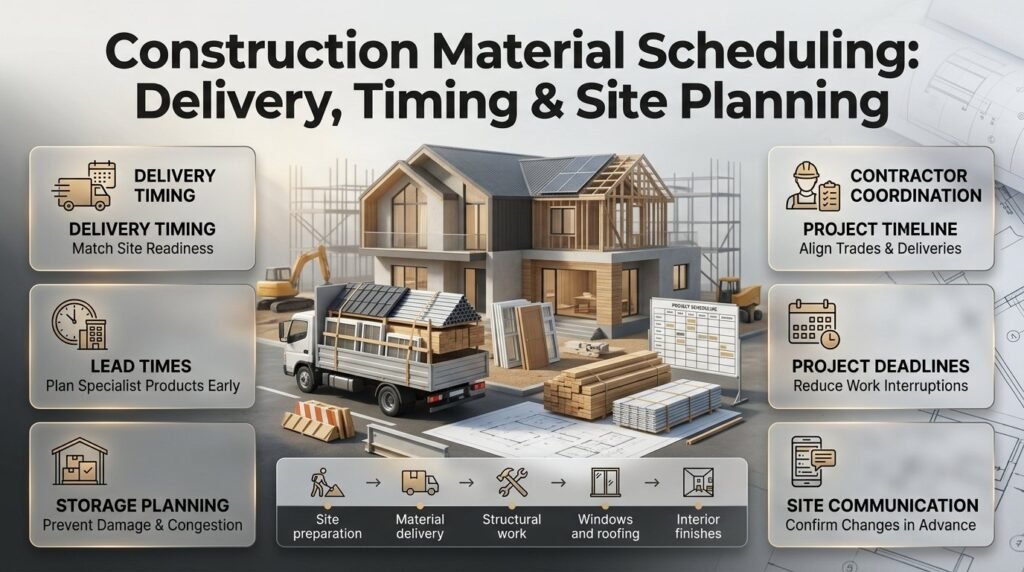
Materials should arrive when the site is ready to receive and install them. Early delivery may create storage problems, while late delivery can delay trades and increase labour costs.
Confirm lead times for specialist products, windows, doors, roofing systems, and finishes before setting deadlines.
If you need to manage construction arrangements while away from the property, plan site visits and contractor communication in advance. The site’s Travel Guide and Plan a Journey resources may help with general travel planning when visits need to be coordinated with other commitments.
How Do Building Materials Affect Long-Term Property Maintenance?
Material selection continues to matter after construction ends. The durability of finishes, accessibility of components, and availability of replacement products all influence the effort required to keep a property in good condition.
For example, an exterior finish exposed to direct sunlight may need a different inspection and maintenance routine from an interior wall. A roof requires attention to drainage and weather protection, while bathroom finishes depend on effective ventilation, grout care, and waterproofing integrity.
Create a maintenance record for major components. Include the installation date, product details, warranty conditions, inspection recommendations, and any repairs completed.
Routine checks should focus on identifying developing issues, such as deteriorating finishes, damaged seals, blocked drainage, or moisture where it should not be present. Addressing the underlying cause is more important than simply covering visible symptoms.
A consistent maintenance plan helps protect the investment made in selecting quality materials. It also makes future repairs easier because you have reliable information about the original products and specifications.
How Do You Choose the Best Building Materials for a New Home?
Choosing the best building materials for a new home starts with understanding the building’s structural requirements, local climate, intended use, and available budget. Materials should be selected according to their performance rather than appearance or price alone. For example, roofing materials must suit the roof design and weather exposure, while flooring should match the room’s moisture levels, foot traffic, and maintenance needs. Structural materials, including concrete, reinforcement steel, and load-bearing masonry, must meet the approved specifications and applicable building regulations.
Before making a final decision, compare product quality, installation requirements, expected service life, and replacement availability. Consulting a qualified architect or structural engineer is particularly important when selecting materials that affect building safety.
Important factors to consider:
Structural suitability: Confirm that materials meet the approved design and required strength specifications.
Climate compatibility: Consider heat, rainfall, humidity, sunlight, and corrosion risks.
Long-term value: Compare installation, maintenance, and replacement costs.
Product availability: Choose materials that can be sourced and replaced reliably when necessary.
How Can You Check the Quality of Building Materials Before Buying?
The quality of building materials should be assessed through product specifications, relevant standards, manufacturer documentation, and appropriate inspection or testing. A product that looks strong or has an attractive finish may not necessarily meet the technical requirements of a construction project. For this reason, buyers should request written information about the material’s grade, dimensions, performance characteristics, and intended application.
For structural materials such as cement, concrete, reinforcement steel, bricks, and blocks, follow the project’s quality-control requirements. Depending on the material and application, this may involve reviewing certificates, checking batch identification, or arranging testing through a qualified laboratory. For finishing materials, inspect samples for visible defects and confirm compatibility with the intended installation system.
Practical quality checks include:
Request product specifications and applicable quality certificates.
Check dimensions, labels, batch details, and visible condition.
Verify that the product meets the project’s required standards.
Inspect deliveries and document any damage or shortages.
Arrange professional testing when required, particularly for safety-critical materials.
How Do You Choose Building Materials That Fit Your Budget Without Sacrificing Quality?
The most effective way to control construction costs is to compare the total cost of using a material rather than focusing only on its purchase price. A cheaper product may require additional preparation, specialist installation, frequent maintenance, or earlier replacement. In contrast, a more durable option may provide better value over its useful life, provided its additional cost is justified by the project’s requirements.
Start by establishing a realistic budget for structural work, roofing, insulation, windows, flooring, finishes, labour, transportation, and unexpected expenses. Obtain written quotations from multiple suppliers and ensure that the products being compared have equivalent specifications. You can also reduce waste by measuring accurately, coordinating dimensions, and scheduling deliveries according to the construction programme.
Budget-friendly selection strategies:
Compare the complete installed cost instead of the unit price alone.
Prioritize structural safety, waterproofing, and essential performance requirements.
Choose suitable standard sizes to reduce cutting and material waste.
Confirm delivery charges, accessories, and replacement policies before ordering.
Avoid expensive design changes after materials have been purchased.
Maintain a contingency allowance based on the project’s risks.
Which Building Materials Are Best for Hot and Humid Climates?
The best building materials for hot and humid climates are those selected to manage heat, moisture, ventilation, and weather exposure as part of a complete building design. No single material is ideal for every property. The right combination depends on local conditions, the building’s orientation, roof design, wall construction, and the performance requirements of the project.
In hot areas, suitable insulation, shading, appropriate glazing, and roofing systems designed to reduce unwanted heat gain can improve indoor comfort. In humid or rainy environments, moisture-resistant finishes, properly designed drainage, effective waterproofing, and suitable ventilation become particularly important. Metal components may also need appropriate corrosion protection where exposure conditions require it.
Key selection considerations:
Choose roofing and insulation systems appropriate for local temperatures.
Use suitable waterproofing and drainage details in moisture-prone areas.
Select window and door systems with appropriate sealing and glazing.
Confirm that coatings, adhesives, and finishes suit the expected exposure.
Follow local building regulations and seek professional advice for complex assemblies.
What Common Mistakes Should You Avoid When Choosing Building Materials?
One of the most common mistakes is choosing materials based only on their price or appearance without checking whether they are suitable for the intended application. Other problems include ignoring climate conditions, purchasing incorrect quantities, overlooking storage requirements, and accepting substitutions without professional approval. These decisions can lead to delays, additional expenses, poor performance, and avoidable maintenance problems.
A better approach is to prepare a material schedule before purchasing supplies. Record each product’s specification, quantity, intended location, supplier, delivery date, and installation requirements. Inspect materials when they arrive and keep relevant invoices, warranties, and quality documents. For structural components and other safety-critical systems, never change the approved specification without obtaining the required professional approval.
Mistakes to avoid:
Selecting the cheapest product without comparing specifications.
Ignoring moisture, heat, wind, and other environmental conditions.
Ordering materials without accurate measurements.
Failing to protect materials during storage and transportation.
Combining incompatible products or installation systems.
Replacing specified structural materials without approval.
Overlooking future maintenance and replacement availability.
Conclusion
Choosing the right building materials is one of the most important decisions in any construction or renovation project. The materials you select influence the strength, safety, durability, appearance, energy efficiency, maintenance requirements, and long-term cost of your property. Instead of focusing only on the initial purchase price, consider how each material will perform over time, whether it suits your local climate, and how well it meets the needs of your building.
Start by defining your project requirements, setting a realistic budget, comparing material specifications, and checking quality standards before making purchasing decisions. Give particular attention to foundations, structural components, roofing, insulation, waterproofing, windows, doors, and finishes. These elements serve different purposes, so selecting each one according to its intended use is essential. Consulting qualified construction professionals can also help you avoid unsuitable materials, unnecessary expenses, and preventable repairs.
Careful planning makes the process easier to manage. Review your quantities, delivery arrangements, maintenance expectations, and potential future costs before finalizing your choices. By following a structured approach and understanding the principles explained in this guide, you can make informed decisions that support a safer, more comfortable, and longer-lasting property.
For more practical guidance on construction, renovation, and property upkeep, explore Brendan Active Property Care. With thoughtful material selection and a clear plan, you can build or improve your property with greater confidence and create lasting value for the years ahead.