Introduction
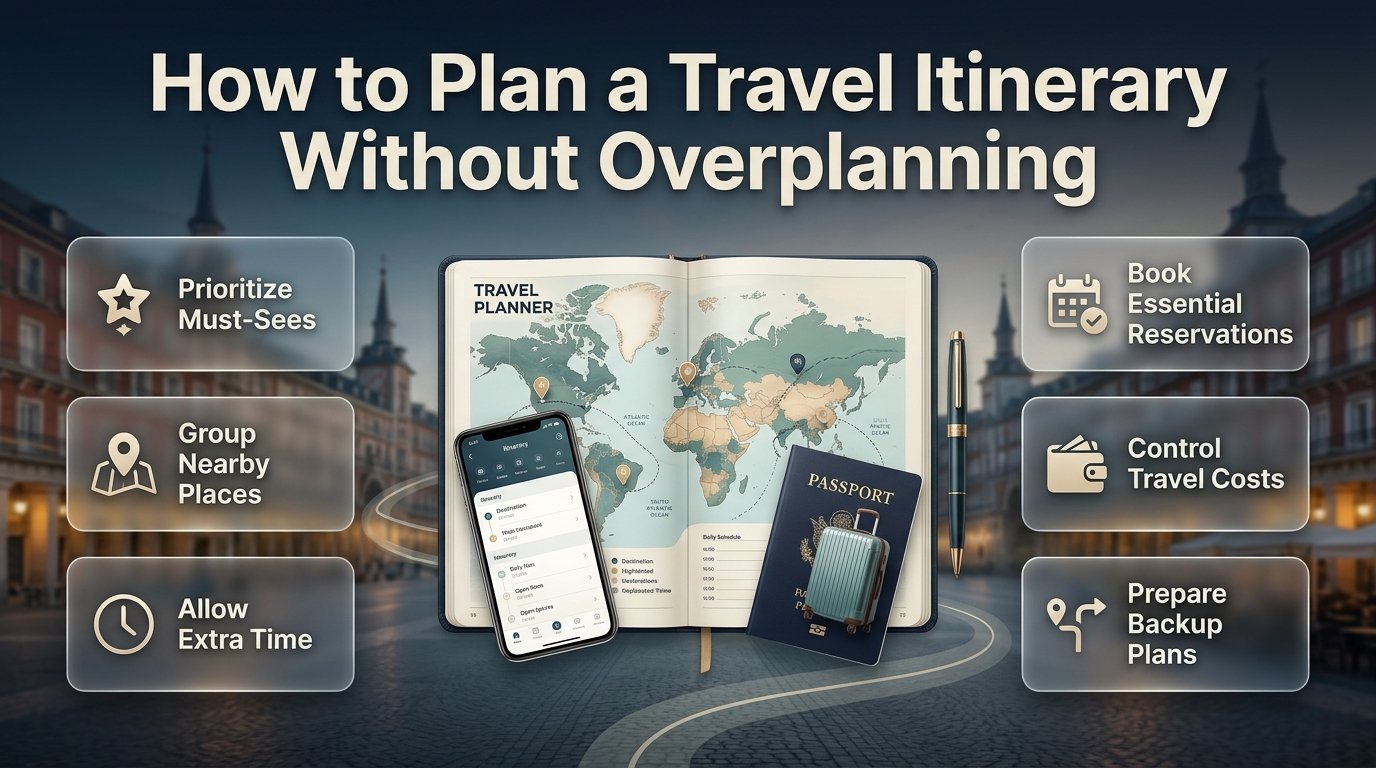
How to Plan a Travel Itinerary Without Overplanning | Planning a holiday should make you feel excited about the journey ahead, not worried about whether you can fit every attraction into a limited number of days. Many travelers begin with a simple wish list, but after researching destinations, restaurants, activities, and transport options, their plans become so crowded that enjoying the trip becomes difficult. A delayed train, unexpected weather, or a longer visit to a museum can quickly disrupt an entire day.
Learning how to plan a travel itinerary without overplanning helps you organize the essential details while leaving enough room for rest, spontaneous discoveries, and changes in your interests. Instead of trying to see everything, you can focus on experiences that matter most, choose realistic daily activities, and make decisions before they become stressful.
A successful travel itinerary is not a minute-by-minute schedule. It is a practical framework that helps you understand where you want to go, how you will get there, what needs to be booked in advance, and which parts of the journey can remain flexible.
This guide explains how to prioritize activities, organize destinations, estimate travel times, manage reservations, control costs, prepare backup plans, and avoid common itinerary-planning mistakes. You will also learn how to create a flexible travel schedule that works for city breaks, international holidays, family trips, and longer journeys.
1. What Does It Mean to Plan a Travel Itinerary Without Overplanning?
Planning a travel itinerary without overplanning means organizing your essential travel arrangements without assigning a fixed time to every possible activity. You identify your main priorities, confirm important bookings, group nearby attractions, and leave open periods for meals, rest, and unexpected opportunities.
The objective is to make the trip easier to manage without turning it into a series of obligations.
A useful itinerary normally includes:
- Arrival and departure details.
- Accommodation addresses and check-in arrangements.
- Essential transport connections.
- A manageable list of important attractions.
- Activities grouped by location.
- Approximate time blocks for sightseeing.
- Reservations that cannot easily be changed.
- Free time for relaxation and spontaneous decisions.
For example, imagine you have three days in a city known for its historical buildings, food markets, and museums. You could attempt to visit eight attractions by moving between different districts throughout the day. Alternatively, you could select one major attraction each morning, explore the surrounding area afterward, and keep the evening flexible.
The second approach provides direction without creating unnecessary pressure.
Why does overplanning make travel less enjoyable?
Overplanning often begins with good intentions. Travelers want to make the most of their money, avoid missing important sights, and ensure that every day feels worthwhile.
However, too many commitments can create several problems. You may spend more time traveling between attractions than experiencing them. You may feel disappointed when an activity takes longer than expected. You might also overlook enjoyable opportunities because they were not included in the original schedule.
A flexible itinerary reduces these problems by making the important decisions in advance while allowing smaller decisions to happen naturally.
Pro Tip: Before adding an activity, ask yourself whether it contributes meaningfully to your trip. If the only reason for including it is that other travelers recommend it, consider leaving it optional.
2. How Can You Identify Your Main Travel Priorities?
The first step in creating a realistic itinerary is deciding what you want from the trip. Without clear priorities, it is easy to collect attractions and activities without understanding how they fit together.
Start by identifying the experiences that would make the journey worthwhile. Your priorities might include exploring historical sites, enjoying local food, spending time in nature, visiting friends, shopping, or simply relaxing away from your usual routine.
Choose two or three broad priorities for the overall trip.
For instance, a traveler visiting a coastal destination might prioritize beaches, local seafood, and scenic walks. Someone visiting a major European city might focus on architecture, museums, and neighborhood cafés.
These preferences should influence which activities you choose and how much time you allocate to each location.
Separate essential, preferred, and optional activities
A simple priority system prevents your itinerary from becoming overloaded.
Essential activities are experiences that strongly influence your decision to visit the destination. These may include a major landmark, a family event, or a guided excursion available only on a particular date.
Preferred activities are experiences you would enjoy but could skip without significantly affecting the trip.
Optional activities are extras that sound interesting but do not need a dedicated time slot.
Consider a two-day visit to a historic city. Visiting its most famous landmark might be essential, exploring a nearby neighborhood could be preferred, and visiting a second museum might be optional.
This structure gives you a clear order of importance when unexpected delays occur.
How many essential activities should you choose?
There is no universal number, because a small attraction may take less than an hour while a major museum or outdoor excursion may occupy most of a day.
Instead of setting a rigid limit, estimate how much time each essential experience requires. If your essential list already fills every available morning and afternoon, you probably need to remove some commitments.
A practical test is to imagine that one activity takes twice as long as expected. Would the rest of the day still work? If not, the schedule may be too restrictive.
Quick Tip: Keep a separate wish list for places you might visit on a future trip. You can save useful research without feeling obligated to include every discovery in the current itinerary.
3. How Many Activities Should You Schedule Each Day?
For a typical leisure trip, one to three major activities per day is a useful starting point. The appropriate number depends on the duration of each activity, the distance between locations, your travel style, and the amount of rest you need.
A major attraction can involve transport, queues, security checks, several hours of exploration, and time for a meal afterward. Counting it as just one item can underestimate how much of the day it requires.
Use one main activity as the foundation
Choose the experience you most want to enjoy and build the day around it.
A realistic sightseeing day might include a morning visit to a historical landmark, lunch nearby, and an afternoon spent exploring the surrounding streets. The evening could remain open for dinner or a relaxed walk.
This arrangement works well because the day has a clear purpose without requiring every available hour to be occupied.
If the main attraction finishes earlier than expected, you can add a nearby activity. If it takes longer, you can continue enjoying the experience without worrying about missing several other reservations.
When can you schedule more activities?
Several smaller activities may fit comfortably into one day when they are close together and do not require complicated transport arrangements.
For example, visiting a local market, a nearby public garden, and a small gallery may be realistic if all three are within the same district.
However, adding a long-distance excursion or a second major attraction may require a different schedule.
Consider the effort involved rather than counting locations alone. A day containing three short walks may feel easier than a day containing two demanding activities separated by long journeys.
Should you plan different amounts of activity for different days?
Yes. A balanced itinerary does not need to give every day the same structure.
You might schedule a more active day after arriving at your destination, follow it with a lighter day, and reserve another morning for a major attraction.
If your trip involves changing hotels, taking a long train journey, or returning from an excursion, keep those days relatively simple.
This creates a more sustainable rhythm and reduces the likelihood that tiredness will affect the entire holiday.
4. How Can You Create a Flexible Daily Travel Schedule?

A flexible daily schedule organizes activities into broad periods rather than assigning an exact start time to every task. Morning, afternoon, and evening blocks are often enough to provide direction while allowing room for changes.
Begin with fixed commitments, such as timed attraction tickets or transport departures. Then add activities that can be moved easily.
Example of a flexible sightseeing day
Morning: Main attraction
Visit the place you most want to see. Allow time for transport, entry procedures, exploration, and photographs.
Afternoon: Nearby exploration
Have lunch in the area and decide whether you have enough time and energy for a second activity. If the morning runs late, enjoy the neighborhood instead.
Evening: Flexible plans
Choose a restaurant, take a walk, attend a previously booked event, or return to your accommodation for rest.
The structure works because it provides a clear direction without requiring you to follow a rigid timetable.
How should you handle fixed appointments?
Fixed commitments need more attention than flexible activities. These may include train departures, guided tours, timed museum entry, ferry crossings, and reservations that cannot be changed easily.
Record these details separately so that you can see which parts of your day are non-negotiable.
Avoid placing another important booking immediately after a major activity. A guided tour may run late, transport may be delayed, or the journey between locations may take longer than expected.
For example, if your main attraction has a timed entry at 10 a.m., avoid booking another ticketed experience for a time that leaves almost no room for travel or unexpected delays.
Expert Tip: Protect the experience that matters most. It is usually better to remove an optional stop than to rush through your main attraction simply to keep the original schedule intact.
5. How Can You Group Attractions by Location?
Grouping activities by neighborhood or district is one of the most effective ways to reduce unnecessary travel. Instead of crossing a city several times, organize your days around locations that make geographical sense.
Start with a map and mark the attractions you genuinely want to visit. Identify clusters of places that can be explored during the same outing.
You can group activities around:
- Historical districts and architectural landmarks.
- Museums and cultural institutions.
- Shopping streets and local markets.
- Parks, gardens, and waterfront areas.
- Restaurants and food markets.
- Walking routes and nearby viewpoints.
For example, if several historical buildings are located in the same district, visit them together rather than returning to that area on different days.
Why is geographical planning so important?
Unnecessary journeys consume time, increase transport costs, and add fatigue. They can also make the itinerary more vulnerable to traffic and service delays.
When attractions are grouped sensibly, you may discover cafés, shops, or small streets that were not on your original list.
However, do not assume that nearby places are always easy to reach. A short distance on a map may involve steep hills, limited crossings, restricted pedestrian access, or an inconvenient public transport connection.
Check actual routes before deciding the order of activities.
How should you organize a destination with several districts?
Assign each day a general geographical focus. You do not need to visit every attraction in a district, but you should avoid unnecessary backtracking.
If an attraction is far from the rest of your plans, ask whether it deserves a separate day or whether another activity nearby would make the journey more worthwhile.
The purpose is not to optimize every minute. It is to make the overall experience more comfortable and logical.
6. How Much Free Time Should You Leave in Your Itinerary?
Free time gives your trip room to breathe. It allows you to eat without rushing, explore a place that catches your attention, rest when you are tired, and adapt when ordinary travel delays occur.
The amount you leave open depends on the destination and the purpose of the trip. A relaxed beach holiday may require very little scheduling, while a short city break may need more advance organization.
Rather than following a universal percentage, examine how much of each day is already committed.
If every hour is assigned to a specific activity, transport connection, or reservation, you have little room to adapt.
Plan for the complete experience, not just the attraction
An activity rarely begins and ends at its advertised duration.
A two-hour museum visit might also involve getting there, waiting for entry, checking a bag, buying refreshments, and walking to your next destination.
Similarly, a restaurant meal can take longer than expected, especially when the location is busy.
Allowing for these ordinary details helps prevent one small delay from disrupting the rest of your plans.
Keep optional activities nearby
Create a short list of low-commitment activities that you can enjoy if time allows.
These might include a nearby café, a local market, a public garden, a scenic street, or a small gallery.
Choose alternatives that do not require expensive advance bookings or complicated transport arrangements.
If your main activity finishes early, you can choose one of these options. If not, you can leave without feeling that the day has failed.
Common Mistake: Treating free time as wasted time. A quiet afternoon, an unplanned meal, or a longer walk can become one of the most memorable parts of a trip.
7. How Should You Plan Transportation and Travel Time?
Transportation should influence your itinerary from the beginning. Before assigning attractions to particular days, understand how you will reach them and how much time the journeys are likely to require.
Start by confirming your arrival and departure details, accommodation location, and any essential intercity journeys.
Then research the connections between your main activities.
Build your schedule around essential journeys
Flights, trains, ferries, and long-distance buses may have fixed departure times. These should be considered before optional sightseeing.
Check the current timetable, departure station, arrival point, transfer requirements, and relevant ticket conditions.
If you must change trains or use several forms of transport, allow sufficient time for the connection. Do not assume that every journey will proceed exactly as planned.
Keep arrival and departure days lighter
Arrival days can involve immigration procedures, baggage collection, airport transfers, accommodation check-in, and recovering from a long journey.
Departure days may require packing, checking out, and reaching an airport or station well before the scheduled departure.
Unless you have a confirmed reason to do otherwise, avoid filling these days with important attractions.
A short walk or a nearby meal may be more practical than a distant excursion.
Consider the location of your accommodation
Your hotel or other accommodation affects daily travel time. A lower room price may not represent the best overall value if reaching the attractions requires expensive or lengthy journeys.
Compare accommodation options by considering the places you intend to visit, transport access, safety, and the convenience of returning during the day.
The guide to How to Choose the Right Hotel Location can help you evaluate this decision before finalizing your daily schedule.
For broader travel preparation, the travel guide provides another starting point for organizing the practical aspects of a journey.
8. What Should You Book in Advance and What Should Stay Flexible?
Advance booking is most useful when an activity has limited availability, a fixed departure time, or a significant impact on your trip. Activities that are easy to change or replace can often remain flexible.
The objective is to protect the experiences that matter without creating unnecessary commitments.
Prioritize essential bookings
Flights, accommodation, important transport connections, and popular attractions may require early decisions, particularly during busy travel periods.
Check the official booking information for current availability, entry requirements, operating hours, and cancellation conditions.
For guided tours or special experiences, consider how difficult it would be to arrange an alternative if your preferred option were unavailable.
Leave ordinary activities open
You may not need to reserve every restaurant, café, shopping visit, or neighborhood walk.
Keeping some decisions open allows you to choose based on your location, appetite, energy, and interests on the day.
If you do want to visit a particular restaurant, research its booking requirements rather than assuming that reservations are always necessary.
Maintain a separate booking record
Keep essential information in one accessible place. A simple document or travel application can include:
- Booking name and confirmation number.
- Date and local time.
- Address or meeting point.
- Departure or check-in requirements.
- Cancellation deadline, where applicable.
Save essential confirmations securely and make important details available offline when practical.
This reduces the need to search through multiple messages while you are traveling.
9. How Can You Use Your Travel Budget to Prevent Overplanning?
A travel budget helps you decide which activities deserve your time and money. Without a clear spending limit, it is easy to build an itinerary around experiences that are more expensive than expected.
Estimate the major costs before deciding how many paid activities to include.
Consider accommodation, transport, meals, attraction tickets, guided experiences, travel insurance, and an allowance for unexpected expenses.
Then compare the cost of your preferred activities with the money available for the trip.
Choose experiences according to value
The most expensive attraction is not necessarily the most rewarding. A free walking route, public garden, or local market may offer an experience that suits your interests better than another paid tour.
Ask whether each proposed activity adds something distinctive to the journey.
If two attractions offer similar experiences, choose the one that better matches your priorities, location, and budget.
Avoid filling every available slot with a paid activity
Travelers sometimes feel that a holiday should contain as many paid experiences as possible because they want to get value from their spending.
However, paying for more attractions does not automatically improve a trip.
You can often create a more enjoyable day by choosing one worthwhile experience and spending the remaining time exploring the surrounding area.
For a structured approach to estimating costs, use How to Plan a Trip Budget.
If you need to make financial decisions before committing to reservations, How to Plan a Trip Budget Before You Book can help you consider the likely expenses before finalizing the trip.
10. How Can You Adapt an Itinerary to Different Travel Styles?

An itinerary should reflect the people taking the trip, not simply the number of attractions at the destination.
A solo traveler may enjoy changing plans at short notice. A family may need predictable meal times and suitable rest periods. A road trip may require careful attention to driving distances and overnight accommodation.
Solo city breaks
Plan the main attractions and identify convenient transport routes, but leave room to explore independently.
You may find a neighborhood more interesting than expected or decide to spend additional time in a museum. A flexible schedule makes these changes easier.
Family holidays
Consider the ages, interests, and energy levels of everyone traveling.
Choose activities that are reasonably close together and avoid assuming that children can maintain an adult sightseeing pace throughout the day.
Include time for meals, breaks, and changes of plan. Keep a nearby alternative available when an activity becomes unsuitable.
Couples’ trips
Reserve important experiences, such as a special dinner or a guided excursion, when necessary. Leave the remaining schedule flexible enough to enjoy conversations, walks, and unplanned discoveries.
The aim is to create opportunities for shared experiences without turning the trip into a checklist.
Adventure travel
Outdoor activities may depend on weather, local conditions, daylight, and safety requirements.
Plan essential transport, equipment, permits, and any necessary professional guidance. Keep alternatives available when an activity cannot safely proceed.
Flexibility is especially important when the conditions are outside your control.
Road trips
Road trips require realistic estimates of driving time, rest stops, fuel needs, and overnight stays.
Avoid assuming that you can comfortably cover long distances and visit multiple attractions every day.
Confirm essential accommodation and any time-sensitive activities, then allow room for scenic stops and changes in the pace of travel.
11. How Should You Handle Weather, Delays, and Unexpected Changes?
A flexible itinerary anticipates the possibility that plans will change. You do not need to prepare a detailed alternative for every situation, but you should identify the commitments that matter most and consider what could affect them.
Weather, transport disruption, illness, attraction closures, and unexpected delays can all influence travel plans.
Prepare one practical alternative
For an outdoor sightseeing day, identify a suitable indoor attraction or a different activity that does not depend on favorable weather.
For a long-distance journey, understand the transport operator’s procedures for delays and missed connections.
For an important reservation, check whether it can be changed and how much notice is required.
These small preparations reduce the need to make every decision under pressure.
Reorder flexible activities when necessary
If your morning activity takes longer than expected, move an optional afternoon visit to another day or remove it entirely.
If poor weather makes a scenic walk unsuitable, consider another activity that fits your location and interests.
Avoid trying to recover every missed activity by packing the following day more tightly. This often transfers the original problem rather than solving it.
Know when to abandon the original plan
Sometimes the best decision is to stop following the itinerary.
If transport becomes unreliable, conditions change, or you are too tired to enjoy another activity, adjust your expectations.
An itinerary exists to support your experience, not to create a reason to ignore practical concerns.
12. What Common Mistakes Make a Travel Itinerary Too Complicated?
Overplanning usually results from several small decisions rather than one major error. Recognizing these habits can help you build a simpler and more realistic schedule.
Mistake 1: Trying to visit every popular attraction
Travel websites, recommendations, and social media can make every landmark appear essential.
The problem is that different attractions require different amounts of time, and visiting them all may leave little room to appreciate any of them.
How to avoid it: Select the experiences that genuinely interest you. Save the remaining ideas for another visit.
Mistake 2: Underestimating travel time
A schedule may look reasonable until you account for traffic, queues, walking distances, transfers, and finding the correct entrance.
How to avoid it: Check actual routes and include realistic buffers. Avoid planning activities so tightly that a small delay disrupts everything.
Mistake 3: Making too many non-refundable reservations
Numerous fixed bookings reduce your ability to change plans when circumstances change.
How to avoid it: Reserve essential experiences first. Before paying, understand the cancellation terms and consider whether the activity truly needs to be booked in advance.
Mistake 4: Planning every meal
Researching local restaurants can improve a trip, but selecting a specific restaurant for every meal may force you to travel unnecessarily.
How to avoid it: Identify a few places you particularly want to try. Keep ordinary meals flexible and choose convenient options based on your location.
Mistake 5: Ignoring rest and recovery
Walking, navigating unfamiliar streets, and changing transport connections can be tiring even when each activity appears manageable.
How to avoid it: Include breaks, avoid excessive backtracking, and leave some evenings free.
Mistake 6: Researching endlessly without making decisions
Travel research can become overwhelming when you keep comparing attractions long after you have enough information to choose.
How to avoid it: Set a clear limit for research. Once you have identified your priorities, checked essential details, and compared realistic alternatives, move on to the next planning step.
Mistake 7: Treating every recommendation as a requirement
Other travelers may have different interests, budgets, and schedules.
How to avoid it: Use recommendations to discover possibilities, not to create obligations. Choose experiences that suit your own trip.
Mistake 8: Refusing to change the itinerary
A plan can become a source of stress when you treat every skipped activity as a failure.
How to avoid it: Review your priorities rather than counting completed attractions. If the most important experiences are going well, the trip is progressing successfully.
13. How Can You Prepare Your Home Without Complicating Your Travel Plans?
Preparing your home before departure can reduce unnecessary worries during a holiday. The goal is to handle essential responsibilities in advance without turning the final days before travel into another complicated schedule.
Start by identifying the tasks that genuinely need attention. These may include securing doors and windows, arranging care for pets, managing deliveries, and checking any essential property maintenance requirements.
If you are responsible for ongoing household tasks, the Property Care guide can help you consider the practical responsibilities that may need attention before leaving.
Complete essential household maintenance early
Avoid leaving important maintenance tasks until the night before departure.
If you already know that a repair needs attention, arrange it early enough to reduce the risk of disrupting your travel preparations.
The Care for a Property guide provides a broader reference for organizing routine property responsibilities.
For routine household tasks, consult Home Maintenance and Seasonal Property Maintenance.
These resources can help you identify relevant maintenance needs without adding unnecessary tasks to your travel schedule.
Avoid starting major projects immediately before departure
A significant repair or renovation can introduce unexpected decisions, delays, and expenses.
If you are already planning work on your property, review the schedule before arranging travel. Where practical, avoid overlapping essential project milestones with the period when you will be away.
The Common Home Repairs and Improvements guide may help you identify work that needs attention before your trip.
For outdoor responsibilities, review Outdoor & Garden Care. For basic household tidiness and organization, Cleaning & Organization may help you prepare the home without overloading your final days.
Keep renovation planning separate from travel planning
If you have construction or renovation work underway, organize the important decisions before departure whenever possible.
Resources such as Construction Guide, Build or Renovate, and How to Plan a Construction Budget may be useful when you need to coordinate broader property projects.
For more detailed preparation, consult Construction Cost Breakdown Explained, How to Plan a Construction Budget Before Work Begins, and How to Choose Building Materials.
If renovation work is part of your existing plans, the Home Renovation Planning Checklist and Home Renovation Planning Checklist — Additional Resource can help you organize relevant responsibilities.
You can also review How to Plan a Trip Budget Before You Book when balancing travel expenses with other planned commitments.
The important point is to handle only the property-related tasks that are genuinely necessary before departure. You do not need to complete every possible household improvement before enjoying a holiday.
14. What Practical Tools Help You Keep an Itinerary Simple?
The best planning tool is one that makes essential information easy to find. You do not need several applications, elaborate spreadsheets, or complicated scheduling systems to organize an ordinary trip.
A notes application, calendar, spreadsheet, or travel-planning tool may be sufficient.
Keep one master itinerary
Store your travel dates, accommodation details, transport arrangements, and essential activities in one main document.
This reduces confusion when plans change and prevents you from maintaining several conflicting versions.
Organize the document by date. Under each date, list the main activity, any important booking, and a few flexible alternatives.
Use a calendar only for fixed commitments
A calendar is useful for flights, train departures, timed attraction entry, and reservations that cannot easily be moved.
Avoid filling it with every possible activity. Optional visits can remain in the itinerary notes instead.
This keeps the calendar readable and makes the most important deadlines easier to recognize.
Save important information for offline access
Internet access may be unreliable during a journey, particularly when crossing borders or visiting remote areas.
Save essential confirmations, accommodation addresses, transport information, and relevant documents securely where practical.
Check that any saved information is current before departure.
Stop researching when you have enough information
You do not need to compare every attraction, restaurant, and transport option in a destination.
Research the details that could materially affect your decisions: availability, cost, travel time, safety, opening hours, and booking conditions.
Once these questions have been answered, allow the rest of the itinerary to remain simple.
15. What Do Experienced Travel Planners Recommend Before Departure?
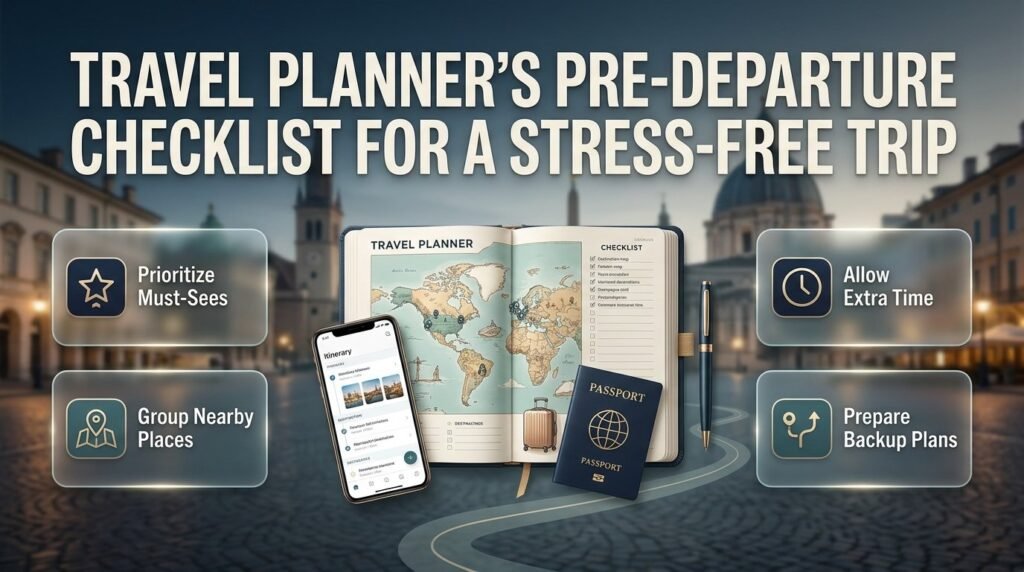
A well-prepared itinerary should make travel decisions easier without requiring constant attention. Before leaving, focus on the practical details that could disrupt the journey if overlooked.
Review the next important commitment
Check your arrival arrangements, accommodation information, essential reservations, and transport connections.
If you have a long journey or a timed attraction, confirm the departure or entry details through the relevant official source.
Check current conditions
Review the weather forecast, transport updates, attraction opening hours, and any relevant travel requirements shortly before departure.
For international journeys, make sure your documents and entry arrangements meet the applicable requirements.
Do not assume that information gathered weeks earlier will remain unchanged.
Prepare a simple backup strategy
For each major day, identify one alternative that could work if the original plan becomes impractical.
You might choose an indoor attraction for a rainy day or identify another transport option for a particularly important journey.
Avoid researching every possible contingency. A few practical alternatives are usually more useful than an elaborate backup schedule.
Review your itinerary without rebuilding it
Read through the complete plan once and check that the essential arrangements make sense.
Remove activities that no longer fit your interests, budget, or available time.
Then stop adding new commitments unless there is a genuine reason to change the plan.
For an organized starting point, visit Brendan Active Property Care and explore the resources relevant to your existing household and travel responsibilities.
16. How Can You Create a Travel Itinerary Step by Step?
You can create a flexible itinerary by working from the biggest decisions toward smaller details. This method helps you avoid spending hours researching activities before understanding your available time and budget.
Step 1: Confirm your travel dates and destination
Establish the number of nights, arrival and departure times, and the locations you will visit.
If you are traveling to several destinations, identify how much time will be spent moving between them.
Why it matters: You cannot create a realistic daily schedule without knowing how much usable time you have.
Step 2: Choose your main experiences
Write down the activities that would make the trip worthwhile. Separate essential experiences from those you would enjoy only if time allows.
Why it matters: Clear priorities prevent an endless wish list from controlling the itinerary.
Step 3: Confirm accommodation and transportation
Check where you will stay, how you will reach the accommodation, and which transport connections require advance booking.
Why it matters: These arrangements influence where you can comfortably go and how much time remains for sightseeing.
Step 4: Group attractions geographically
Use a map to identify activities that can be combined without excessive travel.
Why it matters: Logical grouping reduces unnecessary journeys and makes the daily schedule more manageable.
Step 5: Assign broad time blocks
Place your main activities into morning, afternoon, or evening periods.
Add fixed appointments and transport departures, but leave optional activities flexible.
Why it matters: Time blocks provide direction without making the entire day dependent on a rigid schedule.
Step 6: Check the budget
Estimate transport, accommodation, meals, tickets, and other important expenses.
Remove or replace activities that do not fit your available budget.
Why it matters: Budget decisions are easier before you have paid for several non-refundable bookings.
Step 7: Add breaks and one practical alternative
Allow time for meals, rest, delays, and unexpected discoveries.
Identify a useful alternative for any day that depends heavily on weather or a fixed arrangement.
Why it matters: A realistic itinerary can adapt without requiring you to redesign the entire trip.
Step 8: Review and simplify
Check opening hours, booking details, routes, and essential requirements.
Remove activities that add little value or create unnecessary pressure.
Why it matters: Simplifying the final itinerary makes it easier to use while traveling.
How Do You Plan a Travel Itinerary Without Making Your Trip Too Busy?
The best way to plan a travel itinerary without making your trip too busy is to prioritize a few meaningful experiences, group nearby attractions, and leave open time between major activities. Instead of scheduling every hour, build your days around one main experience and add optional activities only when time and energy allow.
Start by separating your plans into essential, preferred, and optional activities. Essential experiences should receive priority, while optional attractions should never prevent you from enjoying the places that matter most. Consider transportation, meal breaks, queues, and the time required to explore each location before finalizing your schedule.
Practical tips:
Choose one to three major activities per day, depending on their duration and location.
Group attractions within the same neighborhood to reduce unnecessary travel.
Leave some periods unplanned for rest and spontaneous discoveries.
Avoid booking activities too close together.
Review your schedule and remove anything that creates unnecessary pressure.
A well-balanced itinerary gives you a clear direction without making you feel obligated to complete every activity. The aim is to enjoy your destination, not race through a checklist.
How Many Activities Should You Plan Per Day When Traveling?
The number of activities you should plan per day depends on the destination, transportation requirements, activity duration, and your preferred pace of travel. For most leisure trips, one to three major activities provide a useful starting point, but smaller attractions located close together may allow for additional stops.
A large museum, guided excursion, or demanding outdoor activity may require several hours. By contrast, a short visit to a local market or scenic viewpoint may fit comfortably between other plans. Always consider the complete time commitment rather than counting attractions alone.
How to decide what fits into your day:
One major activity: Best for demanding excursions, long museum visits, or relaxed travel days.
Two major activities: Suitable when both experiences are manageable and travel between them is convenient.
Three or more activities: Consider this when the stops are short, nearby, and do not require multiple fixed reservations.
Avoid planning a full day around ideal travel conditions. Allow time for unexpected delays, meals, and breaks. If your schedule becomes crowded, remove an optional activity instead of rushing through the main experience.
The right itinerary is one that matches your available time and energy while allowing you to appreciate each destination comfortably.
Should You Book Attractions in Advance or Keep Your Travel Plans Flexible?
You should book attractions in advance when availability is limited, entry requires a specific time, or missing the experience would significantly affect your trip. Activities with flexible entry arrangements can often be left open, giving you more freedom to respond to weather, delays, and changing interests.
Advance reservations are particularly useful for popular attractions, guided excursions, important transport connections, and experiences with limited capacity. However, booking every activity can make your itinerary unnecessarily restrictive, especially when reservations are non-refundable or difficult to change.
A practical booking strategy:
Confirm flights, accommodation, and essential transportation first.
Reserve high-priority attractions when advance booking is necessary.
Check cancellation policies before paying.
Keep ordinary meals, shopping, and neighborhood walks flexible.
Maintain a separate list of optional activities that require no advance commitment.
For example, you might reserve a timed morning visit to a famous landmark but leave the afternoon open for exploring nearby streets. If the visit takes longer than expected, you can enjoy the area without worrying about another fixed appointment.
The most effective approach is to secure the arrangements that genuinely matter while leaving the smaller decisions until you know how your day is unfolding.
How Can You Avoid Wasting Time Between Attractions When Planning a Trip?
You can avoid wasting time between attractions by organizing your itinerary geographically, researching actual transportation routes, and avoiding unnecessary journeys across the same city. A location-based itinerary reduces travel fatigue, helps control transportation costs, and creates more opportunities to enjoy the destination.
Begin by marking your essential attractions on a map. Group nearby places into the same day, then check walking routes, public transportation connections, traffic conditions, and opening hours. Do not rely exclusively on straight-line distances because hills, road layouts, and transport connections can make short journeys more complicated than expected.
Ways to make your route more efficient:
Visit attractions in the same district together.
Choose accommodation with convenient access to your main destinations.
Check transport schedules before committing to timed activities.
Allow extra time for queues, transfers, and finding entrances.
Avoid placing distant attractions into an already crowded day.
For example, if a museum and a historic market are within the same district, visiting them together may be more practical than returning to that area on separate days.
However, efficiency should not become another form of overplanning. You do not need to calculate every minute or eliminate every detour. The objective is to reduce unnecessary travel while preserving enough flexibility to explore naturally.
What Should You Do When Your Travel Itinerary Changes Unexpectedly?
When your travel itinerary changes unexpectedly, protect your most important commitments, reassess the remaining time, and move or remove optional activities rather than trying to complete everything. Delays, bad weather, attraction closures, and changes in energy levels are normal parts of travel, so a good itinerary should be able to adapt.
Start by identifying which plans are time-sensitive. A train departure, an important reservation, or a timed attraction may require immediate attention. Flexible activities, such as casual sightseeing or shopping, can usually be moved to another period or skipped altogether.
Follow these practical steps:
Check whether the change affects an essential booking or transport connection.
Review the remaining activities and remove those that no longer fit comfortably.
Choose a nearby alternative if the original activity becomes impractical.
Check official updates when transport services or attraction opening hours change.
Avoid overcrowding the following day to compensate for missed activities.
For example, if heavy rain prevents an outdoor excursion, you might visit a suitable indoor attraction instead. If no alternative feels worthwhile, use the time to relax and continue with your original plans when conditions improve.
Remember that changing your itinerary does not mean your planning has failed. A flexible schedule gives you the freedom to make sensible decisions without sacrificing the overall enjoyment of your trip.
Conclusion: Plan a Travel Itinerary That Leaves Room to Enjoy the Journey
Planning a travel itinerary without overplanning is about finding the right balance between preparation and flexibility. A well-organized trip gives you a clear idea of where to go, how to get around, what to prioritize, and how much to spend, without turning every hour into a fixed obligation. Instead of trying to visit every attraction, focus on the experiences that matter most to you and allow enough time to enjoy them comfortably.
Start by identifying your travel priorities, grouping nearby attractions, estimating realistic travel times, and leaving open periods for rest, unexpected discoveries, and changes in plans. Book essential arrangements in advance when necessary, but avoid committing to every activity before you understand the pace of your destination. A practical itinerary should support your journey, not control it.
Before departure, review your transport, accommodation, important documents, and travel budget. If you are leaving your home unattended, take care of essential household responsibilities so you can travel with greater peace of mind. Most importantly, remember that unexpected delays and spontaneous opportunities are normal parts of traveling.
The best itinerary is not the one with the most activities. It is the one that helps you experience your destination without unnecessary pressure. Plan the essentials, prioritize meaningful experiences, and leave room for the unexpected. With a thoughtful approach, you can enjoy a smoother, more comfortable, and more memorable journey while making the most of your time away.