Introduction
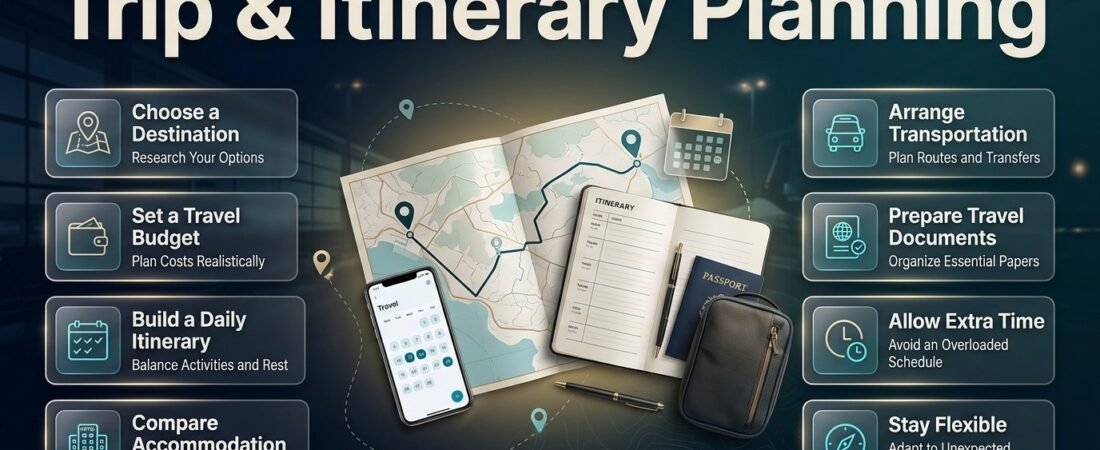
Trip & Itinerary Planning | Planning a trip can become stressful when you have to choose a destination, compare travel costs, book accommodation, arrange transportation, and decide how to spend each day. Without a clear plan, you may waste valuable time travelling between attractions, exceed your budget, or discover that an activity you wanted to enjoy is unavailable.
Trip & Itinerary Planning helps you organize these decisions before departure. A good plan gives you a clear direction while leaving enough flexibility to enjoy your journey without feeling rushed. Whether you’re arranging a short weekend break, a family holiday, a road trip, or an international adventure, the right preparation can make the experience more comfortable and manageable.
At Active Property Care Brendan, practical guidance helps readers approach everyday planning with greater confidence. Travel planning follows the same principle: understand your needs, organize the important details, and make informed decisions before committing your time and money.
This guide explains how to choose a destination, set a realistic budget, build a daily itinerary, compare accommodation and transportation, prepare travel documents, avoid common mistakes, and handle unexpected changes. You’ll also learn how to plan efficiently without filling every hour with activities.
What Is Trip & Itinerary Planning?
Trip and itinerary planning is the process of organizing a journey from the initial idea to the return home. It includes choosing a destination, setting dates, calculating expenses, arranging transport, selecting accommodation, researching activities, and preparing a practical schedule.
A trip plan provides the overall structure of your journey. An itinerary explains how that journey will work day by day.
For example, a four-day holiday plan might identify the destination, travel dates, estimated budget, and accommodation. The itinerary would show which attractions you’ll visit each day, how you’ll reach them, and when you’ll take breaks.
Both serve different purposes, but they work best together.
Why Is Planning Important Before Travelling?
A realistic plan helps you use your time wisely, control expenses, and reduce avoidable problems. It also makes it easier to recognize when your expectations exceed the time or money available.
The main benefits include:
- Better budget management: Estimate major expenses before making bookings.
- Efficient transportation: Group nearby activities and avoid unnecessary journeys.
- Fewer scheduling problems: Check opening hours, reservation requirements, and travel times.
- Improved comfort: Include meals, rest periods, and realistic arrival times.
- More flexibility: Prepare alternatives for bad weather, delays, and unexpected closures.
A useful itinerary isn’t necessarily detailed down to the minute. It simply answers the important questions before they become problems.
How Do You Choose the Right Destination?
Choose a destination that matches your interests, available time, budget, and travel requirements. Before comparing flights or hotels, decide what you want from the experience. Some travellers want relaxation, while others prefer outdoor adventures, historical attractions, shopping, local food, or time with family.
Start with two or three possible destinations. Compare their overall costs, journey times, seasonal conditions, transportation options, and available activities.
Consider Your Travel Priorities
Available time: A destination requiring extensive travel may not be suitable for a short weekend. Consider how many full days you’ll actually have after accounting for arrival and departure.
Total cost: Look beyond advertised flight or hotel prices. Meals, local transportation, admission fees, and additional charges can significantly affect affordability.
Weather and season: Research typical seasonal conditions and any weather-related restrictions. Outdoor activities may require backup arrangements.
Interests and accessibility: Make sure the destination offers experiences that suit everyone travelling with you, including any mobility or comfort requirements.
Entry requirements: International destinations may require visas, specific passport validity, transit documentation, or other preparations.
Which Destination Suits Your Travel Style?
| Travel style | Main priority | Recommended approach |
|---|---|---|
| Weekend getaway | Convenience | Choose one main area |
| Family holiday | Comfort and variety | Balance activities with rest |
| Road trip | Route and driving time | Plan overnight stops |
| Cultural holiday | History and local experiences | Explore by neighbourhood |
| Nature adventure | Conditions and safety | Check access and seasonal restrictions |
| International journey | Documents and connections | Prepare essential arrangements early |
For instance, if you have three days available, exploring one city thoroughly may be more enjoyable than visiting three places and spending most of the trip travelling between them.
For broader travel preparation, use the Travel Guide and Plan a Journey resources to support your decisions.
How Do You Set a Realistic Travel Budget?
A travel budget estimates the full cost of your journey, including transportation, accommodation, meals, activities, and other expenses. It should also include a contingency allowance for unexpected costs.
Begin with the amount you can comfortably afford. Then calculate the likely cost of the trip before making non-refundable commitments.
Which Expenses Should You Include?
Create a checklist covering the following categories:
- Return flights, train tickets, bus fares, or fuel.
- Hotel, guesthouse, or other accommodation.
- Local transport, parking, and tolls.
- Meals, drinks, and snacks.
- Attraction tickets and guided activities.
- Necessary travel documents and visa charges.
- Travel insurance where appropriate.
- Mobile data and communication expenses.
- Luggage fees and booking charges.
- Emergency expenses and a contingency reserve.
Separate confirmed expenses from estimates. A confirmed booking gives you a more reliable figure, while meals and local transport may require estimates based on your destination.
How Can You Calculate the Total Cost?
Use this simple formula:
Total trip budget = transportation + accommodation + food + activities + other expenses + contingency reserve.
Consider an illustrative three-day trip:
| Expense | Example estimate |
|---|---|
| Return transportation | $120 |
| Two nights of accommodation | $100 |
| Meals | $60 |
| Local transport | $25 |
| Activities | $35 |
| Other expenses | $20 |
| Subtotal | $360 |
| Contingency reserve of 10% | $36 |
| Estimated total | $396 |
These figures are examples rather than current prices. Replace them with actual costs for your destination, dates, and travel arrangements. The accommodation figure represents the total for both nights.
For a detailed budgeting method, consult How to Plan a Trip Budget. If you are still comparing destinations and have not booked anything, How to Plan a Trip Budget Before You Book is particularly relevant to that early decision-making stage.
How Can You Avoid Hidden Travel Expenses?
Check the final price before confirming a booking. Advertised prices may exclude baggage, airport transfers, accommodation taxes, parking, breakfast, or other charges.
Also consider the cost of reaching attractions from your hotel. A lower nightly rate may not provide better value if you need expensive transport several times each day.
Pro Tip: Keep your contingency reserve separate from money allocated to planned activities. This makes it easier to handle an unexpected expense without disrupting the rest of your holiday.
How Do You Create a Travel Itinerary Step by Step?
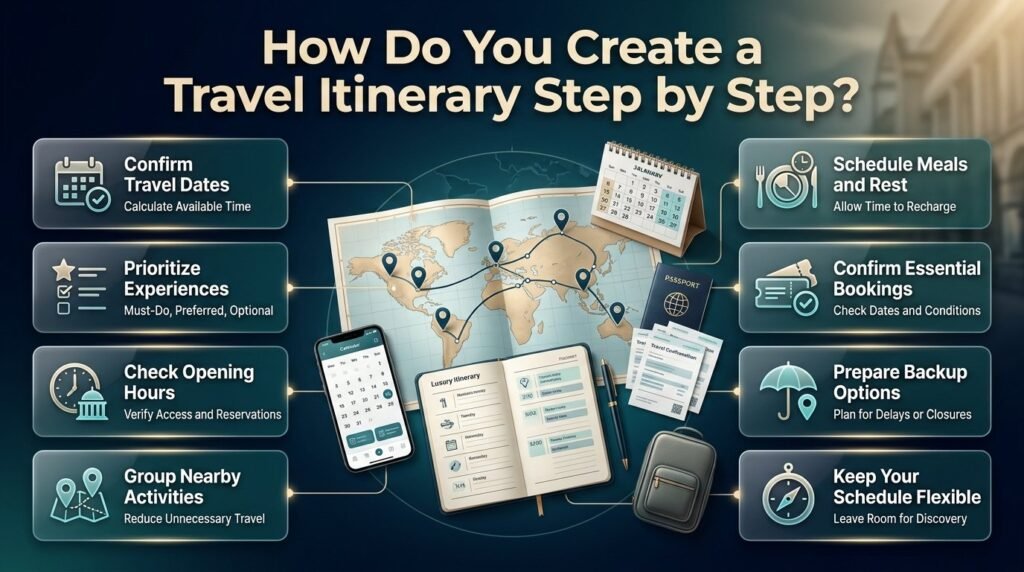
A practical itinerary connects your bookings, destinations, activities, and transportation into a manageable schedule. Build it in stages, beginning with the decisions that affect everything else.
Step 1: Confirm Your Travel Dates
Choose your departure and return dates, then calculate the time available at your destination.
A five-day trip may provide only three full sightseeing days if you arrive late on the first day and leave early on the last.
Why it matters: You can choose an appropriate number of activities and avoid expecting too much from limited time.
Professional advice: Record arrival and departure times before scheduling sightseeing. Allow for luggage collection, transfers, check-in, and possible delays.
Step 2: List Your Essential Experiences
Write down the activities that matter most. Divide them into three groups:
- Must-do: Experiences that are central to your trip.
- Preferred: Activities you would enjoy if time permits.
- Optional: Stops you can skip without affecting the main experience.
This ranking makes adjustments easier. If a museum visit takes longer than expected, you can remove an optional stop rather than disrupting the entire day.
Step 3: Research Opening Hours and Access
Check official attraction information before finalizing your schedule. Some places require advance reservations, operate on limited days, or have seasonal closures.
Confirm how long you need for the visit, whether tickets must be purchased in advance, and how early you should arrive.
Step 4: Group Nearby Activities
Arrange your itinerary geographically. Visit attractions in the same area together instead of repeatedly crossing the city.
For example, explore a historic district in the morning, eat lunch nearby, and visit a local museum in the afternoon.
This approach reduces unnecessary transport and leaves more time for the experiences themselves.
Step 5: Include Meals and Rest
Meals, breaks, and unplanned discoveries are essential parts of a realistic schedule.
Families travelling with children may need additional breaks. Older travellers or people with mobility requirements may benefit from shorter walking distances and convenient transport.
Avoid making every activity dependent on a fixed reservation. A little flexibility can prevent one delay from affecting the whole day.
Step 6: Confirm Essential Bookings
Once your itinerary is realistic, review transport, accommodation, and activities before committing to payments.
- Verify dates and entry requirements.
- Compare essential transportation options.
- Check accommodation availability and location.
- Reserve activities with limited availability.
- Arrange necessary transfers or car hire.
- Save confirmation numbers and cancellation conditions.
The correct order may vary. If accommodation is scarce or a major event has limited tickets, compare those options before committing to other non-refundable arrangements.
Step 7: Prepare Alternatives
Identify backup activities for poor weather, transport delays, or unexpected closures.
If an outdoor excursion is the main activity, find an indoor alternative that interests you. If a restaurant is fully booked, know where you could eat nearby.
You don’t need a second complete itinerary. A few suitable alternatives can prevent unnecessary stress.
For a more detailed explanation of itinerary structure, consult How to Plan a Travel Itinerary.
What Should a Daily Travel Itinerary Include?
A daily itinerary should show your main activities, approximate timings, transportation arrangements, and opportunities for rest. It should be detailed enough to guide your day without requiring you to follow every minute rigidly.
Consider this example of a city sightseeing day:
| Time | Planned activity | Practical consideration |
|---|---|---|
| 8:00–9:00 AM | Breakfast and preparation | Check weather and opening hours |
| 9:00–11:00 AM | Main attraction | Allow time for queues |
| 11:00 AM–12:00 PM | Explore the surrounding area | Keep walking distances manageable |
| 12:00–1:00 PM | Lunch | Choose a convenient location |
| 1:00–3:00 PM | Museum or cultural activity | Check ticket requirements |
| 3:00–4:00 PM | Rest break | Leave room for delays |
| 4:00–6:00 PM | Flexible sightseeing | Adjust according to energy |
| Evening | Dinner and return | Check transport availability |
The times are illustrative. Adapt the schedule to local opening hours, weather, travel distances, and personal preferences.
How Many Activities Should You Plan Each Day?
There is no universal number because activities vary in duration and complexity. A short visit to a nearby landmark requires a different time commitment from a guided tour or a full-day excursion.
Estimate the complete time required for each activity, including:
- Travel to and from the location.
- The expected visit duration.
- Queues, security checks, or transfers.
- Meals and rest periods.
- The time needed to reach your next commitment.
Build your schedule around one main experience and add nearby activities only when they fit comfortably.
Expert Tip: Treat the itinerary as a guide rather than a strict timetable. A successful day is one in which you enjoy the planned experiences without feeling pressured to complete every optional stop.
How Do You Choose the Right Hotel Location?

The right hotel location supports your activities, transportation needs, budget, and comfort. A low nightly rate may not be good value if reaching your main attractions requires long journeys or expensive transfers.
Mark your main attractions, arrival point, and departure point on a map. Then compare accommodation options based on the total time and cost of getting around.
What Should You Check Before Booking?
Transport access: Look for convenient connections to public transport or reliable transfer services.
Distance to attractions: Consider whether the property is close to your priority activities.
Complete cost: Include taxes, service fees, parking, breakfast, and other charges.
Arrival arrangements: Confirm check-in times, luggage storage, and late-arrival policies.
Safety and accessibility: Research the immediate surroundings and any accessibility requirements.
Cancellation conditions: Understand refund rules and change fees before choosing a non-refundable rate.
A central hotel may cost more but reduce daily travel expenses. Alternatively, accommodation near a railway station may be more useful for a multi-city trip.
Use How to Choose the Right Hotel Location when comparing different properties.
How Should You Arrange Transportation?
Transportation planning determines how easily you can move between airports, hotels, attractions, and different destinations. Compare each option based on price, journey time, reliability, comfort, and luggage requirements.
| Transport option | Best suited for | What to consider |
|---|---|---|
| Plane | Long-distance and international journeys | Baggage charges and airport transfers |
| Train | Connected cities and regional travel | Timetables and station locations |
| Bus | Budget-conscious journeys | Duration and luggage rules |
| Rental car | Road trips and remote areas | Fuel, parking, insurance, and local rules |
| Public transport | Exploring cities | Routes and operating hours |
| Taxi or ride-hailing | Direct journeys | Fare estimates and availability |
How Can You Reduce Unnecessary Travel?
Plan the route before booking activities. When visiting several cities, compare their order and avoid unnecessary backtracking.
For road trips, consider driving breaks, fuel stops, overnight accommodation, parking, and likely traffic. Check local driving requirements before hiring a vehicle.
Do not assume that an early flight arrival means you can begin sightseeing immediately. Airport procedures, transfers, and luggage collection may take a considerable amount of time.
A realistic transport schedule protects your reservations and makes the journey more comfortable.
How Do You Prepare for International Travel?
International travel requires additional preparation because entry rules, documentation, payment methods, and local transportation vary by destination.
Start checking requirements early. Passport validity rules, visa conditions, and transit requirements depend on your nationality and the countries you visit.
Essential International Travel Checklist
- Confirm passport validity and visa requirements.
- Check entry and transit conditions through official authorities.
- Review baggage allowances and airline check-in requirements.
- Consider suitable travel insurance.
- Keep copies of essential reservations and documents.
- Check local currency and payment methods.
- Arrange mobile data or another communication option.
- Research local laws, customs, weather, and transport.
- Save emergency contacts and accommodation details.
- Share your general itinerary with someone you trust.
Keep important information accessible if your phone battery runs out or internet service becomes unavailable. Secure digital copies and appropriate paper copies can provide useful alternatives.
For a dedicated preparation resource, see First-Time International Travel Checklist.
Common Mistake: Assuming that a travel requirement applies equally to everyone. Always check the rules that apply to your nationality, destination, and transit arrangements.
Which Tools Make Trip Planning Easier?
You don’t need numerous applications to organize a successful trip. A spreadsheet, digital calendar, mapping service, and secure place for booking confirmations may be sufficient.
| Tool | Main purpose | Useful information |
|---|---|---|
| Spreadsheet | Budget and itinerary organization | Dates, costs, and bookings |
| Calendar | Time-sensitive commitments | Reservations and reminders |
| Mapping service | Route planning | Distances and journey times |
| Booking confirmations | Reservation management | Reference numbers and conditions |
| Offline notes | Access without internet | Addresses and daily plans |
| Official attraction information | Verifying arrangements | Opening hours and ticket requirements |
What Information Should Your Itinerary Contain?
Include your travel dates, transport details, accommodation addresses, daily activities, approximate timings, reservation references, estimated expenses, and backup options.
Keep the main document easy to scan. Store sensitive personal and payment information securely rather than placing it in a document shared with everyone in the group.
Before departure, confirm that essential documents and saved maps are available offline. This small step can be particularly useful when travelling through unfamiliar areas.
How Can You Plan a Trip Without Overplanning?
Overplanning occurs when every meal, walk, shopping stop, and rest period receives a fixed time slot. A detailed schedule may feel reassuring, but it can become difficult to follow when a journey takes longer than expected.
A balanced itinerary separates fixed commitments from activities that can be moved or skipped.
Use Four Activity Categories
Fixed commitments: Flights, train departures, timed-entry tickets, and confirmed tours.
Priority activities: Experiences you want to complete but may be able to reschedule.
Flexible activities: Shopping, café visits, scenic walks, and optional attractions.
Backup activities: Alternatives for poor weather, closures, or delays.
This structure makes adjustments easier without requiring you to rebuild the entire plan.
For example, if a museum visit takes longer than expected, you can shorten an optional shopping stop rather than missing a pre-booked evening activity.
The key is to protect the important parts of the trip while leaving the remaining schedule adaptable.
What Are the Most Common Trip Planning Mistakes?
Many travel problems arise from unrealistic expectations rather than a lack of research. Understanding common mistakes can help you make better decisions before spending money.
Trying to Visit Too Many Destinations
Why it happens: Travellers want to experience as much as possible during a limited holiday.
Why it’s harmful: Frequent transfers consume time and energy, leaving less time to enjoy each place.
How to avoid it: Compare actual travel times with the time available at each destination. Remove stops that make the journey unnecessarily demanding.
Underestimating the Budget
Why it happens: Travellers calculate flights and hotels but overlook meals, local transport, taxes, and additional fees.
Why it’s harmful: Unexpected costs may force you to change activities or exceed your spending limit.
How to avoid it: Estimate the full cost, confirm final booking prices, and reserve a reasonable contingency amount.
Booking Without Checking Conditions
Why it happens: Attractive prices encourage quick decisions.
Why it’s harmful: Changes may lead to cancellation charges or losses on non-refundable bookings.
How to avoid it: Compare the total price, cancellation conditions, change fees, and flexibility before paying.
Ignoring Local Travel Times
Why it happens: Attractions appear close together on a map.
Why it’s harmful: Traffic, queues, transfers, and walking distances make the day longer than expected.
How to avoid it: Check realistic journey estimates and group nearby activities together.
Forgetting Opening Hours
Why it happens: Travellers assume attractions operate every day.
Why it’s harmful: You may arrive on a closure day or discover that advance tickets are required.
How to avoid it: Verify current opening hours, special closures, and reservation requirements before finalizing your schedule.
Leaving No Room for Delays
Why it happens: A tightly packed schedule appears efficient.
Why it’s harmful: One delayed journey can disrupt several later bookings.
How to avoid it: Add time buffers between important commitments and avoid scheduling optional activities immediately before timed reservations.
Planning Without Considering Everyone
Why it happens: One traveller chooses the activities without discussing the needs of the group.
Why it’s harmful: Differences in interests, budget, mobility, and energy can make the experience uncomfortable.
How to avoid it: Agree on the main priorities together and include activities that suit the people travelling.
The central lesson is that an enjoyable trip depends on realistic decisions, not the number of attractions on your list.
How Should You Prepare Your Home Before Leaving for a Trip?

Travel preparation doesn’t end with booking tickets and arranging accommodation. If you’ll be away for several days, preparing your home or property can help prevent avoidable maintenance problems and make your return more comfortable.
The amount of preparation required depends on the length of your absence, the season, the type of property, and whether someone will check on it while you’re away.
Create a Simple Pre-Departure Home Checklist
Before leaving, check doors and windows, arrange for deliveries, and make sure essential household systems are operating safely. Ask a trusted person to check the property if you’ll be away for an extended period.
Useful preparations include:
- Secure doors, windows, and other access points.
- Arrange care for pets and plants.
- Dispose of perishable food and household rubbish.
- Check that essential appliances are switched off when appropriate.
- Arrange mail collection or delivery management.
- Confirm that smoke alarms and other safety equipment are working.
- Leave emergency contact information with a trusted person.
- Address any known leaks or maintenance concerns before departure.
For ongoing household preparation, the Home Maintenance resource can help you identify routine tasks that deserve attention before leaving.
If you’ve noticed a leaking tap, damaged door, loose fitting, or another minor issue, review Common Home Repairs and Improvements to understand which repairs may need attention before your departure.
Outdoor spaces also require consideration. Depending on the season, you may need to secure garden furniture, arrange watering, or check drainage. The Outdoor & Garden Care guide is relevant when preparing gardens and outdoor areas.
For general tidiness and food-storage preparation, consult Cleaning & Organization. These preparations are especially useful before a longer holiday.
What If Your Property Needs More Extensive Preparation?
Not every property concern can be resolved with a quick checklist. If you know that maintenance, repairs, or renovation work is required, assess the issue before travelling rather than assuming it can wait indefinitely.
The Property Care resource provides a broader starting point for organizing property responsibilities. For a wider overview of looking after a home, use Care of Property.
If significant building work is already planned, the Construction Guide can support your understanding of construction-related preparation. For decisions about whether to improve an existing property or undertake a new project, see Build or Renovate.
These resources address property management rather than travel scheduling, so use them when your pre-departure checklist reveals a genuine property-related need.
How Can You Manage Unexpected Changes During a Trip?
Even a carefully prepared itinerary cannot prevent every disruption. Weather conditions, transport delays, illness, attraction closures, and booking changes can affect travel plans.
The best response is to identify the immediate problem, protect essential arrangements, and adjust the remaining schedule without making rushed decisions.
Follow a Practical Response Process
1. Identify what has changed. Determine whether the disruption affects transportation, accommodation, an activity, or several bookings.
2. Check your booking conditions. Review the relevant cancellation, refund, and change policies before paying for alternatives.
3. Contact the appropriate provider. Ask about available alternatives and any assistance covered by your booking.
4. Recalculate your remaining time and budget. A delayed arrival may make an optional activity impractical, even if the activity itself remains available.
5. Update the itinerary. Move flexible activities, inform travel companions, and confirm any replacement arrangements.
Keep receipts, updated confirmations, and relevant messages. These records may be useful when requesting a refund or making an eligible insurance claim.
If your plans involve a longer absence, remember to reassess property arrangements too. A change in your return date may affect plant care, deliveries, or other household responsibilities.
How Can You Improve Your Planning Before Major Commitments?
Some journeys involve more than ordinary sightseeing. You might combine travel with visiting family, inspecting a property, attending an event, or arranging work at home before departure.
When several responsibilities compete for your time and money, use the same planning principles: define the objective, estimate the total cost, confirm essential arrangements, and leave room for changes.
For example, if renovation work must be completed before a planned holiday, confirm the work scope and expected completion date rather than assuming the project will finish on schedule.
The How to Plan a Construction Budget guide is relevant when estimating the cost of such work. You can also review Construction Cost Breakdown Explained to understand the different components of a construction estimate.
If you are preparing a renovation before leaving, the Home Renovation Planning Checklist can help organize the decisions that need attention. For choosing suitable materials, consult How to Choose Building Materials.
For a more focused look at organizing the renovation itself, see Renovation Planning. These are supporting resources for property projects, not requirements for an ordinary holiday.
What If Construction Work Must Be Budgeted Before It Starts?
When building work is part of your wider plans, estimate costs before agreeing to a start date. Consider labour, materials, delivery, potential additional work, and the time needed to complete each stage.
The How to Plan a Construction Budget Before Work Begins resource addresses early cost preparation.
You can also consult Home Renovation Planning Checklist for a separate checklist resource when organizing renovation tasks.
For practical work involving repairs and upgrades, Repairs & Home Improvements provides another relevant starting point. If you need to compare construction supplies, the Building Materials resource supports that separate decision.
Finally, seasonal conditions may affect whether exterior or interior maintenance should be completed before you leave. Review Seasonal Property Maintenance when preparing for weather-related maintenance needs.
The key is to keep unrelated tasks out of your actual travel itinerary. Complete essential property responsibilities separately so they don’t make your holiday schedule unnecessarily complicated.
How Do You Plan a Trip and Create an Itinerary That Fits Your Budget?
Planning a trip within your budget starts with understanding how much you can comfortably spend and dividing that amount between essential expenses and optional activities. Before booking anything, estimate transportation, accommodation, meals, local travel, attraction tickets, and other likely costs. Compare the complete price of different options instead of choosing based only on the cheapest advertised rate.
Once you have a budget, organize your itinerary around the experiences that matter most. Prioritize activities that require advance reservations, then add affordable attractions and flexible options. Keep a separate contingency allowance so an unexpected expense doesn’t force you to abandon an important part of your journey.
Practical tips:
Set a maximum spending limit before choosing accommodation.
Compare transport costs alongside hotel locations.
Record estimated and actual expenses in a spreadsheet.
Review cancellation fees and additional booking charges.
Keep emergency funds separate from your sightseeing budget.
How Far in Advance Should You Plan a Trip and Book Travel Arrangements?
The ideal planning period depends on your destination, travel season, trip length, and booking requirements. International holidays, popular events, and destinations requiring visas may need several months of preparation. A short domestic getaway can often be organized in less time, particularly when accommodation and transport are readily available.
Begin by confirming your travel dates and checking entry requirements. Next, compare transportation and accommodation options before committing to non-refundable bookings. Research popular attractions early if they require timed tickets or have limited availability. Continue reviewing important arrangements as your departure date approaches because schedules, entry rules, and operating hours can change.
Practical tips:
Check passport and visa requirements as early as possible.
Compare transport and accommodation availability before making major commitments.
Reserve high-demand activities when necessary.
Reconfirm departure times and accommodation details before leaving.
Keep digital copies of booking confirmations accessible offline.
How Do You Create a Daily Travel Itinerary Without Overplanning?
A successful daily itinerary balances organized activities with enough flexibility to enjoy the destination. Instead of scheduling every hour, identify one or two main experiences for the day and add nearby attractions that fit comfortably around them. Consider the actual time required for transportation, queues, meals, and rest rather than calculating only the duration of each activity.
Group attractions by neighbourhood to reduce unnecessary journeys. Keep optional activities separate from fixed reservations so you can adjust your schedule when weather, traffic, or personal energy levels affect your plans. This approach is particularly useful for families, first-time travellers, and anyone visiting an unfamiliar destination.
Practical tips:
Identify your must-do activities before adding optional stops.
Check opening hours and reservation requirements.
Allow realistic travel time between locations.
Schedule meal breaks and periods of rest.
Prepare alternative activities for bad weather or unexpected closures.
What Should You Include in a Complete Travel Planning Checklist?
A complete travel planning checklist should cover transportation, accommodation, budgeting, activities, documents, communication, and essential arrangements at home. Organizing these details in one place makes it easier to identify missing information before departure and reduces the risk of forgetting an important booking or requirement.
Start with your destination and dates, then record your transport details, accommodation address, reservation references, and daily itinerary. For international travel, check the relevant passport, visa, and transit requirements. Before leaving, review luggage allowances, payment methods, mobile connectivity, weather conditions, and any arrangements needed for pets, plants, deliveries, or property care.
Practical tips:
Verify travel documents and entry requirements.
Save tickets, booking confirmations, and accommodation details.
Check baggage rules and transport arrangements.
Prepare suitable payment methods and communication access.
Arrange necessary household responsibilities before departure.
Keep essential information available without an internet connection.
How Can You Handle Unexpected Changes During a Trip Without Ruining Your Itinerary?
Unexpected changes are a normal possibility when travelling. Transport delays, bad weather, cancelled activities, and accommodation problems can affect even a carefully prepared itinerary. The most effective response is to identify which arrangements have been affected, review the available alternatives, and adjust the remaining schedule without making rushed or unnecessary purchases.
Start by contacting the relevant transport provider, hotel, or activity operator. Review the booking terms before paying for replacements, and check whether an alternative departure time or activity is available. Move flexible activities to another time when possible, while protecting essential reservations and allowing enough time for new arrangements.
Practical tips:
Keep provider contact details and booking references accessible.
Check cancellation, refund, and rebooking conditions.
Maintain a list of alternative activities and transport options.
Keep a contingency reserve for unexpected expenses.
Update your itinerary and inform other travellers about changes.
Save receipts and confirmation messages for potential refund or insurance claims.
The key is to plan carefully without assuming everything will happen exactly as expected. A flexible itinerary allows you to respond to disruptions while preserving the most important experiences of your trip.
Conclusion: Make Trip and Itinerary Planning Simple and Stress-Free
Successful trip and itinerary planning starts with clear priorities, a realistic budget, and a practical understanding of what you want from your journey. By choosing a suitable destination, organizing transportation and accommodation, researching important activities, and preparing a flexible daily schedule, you can reduce unnecessary stress and make better use of your travel time. The goal is not to plan every minute but to create a reliable structure that allows you to enjoy the experience without constantly worrying about what comes next.
Before departure, confirm your reservations, check travel documents, prepare a packing checklist, and keep some money and time available for unexpected situations. If your journey involves a longer stay away from home, arranging essential property maintenance and household responsibilities in advance can also provide peace of mind. A thoughtful plan should support your travel experience rather than restrict it.
Use your itinerary as a guide, not a strict set of rules. Leave room for spontaneous discoveries, local recommendations, rest, and changes in weather or transportation. With careful preparation and a flexible approach, trip and itinerary planning becomes easier, more organized, and more enjoyable—helping you travel confidently and return home with positive memories.