
Introduction
How to Plan a Construction Budget | Planning a construction project can be exciting until the costs begin to add up. Materials, labor, equipment, permits, professional fees, and finishing work can quickly push a project beyond its original budget. Even a carefully planned building project can face financial pressure when prices change or unexpected site problems appear. The best way to avoid these difficulties is to prepare a realistic construction budget before work begins.
Learning how to plan a construction budget helps you understand the true cost of your project, decide which expenses deserve priority, and manage your money throughout construction. Whether you are building a new home, extending an existing property, or planning a small building project, a detailed budget gives you a clear financial direction. The practical property and construction resources available at Brendan Active Property Care can also help you approach property decisions with a more organized, long-term perspective.
A successful construction budget is not simply a list of estimated expenses. It is a financial plan that connects the project’s scope, materials, labor, schedule, available funding, and unexpected costs. It also helps you compare contractor quotations, prevent unnecessary spending, and make informed decisions when adjustments become necessary.
This guide explains how to create a construction budget from the beginning, estimate costs accurately, allocate funds, monitor expenses, and avoid common mistakes that can make a project more expensive than expected.
1. What Is a Construction Budget and Why Does It Matter?
A construction budget is a financial plan that estimates how much money a building project will require from initial planning to completion. It organizes expected expenses into categories, establishes spending limits, and provides a reference for comparing actual costs with the original estimates.
Without a clear budget, it becomes difficult to determine whether a contractor’s quotation is reasonable, whether a material upgrade is affordable, or whether enough money remains to finish the project.
A comprehensive construction budget usually includes:
- Design, architectural drawings, and engineering services.
- Site surveys, soil investigations, and preparation.
- Building materials and transportation.
- Labor, subcontractors, and specialist services.
- Equipment rental and temporary facilities.
- Permits, inspections, and applicable statutory charges.
- Plumbing, electrical installations, and other building services.
- Interior finishes, fixtures, and exterior improvements.
- Waste disposal, insurance, and project supervision.
- Contingency funds for unexpected expenses.
- Financing costs, where applicable.
These categories may differ according to the project’s location, size, construction method, and contract arrangement.
For example, the budget for constructing a new house may require land preparation, foundation work, structural construction, roofing, and complete interior finishing. A renovation budget may instead focus on demolition, repairs, replacement installations, and improvements to existing rooms.
The important point is to include the entire agreed scope of work rather than estimating only the most visible expenses.
How Does a Construction Budget Help Control Spending?
A construction budget establishes a financial baseline against which decisions can be evaluated. When an expense increases, you can identify the affected category, understand the reason, and decide whether the change is necessary.
It also improves communication between property owners, contractors, designers, and suppliers because everyone can work from the same documented expectations.
A well-prepared budget helps you:
- Identify financial risks before construction begins.
- Compare quotations using consistent requirements.
- Avoid spending too much on optional upgrades.
- Schedule payments around available funds.
- Track cost increases while there is still time to respond.
- Protect money for essential work and project completion.
Professional tip: Prepare the budget before signing major contracts or ordering expensive materials. Decisions become harder to change after work has started, especially when the changes affect several trades or construction stages.
2. Define the Construction Project Before Estimating Costs
The first step in construction budgeting is deciding exactly what you intend to build. Cost estimates are only meaningful when they relate to a clearly defined project.
If your plans change frequently, the original budget will quickly become outdated. A contractor may estimate a basic finish, while you expect premium materials. Another contractor may include drainage and exterior work that the first quotation excludes.
These differences can make seemingly similar quotations difficult to compare.
Identify the Main Project Requirements
Write down the project’s essential features before collecting prices. For a new residential building, consider its approximate floor area, number of rooms, number of floors, structural requirements, roofing type, and expected finishing quality.
For a renovation, document the rooms involved, existing conditions, replacement requirements, and improvements you want to make.
Your project brief should explain:
- The size and intended use of the building.
- The work that must be completed.
- The materials and finish standards required.
- The building services that need installation or modification.
- Any external work, drainage, or access requirements.
- The features that are optional rather than essential.
- Any work that will be completed in a later phase.
Separate essential requirements from preferences. Structural safety, required approvals, and safe electrical installations should not be treated as optional merely because the budget is limited.
Decorative upgrades, premium finishes, and some landscaping features may offer more flexibility.
Prepare Drawings and Specifications
Drawings and written specifications provide the information needed to estimate quantities and compare quotations. Depending on the project, you may need architectural plans, structural drawings, engineering calculations, electrical layouts, plumbing plans, or site surveys.
Professional advice is particularly important where structural changes, foundations, drainage, or regulated building work are involved.
The cost of preparing suitable drawings should be included in the project budget rather than treated as an unexpected expense later.
If you are still deciding whether to construct a new property or improve an existing one, the Build or Renovate guide can help you consider the decision before committing to a final scope.
Common mistake: Requesting construction quotations before the design is sufficiently clear. Contractors may make different assumptions, producing prices that cannot be compared fairly.
3. Establish a Realistic Maximum Construction Budget
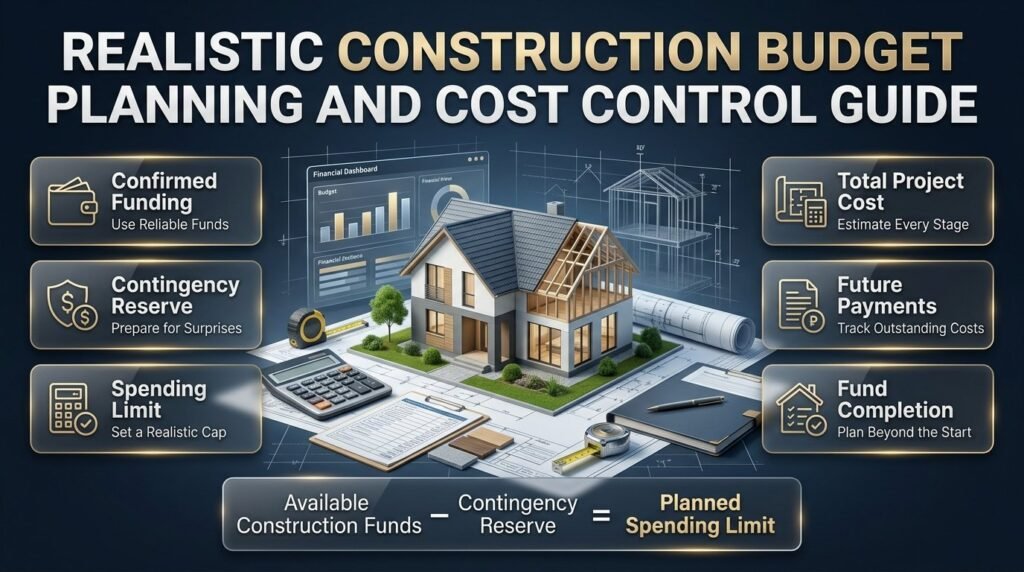
Before estimating individual expenses, determine how much money you can realistically allocate to the project.
Your available funds may include savings, approved financing, or other confirmed sources of funding. Avoid treating unapproved loans, uncertain future income, or money needed for essential household expenses as guaranteed construction funds.
The budget should reflect your actual financial position rather than the most optimistic estimate of what you might eventually afford.
Calculate Your Spending Limit
Start with your total confirmed funding, then decide how much should remain available as a contingency reserve.
A simple formula is:
Available construction funds − contingency reserve = planned spending limit
For example, suppose you have 120,000 currency units available for a project and decide to reserve 12,000 for unexpected expenses.
Your planned spending limit would be 108,000 currency units.
This is an illustrative calculation, not a market price or a recommendation for every project. The appropriate reserve depends on the quality of the estimates, site conditions, and complexity of the work.
If the expected project cost exceeds your planned spending limit, reconsider the scope before construction begins.
Possible adjustments include simplifying the design, selecting suitable standard materials, postponing nonessential features, or dividing the work into professionally planned phases.
Do not reduce essential structural requirements simply to make the figures appear affordable.
Account for the Full Financial Commitment
The construction budget should reflect more than the money required for the next payment. You must consider future obligations, including contractor payments, material orders, outstanding invoices, and costs that have been agreed but not yet paid.
For example, an owner may have enough money to complete the foundation but insufficient funding for the structure, roofing, and essential services. Beginning construction without a credible plan for the remaining stages creates avoidable financial risk.
Before proceeding, estimate the total cost of completion and check whether your funding schedule can support it.
4. Break the Construction Budget Into Clear Cost Categories
Dividing the budget into categories makes it easier to estimate, monitor, and control expenses. Instead of managing one large figure, you can identify the amount allocated to each stage of the work.
A practical cost breakdown may include the following categories.
| Budget category | Expenses to include |
|---|---|
| Planning and design | Drawings, surveys, engineering |
| Approvals | Permits, inspections, statutory fees |
| Site preparation | Clearing, excavation, access |
| Foundations | Concrete, reinforcement, formwork |
| Main structure | Walls, framing, columns, floors, roof |
| Building services | Plumbing, electrical, ventilation |
| Exterior completion | Windows, doors, facade, waterproofing |
| Interior finishing | Flooring, paint, ceilings, cabinetry |
| External works | Drainage, paths, landscaping |
| Project administration | Supervision, insurance, coordination |
| Contingency | Unforeseen costs and approved risks |
Adapt these categories to your project. For example, a small renovation may not require new foundations, while a new building may need substantial site preparation and structural work.
Separate Direct and Indirect Costs
Direct costs relate to the work itself. They commonly include materials, labor, subcontractors, and equipment used for construction.
Indirect costs support the project but may not be tied to a specific building component. These can include administration, insurance, temporary facilities, professional services, and certain approval fees.
Separating the two groups helps you identify missing expenses.
However, avoid double-counting costs. If a contractor’s rate already includes equipment, transportation, or installation, do not add the same amount again unless an additional expense is genuinely required.
Create a Detailed Cost Breakdown Structure
For larger projects, divide each main category into smaller work packages.
For example, the finishing budget might contain separate entries for flooring materials, floor installation, paint, ceiling work, internal doors, light fittings, and bathroom fixtures.
This level of detail helps explain why a category exceeds its allocation.
If the total finishing budget increases, you can identify whether the cause is a material price change, additional work, or a decision to choose more expensive products.
Practical recommendation: Keep the budget detailed enough to support decisions, but avoid creating so many tiny categories that updating the spreadsheet becomes unnecessarily difficult.
5. Estimate Material Quantities and Costs Accurately
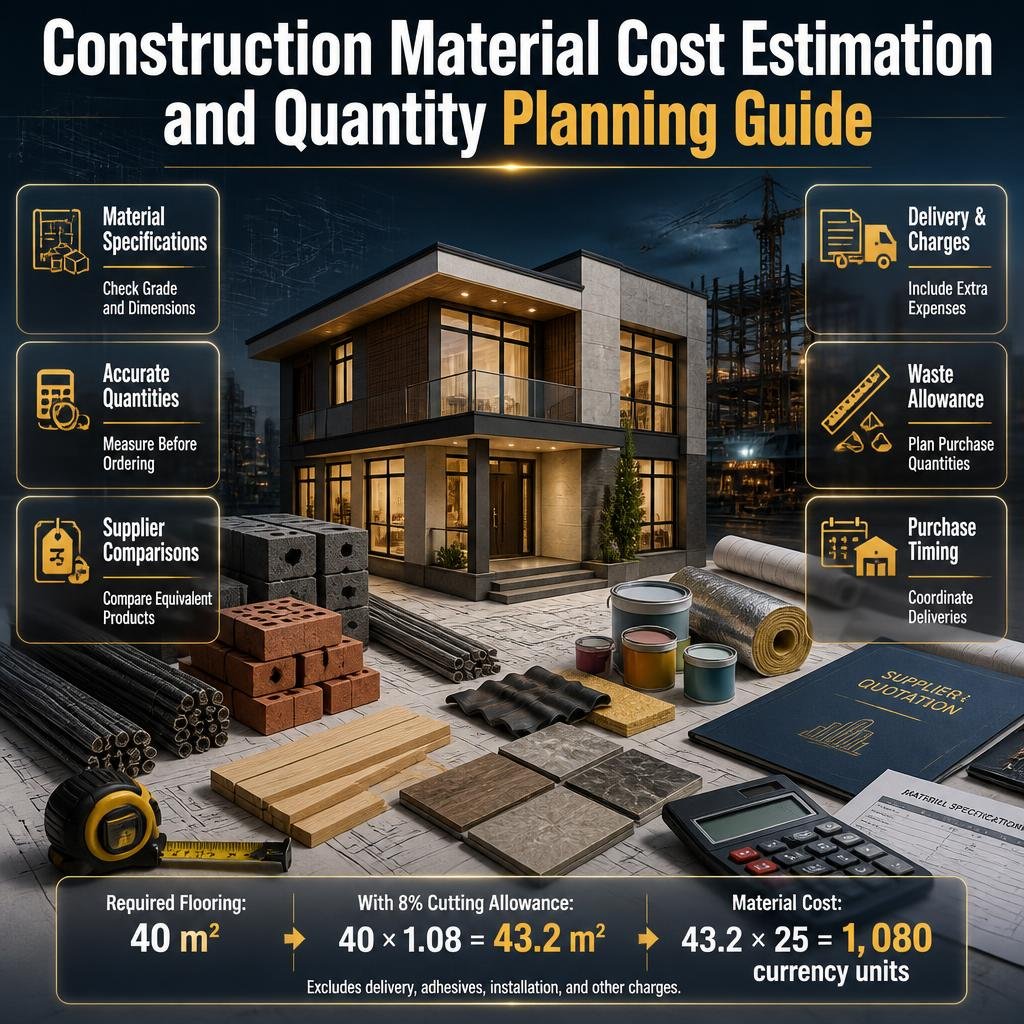
Materials can represent a substantial part of construction expenditure, so quantity estimates deserve careful attention.
The most reliable method is to use the project drawings, measurements, specifications, and appropriate calculation methods rather than relying entirely on rough assumptions.
Calculate Quantities Before Comparing Prices
Depending on the project, you may need quantities for concrete, reinforcement, bricks, blocks, timber, roofing, flooring, paint, tiles, insulation, and other products.
For each material, record:
- The required specification.
- The estimated quantity.
- The unit of measurement.
- The current unit price.
- The expected delivery cost.
- A reasonable allowance for waste, where appropriate.
Then calculate the estimated material cost by multiplying the required purchase quantity by the applicable unit price.
For example, suppose a room requires 40 square metres of flooring. If the installation pattern and supplier guidance indicate an 8% allowance for cutting waste, the purchase quantity would be:
40 × 1.08 = 43.2 square metres.
If the flooring costs 25 currency units per square metre, the material cost would be 1,080 currency units before delivery, adhesives, installation, and other charges.
This example demonstrates the calculation only. Actual waste allowances depend on room dimensions, material format, installation patterns, and product requirements.
Compare Suppliers Using Equivalent Specifications
When requesting supplier quotations, ensure that the products are genuinely comparable.
Check the material grade, dimensions, technical requirements, quantity, delivery arrangements, payment conditions, and applicable taxes.
A lower quoted price may not represent better value if it involves different specifications, unreliable delivery, or additional charges.
For materials used in structural or safety-critical applications, follow the design requirements and professional recommendations rather than selecting a substitute based only on price.
Plan Purchasing and Storage
Ordering materials too early can create storage problems, damage, theft risks, and unnecessary cash-flow pressure.
Ordering too late can delay the project and create additional transport or labor costs.
Coordinate purchasing with the construction schedule and confirm that suitable storage is available before delivery.
Record remaining materials after each stage. Properly stored surplus materials may be usable later, but they should not automatically be treated as money saved if they cannot be used safely or appropriately.
6. Estimate Labor, Contractors, and Specialist Services
Labor estimates should reflect the work required, the skills involved, expected productivity, local rates, and the contractor’s responsibilities.
Construction labor may include general workers, masons, carpenters, electricians, plumbers, roofers, painters, equipment operators, and other specialist trades.
Some contractors provide a combined quotation covering labor and materials. Others price installation separately. Both arrangements can be suitable when the scope and responsibilities are clearly documented.
Request Detailed Contractor Quotations
Ask each contractor to quote against the same drawings, specifications, and work description.
A useful quotation should identify:
- Work included in the price.
- Materials supplied by the contractor.
- Labor and subcontractor costs.
- Equipment and transportation charges.
- Excluded work and provisional allowances.
- Payment milestones.
- Expected duration and scheduling assumptions.
- Procedures for variations and additional work.
- Applicable taxes and other charges.
Review the complete quotation rather than comparing only the final total.
For example, one contractor might quote for laying flooring but exclude the flooring material, adhesive, and preparation of the existing surface. Another might include all those items.
The second quotation may initially look more expensive while offering a more complete scope.
Evaluate Value, Not Just the Lowest Price
Price is important, but so are qualifications, experience, contract clarity, communication, and the ability to complete the specified work.
An unusually low quotation deserves further investigation. It may reflect a genuine cost advantage, but it could also indicate missing work, unrealistic assumptions, or an incomplete understanding of the project.
Ask for clarification before accepting it.
For more general guidance about managing building work, consult the Construction Guide.
Professional tip: Keep written records of quotation revisions. If the scope changes, request an updated price and schedule before approving the additional work.
7. Include Permits, Professional Fees, and Site Expenses
Indirect expenses are often overlooked because they occur outside the main construction activities. Nevertheless, they can have a meaningful effect on the total budget.
Depending on the location and project type, you may need to allow for architectural services, engineering, site surveys, soil testing, permit applications, inspections, insurance, legal services, and utility connections.
Site-related expenses may include clearing, excavation, temporary access, fencing, waste removal, temporary electricity, and water supplies.
Not every project will require every item. Confirm the actual requirements with the relevant professionals and local authorities.
Investigate Site Conditions Early
The condition of the land or existing building can significantly influence the cost.
Potential issues include difficult access, unsuitable soil, drainage problems, buried services, concealed moisture damage, or structural defects.
For a new building, appropriate site investigations can help determine foundation and preparation requirements. For renovation work, surveys and inspections may reveal problems that would otherwise remain hidden until construction begins.
It is usually better to investigate significant risks before committing to a fixed scope and price.
Check Taxes and Contract Exclusions
Read quotations carefully to establish whether applicable taxes, delivery charges, inspection fees, and other costs are included.
Ask the contractor to identify exclusions explicitly.
An incomplete estimate can appear affordable simply because several necessary expenses have been omitted.
A useful budget records both the amount and the basis of each estimate. If a fee has not yet been confirmed, mark it as an allowance or outstanding item rather than treating the figure as final.
8. Set an Appropriate Construction Contingency
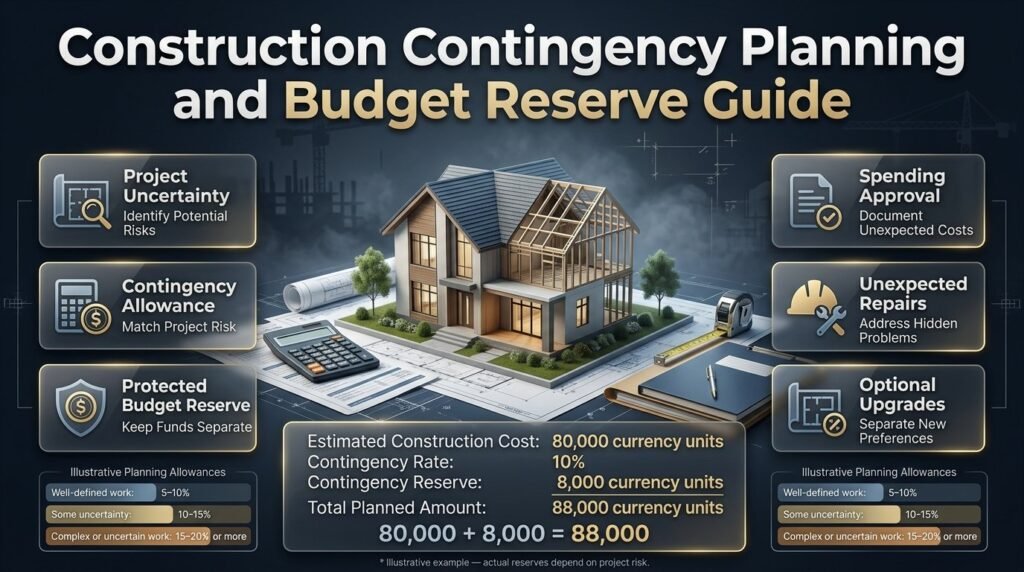
A contingency reserve is money set aside for unexpected expenses and uncertainty. It is not an unrestricted allowance for upgrades or unnecessary changes.
Even well-planned projects can experience price increases, concealed defects, quantity differences, or additional requirements.
The appropriate contingency depends on how much is known about the project and how much uncertainty remains.
| Project conditions | Illustrative planning allowance |
|---|---|
| Well-defined work with reliable estimates | 5–10% |
| Typical work with some remaining uncertainty | 10–15% |
| Complex renovation or uncertain site conditions | 15–20% or more |
These ranges are examples for preliminary planning, not universal rules. A qualified quantity surveyor or project manager can recommend an allowance based on the specific risks.
Keep the Contingency Separate
Suppose the estimated construction cost is 80,000 currency units and the chosen contingency is 10%.
The reserve would be 8,000 currency units, producing a total planned amount of 88,000.
If the project is likely to encounter substantial uncertainty, a higher allowance may be appropriate.
Keep the reserve separate from ordinary spending so you can see how much protection remains.
When an unexpected issue occurs, document the reason, estimate the cost, and approve the expenditure according to the project’s financial controls.
An elective upgrade should normally be funded through a separate decision rather than automatically taken from contingency funds.
Distinguish Contingency From a Scope Upgrade
Suppose a concealed defect requires an additional repair that could not reasonably have been identified earlier. This may justify contingency spending.
By contrast, choosing a premium kitchen finish after the original specification was approved is a scope change.
The distinction matters because it reveals whether the project is experiencing genuine uncertainty or simply becoming more expensive through additional preferences.
9. Prepare a Construction Cash-Flow Plan
A total budget shows how much a project is expected to cost. A cash-flow plan shows when money will be needed.
This distinction is important because construction expenses are not evenly distributed. Design fees and initial materials may be payable early, while other costs arise as different stages are completed.
A project may remain affordable overall but still experience a payment problem if funds are unavailable at the required time.
Match Payments to Construction Milestones
Prepare a schedule showing expected costs at each stage.
| Construction stage | Typical financial requirements |
|---|---|
| Planning | Surveys, design, applications |
| Site preparation | Clearing, excavation, temporary services |
| Foundation | Concrete, reinforcement, labor |
| Structural work | Masonry, framing, roofing |
| Services | Plumbing, electrical, mechanical systems |
| Finishing | Flooring, paint, fixtures, cabinetry |
| Completion | Inspections, corrections, final payments |
The exact sequence depends on the project.
Agree on payment milestones in writing and verify that the corresponding work or contractual requirement has been satisfied before making payments.
Do not assume that the entire amount must be paid at the beginning simply because a contractor requests an early payment. Review the agreement, understand the purpose of the payment, and obtain appropriate professional advice where necessary.
Track Committed Costs
Cash-flow planning should include more than payments already made.
For example, if you have placed a material order but have not yet received the invoice, the financial commitment still exists.
Record outstanding orders, approved variations, upcoming contractor payments, and expected expenses for the remaining work.
This makes it easier to identify future funding shortages before they interrupt construction.
10. Build and Use a Construction Budget Spreadsheet
A spreadsheet is a practical way to manage a small or medium-sized construction budget. It creates a central record of estimates, payments, outstanding commitments, and changes.
A useful spreadsheet can include the following columns:
- Cost code or work category.
- Item description.
- Estimated quantity.
- Unit rate.
- Original budget.
- Actual cost.
- Committed cost.
- Estimated remaining cost.
- Forecast final cost.
- Budget variance.
- Notes and approval status.
For example, a flooring entry might identify the room, material specification, estimated square metres, supplier rate, delivery charge, installation cost, and actual expenditure.
Calculate the Budget Variance
Budget variance shows the difference between the approved amount and the relevant actual or forecast amount.
For a simple comparison:
Budget variance = approved budget − actual cost
If the approved amount is 5,000 and the actual cost is 4,600, the variance is 400 under budget.
If the actual cost is 5,400, the variance is 400 over budget.
However, this calculation only compares the figures entered. It does not account for work that remains incomplete.
For better control, calculate the forecast final cost:
Forecast final cost = actual costs + estimated remaining costs
Make sure committed amounts are incorporated correctly without being counted twice.
Review the Spreadsheet Regularly
Update the budget when new invoices arrive, material prices change, approved variations occur, or estimates for remaining work become more reliable.
During active construction, a weekly review may be appropriate. Smaller projects may need a different review schedule.
Investigate significant differences rather than simply changing the original budget to match the new total. Retaining the original figure helps you understand why the project has changed.
11. How Can You Reduce Construction Costs Without Sacrificing Quality?

Cost control does not mean choosing the cheapest option for every item. It means finding practical ways to reduce waste and unnecessary expenditure while maintaining the required safety, durability, and performance.
Simplify the Design Where Appropriate
Complicated shapes, custom components, unusual roof structures, and extensive decorative details can increase material and labor requirements.
Discuss alternative layouts and construction methods with the designer before finalizing the plans.
A simpler design may reduce both initial costs and future maintenance requirements without making the finished building less useful.
Compare Materials on a Whole-Life Basis
Purchase price is only one part of the decision.
Consider installation requirements, expected durability, maintenance needs, availability, and replacement costs.
A lower-priced product may be suitable for one application but inappropriate for another. Structural and safety-related products must meet the specified technical requirements.
Avoid Unnecessary Design Changes
Late changes can affect several work packages at once.
Changing a room layout, for example, may affect walls, electrical installations, plumbing, flooring, and finishing work.
Before approving a change, obtain its full cost and schedule impact in writing.
Where practical, make design decisions before the affected work begins.
Reduce Waste and Improve Coordination
Coordinate deliveries with the schedule, store materials correctly, and confirm measurements before placing orders.
Plan the sequence of trades so one team’s work does not unnecessarily damage or obstruct another team’s work.
For example, finishing materials should be protected from damage during later activities, and service installations should be coordinated with the relevant structural and finishing requirements.
Consider Maintenance Before Choosing Finishes
The cheapest material is not always the most economical over the life of a property.
A suitable, durable finish may reduce future repair requirements, while poor installation can create recurring costs regardless of the material’s original price.
The Home Maintenance guide can help you think about the relationship between construction decisions and ongoing property upkeep.
For additional work involving repairs and upgrades, the Common Home Repairs and Improvements resource may help you identify related property improvement needs.
12. Common Construction Budgeting Mistakes and How to Avoid Them
Many budget problems arise from avoidable planning errors rather than unavoidable events. Understanding these mistakes makes it easier to create a reliable financial plan.
Underestimating the Project Scope
Why it happens: The initial estimate covers only the obvious building work.
Why it is harmful: Essential services, finishing, site preparation, or approvals may require additional funding.
How to avoid it: Prepare a complete scope and review every stage from planning to completion before approving the budget.
Relying on Unverified Material Prices
Why it happens: Estimates are based on old prices, informal discussions, or incomplete quotations.
Why it is harmful: Actual purchase costs may be higher, leaving insufficient money for other work.
How to avoid it: Obtain current quotations, record their dates and conditions, and confirm prices before placing orders.
Choosing Contractors Based Only on Price
Why it happens: The lowest quotation appears to offer the greatest savings.
Why it is harmful: Important work may be excluded, or the quotation may rely on unrealistic assumptions.
How to avoid it: Compare the same scope, specifications, inclusions, exclusions, and payment conditions.
Using Contingency for Optional Upgrades
Why it happens: The reserve is treated as spare money rather than protection against uncertainty.
Why it is harmful: Unexpected repairs may become unaffordable later.
How to avoid it: Keep contingency separate and approve its use only for documented project risks or legitimate unforeseen costs.
Ignoring the Construction Schedule
Why it happens: The owner focuses on the total budget but does not plan payment dates.
Why it is harmful: Funds may be unavailable when contractors or suppliers need payment.
How to avoid it: Connect the cash-flow forecast with the construction schedule and expected funding.
Failing to Record Changes
Why it happens: Small adjustments are approved informally during site discussions.
Why it is harmful: Their cumulative cost may become substantial, and disagreements may arise about responsibility.
How to avoid it: Document the scope, cost, timing, and approval of significant changes before the work proceeds.
Failing to Monitor Actual Spending
Why it happens: Receipts, invoices, and outstanding commitments are not maintained in one place.
Why it is harmful: Overspending may remain unnoticed until the remaining funds are insufficient.
How to avoid it: Maintain a central spreadsheet and review it regularly with the relevant project participants.
13. Professional Advice for Keeping Your Construction Budget on Track
A strong construction budget depends on disciplined decisions throughout the project, not just an accurate estimate at the beginning.
The following practices can help you maintain financial control.
Verify Major Assumptions Before Committing
Check significant quantities, material specifications, site conditions, and contractor inclusions before making large financial commitments.
If an important estimate is uncertain, identify that uncertainty instead of presenting the figure as a confirmed cost.
Obtain Specialist Advice When Needed
A qualified architect, engineer, quantity surveyor, or project manager can help with complex estimates, structural requirements, cost planning, and risk assessment.
Professional support may be especially valuable for larger projects, extensive renovations, unusual site conditions, or work involving several specialist trades.
Separate the Original Budget From Revised Forecasts
Keep the approved baseline unchanged as a historical reference.
When circumstances change, record the reason, revise the forecast, and obtain approval where required. This approach shows whether differences arise from price changes, unexpected conditions, design revisions, or inaccurate initial estimates.
Protect Essential Work
Never use cost reductions as a reason to bypass required inspections, disregard structural advice, or compromise safe electrical and plumbing installations.
If the budget becomes insufficient, reconsider optional finishes, reduce unnecessary complexity, or explore a suitable phased approach with qualified professionals.
Plan for Completion, Not Just Construction Progress
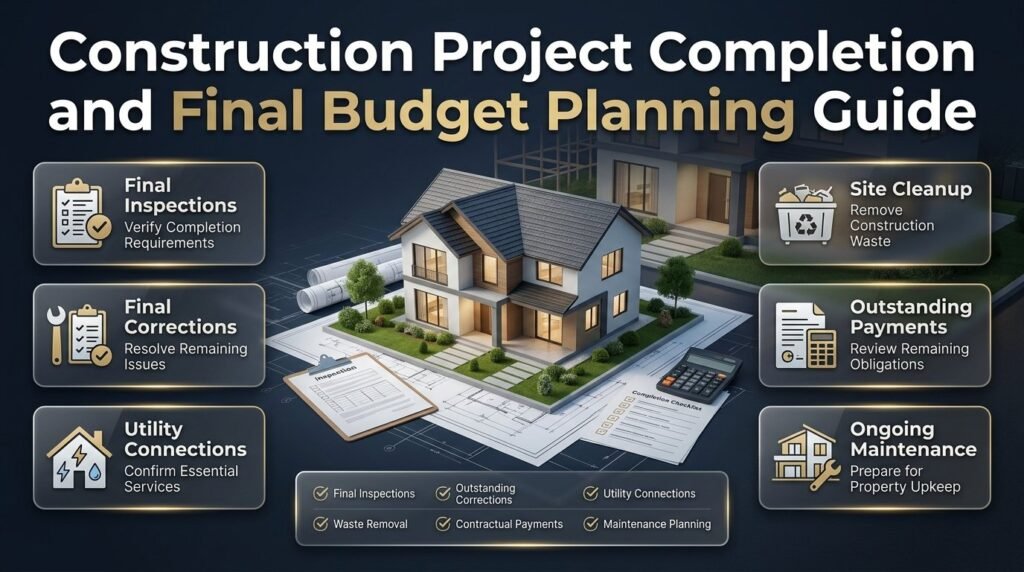
A project is not financially complete simply because the main structure is finished.
Allow for final inspections, outstanding corrections, utility connections, waste removal, and contractual payments that remain due.
If the property is intended for long-term use, consider routine cleaning, garden upkeep, and future maintenance when making relevant decisions. The Outdoor & Garden Care and Cleaning & Organization resources can support planning for these responsibilities after construction.
For broader property management considerations, explore Property Care and Care for a Property.
14. How to Create a Practical Construction Budget Checklist
Before approving a construction budget, use a checklist to confirm that the important financial and planning tasks have been addressed.
Project Planning
- Define the project scope and required finish quality.
- Prepare suitable drawings and specifications.
- Confirm site conditions and access requirements.
- Identify essential work and optional upgrades.
- Establish the maximum available spending limit.
Cost Estimation
- Estimate material quantities using reliable measurements.
- Obtain current supplier quotations.
- Compare contractor quotations against the same scope.
- Include equipment, delivery, labor, and specialist services.
- Account for professional fees, permits, and applicable taxes.
- Check for omitted or duplicated expenses.
Financial Planning
- Set an appropriate contingency reserve.
- Prepare a payment schedule and cash-flow forecast.
- Confirm the funding available for each construction stage.
- Identify outstanding orders and contractual commitments.
- Keep records of assumptions and provisional allowances.
Project Management
- Maintain a central construction budget spreadsheet.
- Record invoices, receipts, and approved variations.
- Compare actual costs with the original estimates.
- Forecast the total cost of completing the remaining work.
- Investigate cost overruns promptly.
- Confirm that final completion expenses are included.
Completing this checklist does not guarantee that every expense will remain unchanged. It does, however, provide a structured way to reduce uncertainty and identify missing information before it becomes a larger problem.
How Do You Create a Realistic Construction Budget for a New Building?
Creating a realistic construction budget starts with defining the project’s scope, confirming the available funds, and estimating every major expense before work begins. Include materials, labor, site preparation, professional fees, permits, equipment, building services, finishing, and a suitable contingency reserve. Base your calculations on reliable drawings, measured quantities, and current local quotations rather than rough guesses.
To make your estimate more dependable:
Define the scope: Specify the building size, structural requirements, materials, and finishing standards.
Calculate quantities: Estimate material requirements using drawings and accurate measurements.
Compare quotations: Obtain detailed prices from qualified contractors and suppliers.
Include indirect costs: Account for approvals, transportation, inspections, and professional services.
Review the total: Confirm that the complete project fits within your available funding.
A realistic budget should reflect the cost of completing the agreed work, not just the amount needed to begin construction.
How Much Contingency Should You Include in a Construction Budget?
A construction contingency is a financial reserve for unexpected expenses, such as concealed building defects, unforeseen site conditions, or necessary changes that could not reasonably be priced at the planning stage. The appropriate allowance depends on the project’s complexity, the quality of the initial estimates, and how much uncertainty remains.
For preliminary planning, some projects use an allowance of around 5–15%, while complex renovations or uncertain site conditions may justify 15–20% or more. These are illustrative ranges rather than fixed rules, so a project-specific assessment is preferable.
Consider these practices when setting your reserve:
Assess project risks: Identify uncertainties involving the site, design, materials, and existing structures.
Keep funds separate: Do not treat contingency money as an ordinary upgrade allowance.
Document unexpected costs: Record the reason for each contingency expenditure.
Review the remaining reserve: Reassess financial exposure as the project progresses.
Seek professional advice: Ask a quantity surveyor or project manager to assess complex projects.
A contingency reserve provides financial protection, but it cannot compensate for an incomplete scope or consistently inaccurate estimates.
What Costs Should Be Included in a Complete Construction Budget?
A complete construction budget should include every significant expense required to deliver the agreed project, from initial planning through completion. Many budgets become unreliable because they cover the main building work but overlook professional services, transportation, utility connections, finishing, or other supporting costs.
Organizing expenses into clear categories helps prevent omissions and makes it easier to compare actual spending with the original estimate.
Your construction budget should generally cover:
Planning and approvals: Architectural drawings, engineering, surveys, permits, and required inspections.
Site preparation: Clearing, excavation, access, drainage, and temporary facilities.
Materials and labor: Structural components, subcontractors, equipment, and installation.
Building services: Electrical systems, plumbing, ventilation, and relevant utility connections.
Finishing and external work: Flooring, paint, fixtures, doors, windows, and planned landscaping.
Project protection: Insurance, waste removal, and an appropriate contingency reserve.
Financing expenses: Relevant loan fees or interest, where applicable.
Check contractor quotations carefully to avoid counting the same expense twice. A budget is only useful when its categories reflect the actual work, contractual responsibilities, and expected completion requirements.
How Can You Keep Construction Costs Under Control Without Compromising Quality?
Controlling construction costs requires careful planning, consistent monitoring, and timely decisions. The most effective savings usually come from reducing waste, avoiding unnecessary changes, comparing equivalent quotations, and choosing materials that offer appropriate durability and performance.
Cutting essential structural work or using unsuitable materials can create expensive problems later. Instead, focus on improvements that reduce unnecessary expenditure without compromising safety or the intended result.
Practical ways to control costs include:
Finalize specifications early: Reduce changes after contractors have started work.
Compare complete quotations: Check inclusions, exclusions, delivery, labor, and applicable charges.
Coordinate material deliveries: Avoid damage, excessive storage, and unnecessary transport costs.
Monitor spending regularly: Compare actual expenses and outstanding commitments with the budget.
Approve changes in writing: Confirm additional costs and schedule effects before proceeding.
Prioritize essential work: Protect structural integrity, waterproofing, safe installations, and required inspections.
Review the forecast final cost throughout construction. If expenses begin exceeding the approved budget, investigate the cause early and adjust optional features or the project scope where appropriate.
What Should You Do If Your Construction Project Goes Over Budget?
When a construction project exceeds its budget, the first step is to identify why the increase occurred. The cause might be rising material prices, inaccurate quantities, unexpected site conditions, additional work, or changes to the original design. Understanding the source helps you choose a suitable response instead of making rushed decisions that could create further problems.
Begin by comparing the original estimate with actual expenses, outstanding commitments, and the cost of completing the remaining work.
Follow these steps to regain financial control:
Identify the variance: Determine which categories have exceeded their allocations.
Recalculate the final forecast: Include completed work, committed costs, and remaining expenses.
Review contingency funds: Establish whether the reserve can cover legitimate unexpected costs.
Reassess optional upgrades: Postpone or remove nonessential features where practical.
Discuss alternatives: Work with the contractor and relevant professionals to evaluate cost-effective solutions.
Document revisions: Record approved changes to the scope, budget, and schedule.
Avoid solving an overrun by ignoring required permits, reducing essential structural standards, or compromising safe installations. If the available funding is insufficient, a professionally planned phased approach may be more appropriate than continuing without a realistic completion plan.
Conclusion
Planning a construction budget is one of the most important steps toward completing a building project successfully. A realistic budget helps you understand the full cost of construction, allocate funds wisely, compare contractor quotations, and prepare for unexpected expenses before they become serious financial problems.
The process begins with a clearly defined project scope and reliable cost estimates. From there, include materials, labor, professional fees, permits, equipment, finishing work, and other essential expenses. Set aside an appropriate contingency reserve, prepare a cash-flow plan, and regularly compare actual spending with the original budget.
Remember that effective budget management does not mean choosing the cheapest option for every decision. It means balancing affordability with quality, durability, safety, and long-term property needs. By documenting changes, monitoring expenses, and addressing cost increases early, you can make better decisions throughout construction.
With careful preparation and consistent financial tracking, you can reduce avoidable surprises, maintain greater control over your spending, and move toward project completion with confidence.