Introduction
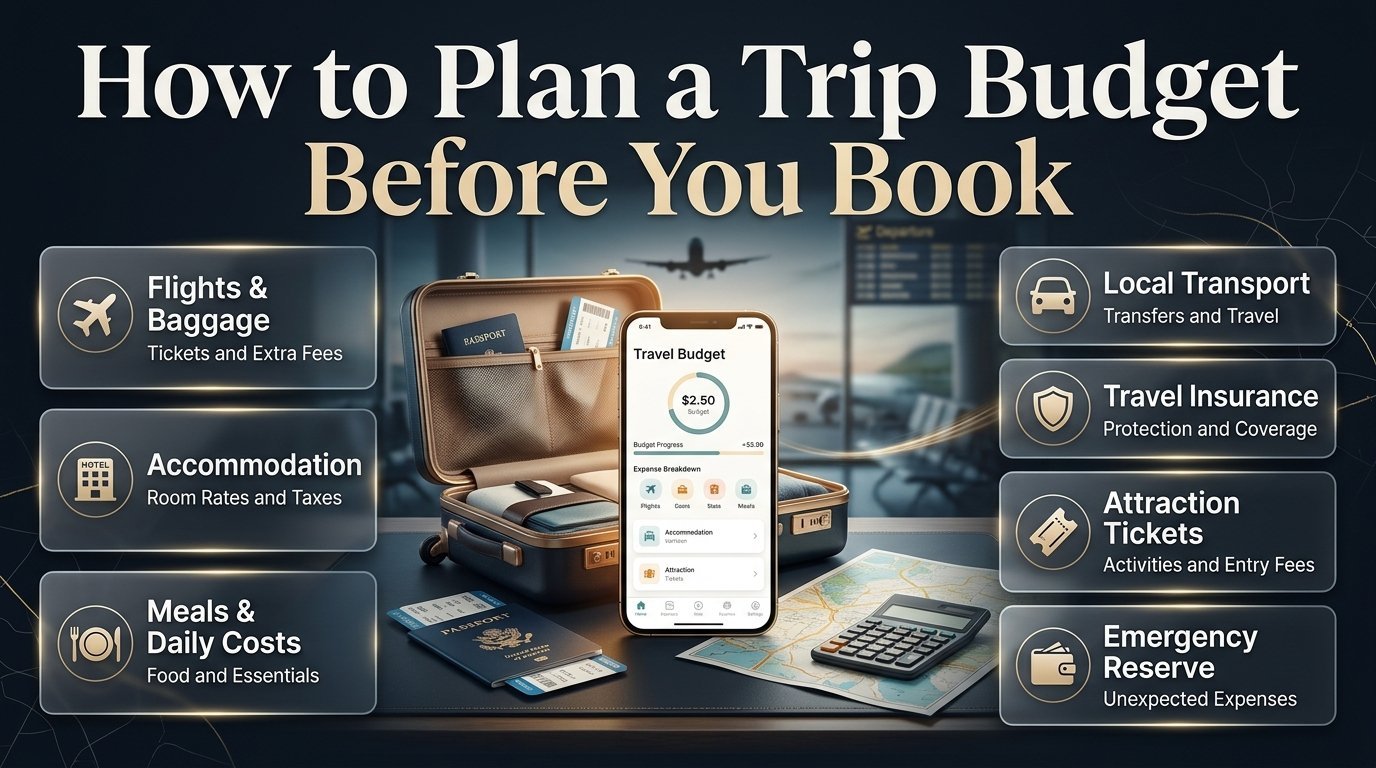
How to Plan a Trip Budget Before You Book | Planning a trip is exciting until you start adding up the real costs. A flight may look affordable, and a hotel may fit your expectations, but meals, local transportation, travel insurance, attraction tickets, baggage charges, and unexpected expenses can quickly increase the total. Without a clear budget, you may end up spending more than you intended or changing your plans after making bookings.
Learning how to plan a trip budget before you book helps you make informed decisions before committing your money. You can compare destinations, estimate the cost of different travel options, decide how much you can comfortably spend, and identify potential savings without sacrificing the experiences that matter most.
At brendanactivepropertycare, practical planning is an important part of making everyday decisions easier. The same principle applies to travel: when you understand the expected costs in advance, you can organize your journey with greater confidence.
You don’t need complicated financial software to prepare a useful travel budget. A simple spreadsheet, realistic estimates, and a clear spending limit are often enough. The key is to consider the complete journey rather than focusing on one attractive flight or accommodation price.
This guide explains how to calculate travel expenses, compare destinations, estimate daily spending, prepare for unexpected costs, avoid common budgeting mistakes, and decide when your trip is financially ready to book.
1. Why Should You Plan a Trip Budget Before Booking?
A trip budget is a financial plan that estimates the total cost of a journey, including transportation, accommodation, food, activities, documentation, insurance, and additional expenses. Preparing it before booking helps you understand whether a trip fits your available money and allows you to adjust expensive choices before they become difficult to change.
A realistic budget also helps you distinguish between the trip you want and the trip you can comfortably afford right now. You may discover that changing your travel dates, shortening your stay, or choosing a different accommodation option makes the same destination more accessible.
Understand the Difference Between a Budget and a Spending Limit
Your spending limit is the maximum amount you are comfortable allocating to a trip. Your budget explains how that amount will be distributed among different expenses.
For example, suppose your maximum travel budget is $1,800. You estimate that flights and accommodation will cost $950, while meals, transport, activities, and other essential expenses will require another $600. You also reserve $150 for unexpected costs.
Your planned total becomes $1,700, leaving $100 below your maximum limit.
That remaining amount provides some flexibility if a price changes. However, it should not encourage you to increase spending unnecessarily.
Identify What You Want From the Trip
Before researching prices, consider the purpose of your journey.
A city break focused on museums and restaurants will have different expenses from a beach holiday, hiking trip, family visit, or road trip. Your priorities determine which costs deserve the largest share of your budget.
Ask yourself:
- Which experiences are essential to the trip?
- How many days do you genuinely need?
- Do you prefer comfort, convenience, or the lowest reasonable cost?
- Will you travel alone or share expenses with others?
- Are your dates flexible?
- Do you need to keep money available for responsibilities after returning home?
Pro Tip: Decide on your maximum budget before browsing attractive deals. This helps you evaluate offers according to your financial priorities rather than allowing appealing prices to determine how much you spend.
2. What Expenses Should You Include in a Trip Budget?
A complete travel budget should include every significant cost from departure preparation to the journey home. Transportation and accommodation usually receive the most attention, but food, documentation, local travel, activities, and payment fees can also affect the final amount.
Start with these expense categories and adapt them to your destination.
| Expense category | What to estimate |
|---|---|
| Main transportation | Flights, trains, intercity buses, or vehicle rental |
| Transfers | Travel between home, airports, stations, and accommodation |
| Accommodation | Room charges, taxes, and mandatory fees |
| Meals | Breakfast, lunch, dinner, snacks, and drinks |
| Local transportation | Public transit, taxis, rideshares, parking, and fuel |
| Activities | Attraction tickets, tours, excursions, and equipment rental |
| Documentation | Passport, visa, and applicable travel authorization fees |
| Travel protection | Insurance premiums and relevant coverage |
| Connectivity | SIM cards, mobile data, and roaming |
| Personal spending | Souvenirs, gifts, and planned purchases |
| Contingency reserve | Unexpected essential expenses |
Separate Fixed Costs From Daily Expenses
Fixed costs are expenses that usually remain relatively stable regardless of how many days you spend at the destination. Examples include many airfare charges, visa fees, and some insurance premiums.
Daily expenses increase as your stay becomes longer. Meals, local transport, snacks, and many activities belong in this category.
This distinction makes it easier to compare different trip lengths.
Suppose your fixed expenses are $650 and your estimated daily spending is $80. A five-day trip would cost approximately $1,050 before additional planned expenses and the contingency reserve. An eight-day trip would cost approximately $1,290 on the same assumptions.
The extra three days add $240, even though your main transportation cost remains unchanged.
Include Expenses That Occur Before Departure
Some travel expenses arise before you leave home rather than at your destination.
These may include:
- Transportation to the airport or station.
- Baggage purchases and essential travel supplies.
- Passport renewal or applicable documentation.
- Pet care or other arrangements at home.
- Airport parking.
- Additional accommodation required because of an early departure or late arrival.
If you expect to be away for an extended period, check whether your home needs any basic arrangements before departure. Your existing household responsibilities and relevant property care needs can help you identify expenses that should be considered separately from your travel spending.
Do not include every possible household expense in the trip total. Add only the costs that are genuinely necessary because of your absence.
Account for Costs That Are Easy to Overlook
Small charges can create a noticeable difference when several apply to the same journey.
For example, an airline may charge separately for checked baggage, while accommodation may apply local taxes or fees. International payments can also involve foreign transaction charges or currency conversion costs.
Before confirming a booking, check the final amount payable rather than relying on the first advertised price.
Common Mistake: Treating a displayed starting price as the complete cost can make an affordable trip appear cheaper than it really is. Always review the final price and relevant booking conditions.
3. How Do You Decide How Much You Can Afford to Spend?
Begin by calculating how much money you can allocate to travel without affecting essential expenses, existing financial commitments, or important savings goals. Your budget should reflect your actual financial situation rather than the amount another traveler spends on a similar journey.
A trip that is affordable for one person may be unsuitable for someone with different income, responsibilities, or savings.
Establish Your Available Travel Funds
Consider your current travel savings and any additional amount you can realistically save before departure.
For example:
| Financial item | Example amount |
|---|---|
| Existing travel savings | $500 |
| Additional planned savings | $600 |
| Total available travel funds | $1,100 |
| Maximum planned trip budget | $1,000 |
| Remaining amount outside the trip budget | $100 |
This example assumes that the listed funds are genuinely available for travel. Money needed for essential bills or emergencies should not be counted simply because it is sitting in an account.
Calculate a Realistic Savings Target
If your estimated trip costs more than your available travel funds, calculate the difference.
Suppose your expected trip budget is $1,500 and you have already saved $600. You need another $900.
If you have six months before departure, you would need to save an average of $150 per month.
This calculation helps you decide whether the trip date is realistic. If the monthly target is too demanding, consider extending the saving period or reducing the estimated trip cost.
Keep Emergency Savings Separate
Your travel contingency reserve and your general emergency savings serve different purposes.
The travel reserve covers unexpected costs associated with the journey, while general emergency savings help protect you against unrelated financial problems. Using both for an ordinary holiday can leave you financially exposed after returning home.
A sensible trip budget should therefore be based on available travel money rather than assuming that every accessible fund can be spent.
Expert Tip: If you cannot cover the planned trip without borrowing for ordinary expenses, revise the trip or postpone it. A holiday is easier to enjoy when its costs do not create unnecessary financial pressure afterward.
4. How Do You Choose a Destination That Fits Your Budget?
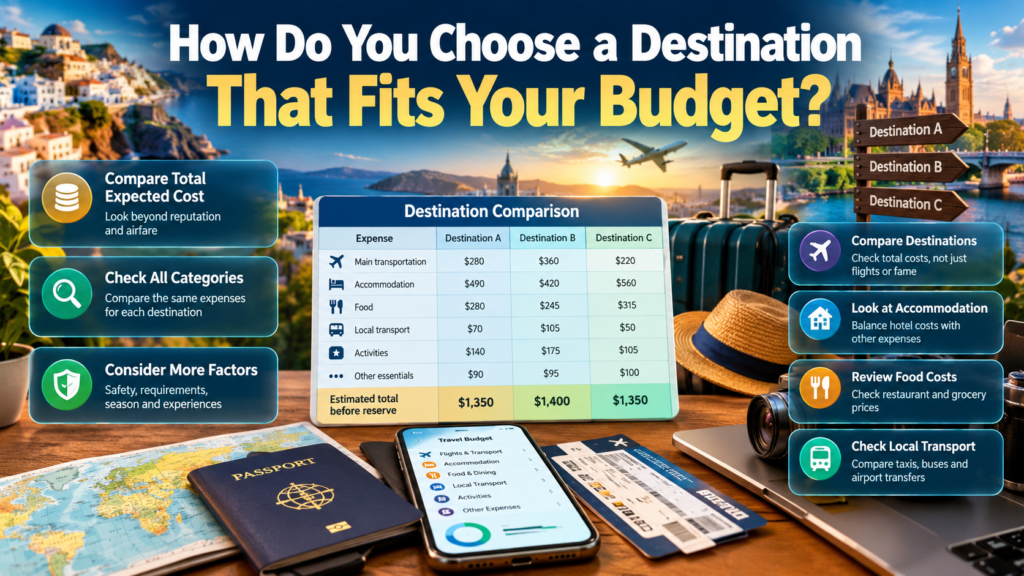
Compare destinations according to their total expected cost, not their reputation or advertised airfare. A destination with inexpensive flights may have costly accommodation, while another with higher transportation costs may offer affordable food, free attractions, and convenient public transport.
Research the same categories for each destination to make a fair comparison.
Compare Three Destination Options
Suppose you are considering three destinations for a one-week trip. Your preliminary research produces the following estimates.
| Expense | Destination A | Destination B | Destination C |
|---|---|---|---|
| Main transportation | $280 | $360 | $220 |
| Accommodation | $490 | $420 | $560 |
| Food | $280 | $245 | $315 |
| Local transport | $70 | $105 | $50 |
| Activities | $140 | $175 | $105 |
| Other essentials | $90 | $95 | $100 |
| Estimated total before reserve | $1,350 | $1,400 | $1,350 |
These are illustrative figures, not current destination prices.
Destination C has the cheapest main transportation, but its higher accommodation and food costs remove much of that advantage. Destination A and Destination C have the same estimated total, although their expense patterns differ.
Your final decision should also consider safety, travel requirements, seasonal conditions, and the experiences available.
Research the Local Cost of Living
Before choosing a destination, investigate typical prices for:
- Meals at the types of restaurants you expect to visit.
- Grocery shopping and basic refreshments.
- Public transport tickets.
- Taxis and airport transfers.
- Hotel rooms during your intended travel dates.
- Popular attractions and guided activities.
Recent prices are more useful than general statements that a city is cheap or expensive.
Consider Travel Dates as Part of the Destination Decision
The same destination can have very different costs depending on when you visit.
Peak seasons, major events, school holidays, and popular festivals may increase demand for flights and accommodation. Traveling during a quieter period can sometimes reduce costs, although weather, transport availability, and seasonal closures also matter.
Compare dates only after considering the practical consequences. A lower room rate may not represent good value if poor weather prevents you from enjoying the activities you planned.
5. How Should You Estimate Transportation Costs?
Transportation budgeting should include the complete journey, from leaving home to returning home. Comparing the advertised airfare alone can be misleading because baggage, transfers, parking, and local travel may increase the total.
Use this formula:
Total transportation cost = outbound journey + return journey + transfers + local transportation + additional fees.
Compare the Full Cost of Flights
When comparing airfares, check:
- The final price for your selected dates.
- Checked and carry-on baggage allowances.
- Seat-selection charges, if relevant.
- Airport locations and transfer costs.
- Arrival and departure times.
- Change and cancellation conditions.
- The cost of reaching your accommodation.
A cheaper flight arriving after public transport has stopped may require a taxi or an extra night of accommodation. A slightly more expensive flight may prove more economical when all related costs are included.
Budget for Trains, Buses, and Road Travel
For train or bus journeys, estimate the cost of tickets, station transfers, luggage charges, and necessary reservations.
For road trips, consider fuel, tolls, parking, vehicle rental, and any other charges that apply. If you use your own vehicle, include reasonable travel-related operating costs rather than treating fuel as the only expense.
Do not assume that driving is cheaper simply because several travelers can share a vehicle. Compare the combined cost against available public transportation.
Allow for Changes Between Locations
Multi-city trips may require several additional journeys.
If your itinerary includes two or three destinations, estimate the cost of moving between them before deciding how long to stay in each place.
A complex itinerary can also involve additional luggage handling, station transfers, and time spent traveling. These costs may make a simpler route better value.
Quick Tip: Calculate the return journey before booking the outbound ticket. This prevents you from spending too much on the first part of a trip and discovering that the return route exceeds your remaining budget.
6. How Do You Set a Realistic Accommodation Budget?
Accommodation budgeting involves more than choosing the lowest nightly rate. The total cost depends on the length of your stay, room type, mandatory charges, location, cancellation terms, and the additional transportation required to reach your planned activities.
Calculate the Total Stay
Use the following formula:
Accommodation total = nightly rate × number of nights + mandatory fees and taxes.
Suppose one property costs $95 per night for six nights. The room subtotal is $570 before applicable additional charges.
Another property costs $110 per night, producing a subtotal of $660. The first option appears to save $90.
However, if the cheaper property requires an extra $18 per day in transportation, the additional six-day transport cost is $108. The apparent saving disappears.
This is why accommodation and local transport should be considered together.
Decide Which Facilities Matter
Choose accommodation according to your practical needs rather than paying for every available facility.
A kitchen may help reduce food expenses if you genuinely intend to prepare some meals. Laundry facilities may be useful for a longer stay. Breakfast included in the room rate may offer value if the alternative would be an expensive morning meal.
On the other hand, a facility that you will rarely use may not justify a higher price.
Check Payment and Cancellation Conditions
Before booking, determine whether you must pay the full amount immediately or whether payment is due later.
Read the cancellation deadline, refund conditions, and any charges that apply when plans change. A nonrefundable room may offer a lower price but create a greater financial risk if your travel dates are uncertain.
Compare that saving with the value of flexibility.
For further planning support, review How to Choose the Right Hotel Location.
7. How Much Should You Budget for Food and Drinks?
Your food budget should reflect local prices, the number of travel days, and your actual eating habits. Estimate breakfast, lunch, dinner, snacks, drinks, and occasional convenience purchases instead of assuming that you will spend the same amount every day.
Build a Daily Food Estimate
Consider this example:
| Daily food expense | Example estimate |
|---|---|
| Breakfast | $8 |
| Lunch | $14 |
| Dinner | $24 |
| Snacks and drinks | $9 |
| Daily total | $55 |
For a seven-day trip, the estimated food budget would be $385 per person.
These figures are examples only. Research local menus and grocery prices before applying a daily estimate to your own destination.
Adjust for Your Accommodation
If breakfast is included in your room rate, account for that when calculating your remaining food expenses. If you have access to a kitchen, you may be able to prepare selected meals.
However, do not count a kitchen as a saving unless you intend to use it. Buying groceries that go unused can increase expenses rather than reduce them.
Avoid Underestimating Snacks and Drinks
Travel days often involve additional purchases because of waiting times, sightseeing, or limited food options.
Include a modest allowance for refreshments and occasional convenience purchases. This creates a more realistic daily estimate and reduces the likelihood of repeatedly exceeding your budget.
You can still enjoy local food without choosing expensive restaurants for every meal. Plan a mixture of affordable everyday meals and selected dining experiences that matter to you.
8. How Should You Budget for Activities and Sightseeing?
List the experiences you want to enjoy, estimate their prices, and decide which ones are essential before booking. This prevents optional activities from consuming money needed for transportation, accommodation, and other important expenses.
Divide Activities Into Three Groups
Must-do experiences: These are the main reasons for choosing the destination, such as a particular museum, tour, or cultural event.
Optional experiences: These are activities you would enjoy if time and money permit.
Free alternatives: These might include parks, public viewpoints, walking routes, free exhibitions, or beaches where access is permitted.
Estimate the cost of your must-do experiences first. Then decide how much remains for optional activities.
Check What Is Included in Ticket Prices
A tour may include transport and admission, while another may charge separately for both. Some attractions also have optional audio guides, equipment rental, or premium entry packages.
Compare the full price before deciding which option offers better value.
Leave Room for Flexibility
Booking every activity in advance can make a trip expensive and inflexible.
Some activities depend on weather, energy levels, or personal interest. When advance booking is not necessary, consider keeping a portion of your activity budget available for decisions made during the trip.
This allows you to respond to local recommendations without automatically increasing your total spending limit.
Pro Tip: Protect your budget for the two or three experiences that matter most. You will often enjoy the trip more by prioritizing meaningful activities than by trying to fit every available attraction into your schedule.
9. What Documentation and Travel Protection Costs Should You Include?
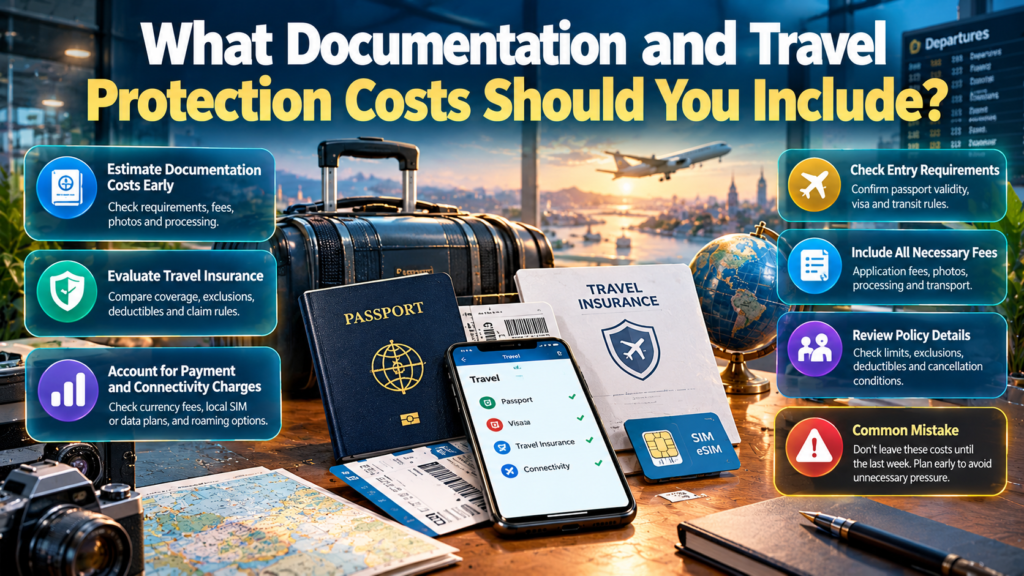
International travel may require a passport, visa, transit authorization, or other documentation. Requirements depend on your nationality, destination, route, and purpose of travel, so confirm the applicable rules before making nonrefundable reservations.
Estimate Documentation Costs Early
Check whether your passport is valid for the required period and whether your destination has specific entry requirements.
Include applicable application fees, photographs, document processing, and necessary transportation to complete the process.
Do not assume that a transit connection automatically permits entry or that every traveler has the same visa requirements.
Evaluate Travel Insurance
Travel insurance may help protect against certain unexpected expenses, depending on the policy and circumstances.
Compare coverage limits, exclusions, deductibles, cancellation conditions, and requirements for making a claim. Consider whether the policy addresses your particular itinerary and any activities you plan to undertake.
The cheapest policy is not necessarily the most suitable, and no policy covers every possible situation.
Account for Payment and Connectivity Charges
International transactions may involve currency conversion costs or foreign transaction fees. Mobile connectivity may also require a local SIM card, travel data plan, or roaming package.
Check your existing services before purchasing additional options. You may already have suitable coverage, but do not assume that your usual mobile plan applies internationally.
Common Mistake: Leaving documentation, insurance, and connectivity until the final week can create unnecessary pressure. Research them while you are still deciding whether the trip fits your budget.
10. How Much Emergency Money Should You Set Aside?
An emergency reserve is money kept available for unexpected travel expenses. A preliminary allowance of 10% to 15% of estimated trip costs can be a useful starting point for a relatively predictable journey, although the appropriate amount depends on your destination, itinerary, insurance, and personal circumstances.
Calculate a Contingency Reserve
Suppose your estimated travel expenses are $1,600 and you decide to use a 12% contingency allowance.
The calculation is:
$1,600 × 0.12 = $192.
Your planned budget becomes $1,792.
This does not mean that you will spend the extra $192. It means that you have planned for a reasonable degree of uncertainty.
Consider the Complexity of Your Itinerary
A direct journey with confirmed accommodation may be easier to estimate than a multi-country trip involving several connections.
A more complex itinerary can create additional uncertainty around transport, accommodation changes, and unexpected delays. You may therefore want a larger reserve than you would use for a short, straightforward trip.
Consider the possible costs rather than selecting a percentage without reviewing your circumstances.
Keep the Reserve Separate
Do not treat emergency money as an extra shopping allowance.
Keep track of your planned expenses and remaining reserve throughout the trip. If you need to use part of it, identify the reason and adjust your discretionary spending if necessary.
The goal is not to avoid every unexpected cost. It is to prevent a manageable surprise from disrupting the entire journey.
11. How Do You Calculate the Complete Trip Budget?
Calculate the full budget by adding fixed costs, daily expenses, planned activities, additional essential costs, and the contingency reserve. Then compare the total with your available travel funds and maximum spending limit.
Use this formula:
Total planned budget = fixed costs + daily expenses × number of days + planned extras + contingency reserve.
Work Through a Practical Example
Imagine you are planning a six-day trip.
| Expense | Estimated amount |
|---|---|
| Return transportation and transfers | $420 |
| Accommodation | $480 |
| Food: $55 × 6 days | $330 |
| Local transport | $65 |
| Activities | $140 |
| Insurance and documentation | $75 |
| Connectivity and miscellaneous expenses | $40 |
| Estimated expenses | $1,550 |
| Contingency reserve: 12% | $186 |
| Total planned budget | $1,736 |
These figures are illustrative and should be replaced with destination-specific estimates.
If your maximum budget is $1,800, the plan leaves $64 below that limit after accounting for the reserve.
That margin is relatively small. You may decide to reduce one optional expense or choose a less expensive travel date to create more flexibility.
Check Shared and Individual Expenses
When traveling with other people, identify which costs are shared and which belong to each traveler.
A hotel room may be paid for by two people, while individual meals and attraction tickets may vary. Calculate the total room cost first, then divide it according to the actual arrangement.
Do not simply divide the entire trip total by the number of travelers unless everyone has agreed to share every expense equally.
Track Payments as Well as Estimates
A complete budget should show more than the expected total.
Record the amount quoted, the amount confirmed, the amount already paid, and the amount still outstanding. This helps you identify whether you have enough available money for upcoming payment deadlines.
A trip can be affordable overall but difficult to manage if several large payments fall due at the same time.
12. How Can You Compare Travel Budget Options?
Comparing alternatives helps you identify savings without making decisions based only on the cheapest advertised price. Use the same travel dates, number of nights, number of travelers, and approximate travel style when evaluating different options.
Compare Shorter and Longer Stays
Suppose a six-day trip costs $1,550 before a contingency reserve, while a nine-day version costs $1,715 before the reserve.
The additional three days increase the estimated cost by $165 in this example, but actual costs may vary depending on accommodation and transportation arrangements.
Check whether the additional days provide enough value to justify the extra expense.
Compare Different Accommodation Choices
A cheaper room may be worthwhile if it meets your practical needs and does not create excessive additional transportation costs.
A more expensive room may offer better value if it includes useful facilities or reduces the need for taxis.
Always compare the total expected cost rather than the room price alone.
Compare Flexible and Fixed Bookings
Flexible bookings may cost more, but they can be useful when dates or circumstances are uncertain.
Nonrefundable options may save money when plans are firm, but they can create greater losses if changes become necessary.
Review the actual conditions and price difference before deciding.
Use a Simple Decision Table
| Decision | Potential benefit | What to check |
|---|---|---|
| Change travel dates | Lower fares or room rates | Weather and availability |
| Shorten the stay | Lower daily expenses | Lost experiences |
| Change accommodation | Better overall value | Location and extra fees |
| Reduce optional activities | Lower total spending | Personal priorities |
| Choose public transport | Potential savings | Routes and travel time |
| Book a flexible rate | Greater adaptability | Additional cost |
A saving is worthwhile when it reduces total costs without creating a larger expense or an unacceptable inconvenience elsewhere.
13. What Tools Help You Organize a Trip Budget?
A spreadsheet is often sufficient for organizing a trip budget, particularly when you need to compare destinations or calculate expenses for several travelers. A budgeting app can also help you track spending during the journey, while a simple notes document may be enough for a short trip.
Create a Basic Budget Spreadsheet
Use columns for:
- Expense category.
- Estimated amount.
- Confirmed amount.
- Amount paid.
- Remaining amount.
- Payment deadline.
- Cancellation conditions.
This structure makes it easier to update your figures as prices become more certain.
For example, if you estimated $450 for accommodation but the confirmed price is $490, the $40 difference becomes visible immediately.
You can then adjust optional spending before confirming other reservations.
Use Simple Formulas
A spreadsheet can calculate the total of your expense categories automatically.
You can also use a formula to calculate your contingency reserve by multiplying your estimated expenses by the percentage you selected.
For example, a 12% reserve is calculated by multiplying the relevant subtotal by 0.12.
Keep the calculation simple enough that you can understand and verify it. A complicated system is not necessarily better if you do not maintain it.
Track Actual Spending During the Trip
Once the journey begins, record your actual expenses and compare them with your estimates.
If you spend more than expected on meals, check whether you can reasonably reduce optional purchases elsewhere. If an activity costs less than planned, keep the difference available rather than assuming you must spend it.
Your budget should guide decisions, not create unnecessary pressure to use every allocated amount.
14. What Are the Most Common Trip Budgeting Mistakes?
Travel budgeting problems often begin with incomplete estimates, unrealistic assumptions, or bookings made before the full cost is understood. Recognizing these mistakes early can prevent avoidable financial stress.
Mistake 1: Choosing a Trip Based Only on Cheap Flights
Why it happens: Airfare is easy to compare, and a large advertised discount looks attractive.
Why it is harmful: Accommodation, food, transfers, and local activities may cost substantially more than expected.
How to avoid it: Estimate the complete cost for each destination before choosing your flight.
Mistake 2: Forgetting Taxes and Mandatory Fees
Why it happens: The first price shown may not include every charge.
Why it is harmful: Additional costs can push the total beyond your limit.
How to avoid it: Check the final amount payable and review the booking conditions.
Mistake 3: Underestimating Daily Spending
Why it happens: Travelers often focus on major purchases and overlook smaller recurring costs.
Why it is harmful: Small differences accumulate across several days.
How to avoid it: Estimate food, transport, drinks, and other routine expenses separately.
Mistake 4: Using Emergency Savings to Cover Ordinary Costs
Why it happens: A traveler may assume that unused savings can always cover a shortfall.
Why it is harmful: Unexpected personal or household expenses may become harder to manage.
How to avoid it: Establish a realistic trip budget and keep unrelated emergency savings separate.
Mistake 5: Booking Before Checking Documentation Requirements
Why it happens: Travelers may assume that documentation will be straightforward.
Why it is harmful: Additional requirements or processing delays can affect both timing and costs.
How to avoid it: Confirm the applicable requirements before making major nonrefundable commitments.
Mistake 6: Ignoring Payment Deadlines
Why it happens: The overall trip cost seems manageable, so the timing of payments receives little attention.
Why it is harmful: Large payments may become due before the necessary funds are available.
How to avoid it: Record payment dates and confirm that the money will be available when required.
Mistake 7: Treating the Contingency Reserve as Spending Money
Why it happens: The reserve may look like unused money after the main bookings are paid.
Why it is harmful: An unexpected expense may leave you without enough flexibility.
How to avoid it: Keep the reserve separate and use it only when needed.
Mistake 8: Trying to Make Every Expense as Cheap as Possible
Why it happens: Travelers sometimes equate a successful budget with the lowest possible cost.
Why it is harmful: Poorly located accommodation, inconvenient connections, or unsuitable arrangements may reduce the value of the trip.
How to avoid it: Compare overall value, convenience, and essential requirements rather than price alone.
15. What Do Experienced Planners Recommend Before Booking?
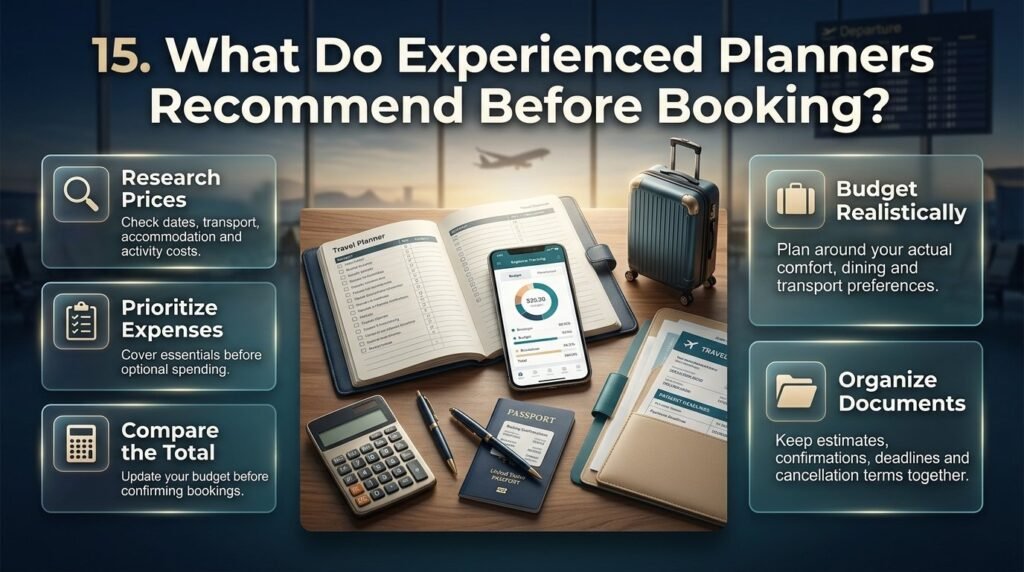
Effective travel planning relies on realistic estimates, clear priorities, and regular checks before financial commitments are made. The goal is not to predict every expense perfectly but to create a plan that remains manageable when ordinary costs change.
Research Prices Before Making Commitments
Use destination-specific information to estimate the expenses that matter most. Check accommodation rates for your exact dates, compare transport options, and investigate the prices of activities you genuinely want to experience.
Where prices are uncertain, label them as estimates rather than treating them as confirmed costs.
Separate Essential Expenses From Optional Spending
Essential expenses include the transport and accommodation required for the trip, applicable documentation, and other necessary arrangements.
Optional expenses may include extra tours, premium room upgrades, souvenirs, or additional dining experiences.
Protect the essential categories first. Allocate the remaining amount according to your priorities.
Compare the Total Before Confirming Each Booking
A new booking can change the amount available for everything else.
After receiving a final quote, update the complete budget and check whether the total still fits your spending limit. If it does not, adjust the plan before confirming the next major expense.
Plan for the Journey You Will Actually Take
Do not build your budget around ideal behavior that you are unlikely to maintain.
If you usually prefer comfortable accommodation, allow for it. If you enjoy restaurant meals, include a realistic dining allowance. If you expect to use taxis because of your itinerary, estimate those costs rather than assuming you will always use public transport.
A realistic plan is more useful than an extremely low estimate that repeatedly proves inaccurate.
Keep Your Planning Documents Together
Store your estimates, booking confirmations, payment deadlines, and cancellation conditions in one accessible place.
This reduces the chance of overlooking a payment or forgetting an important booking detail.
For broader journey organization, the travel guide and Plan a Journey resources can complement your budget planning without replacing the cost calculations in this article.
16. How Can You Prepare Your Budget for Different Types of Trips?
Different journeys create different financial demands. A useful budget should reflect the type of trip, the number of travelers, the length of the stay, and the level of flexibility required.
Solo Travel
Solo travelers are responsible for their own accommodation and transportation costs. They may have fewer opportunities to share expenses, particularly for private rooms and rental vehicles.
Look for accommodation priced appropriately for one person and compare public transportation with private options.
Family Travel
Families may need larger rooms, additional baggage, child-friendly activities, or transport that accommodates everyone comfortably.
Estimate costs for each traveler and identify which expenses are shared. Keep a reasonable allowance for changes to meals, activities, or transport arrangements.
Group Travel
Groups can sometimes reduce accommodation or vehicle costs by sharing expenses.
However, group travel works best when everyone agrees on spending limits, booking responsibilities, and payment arrangements. A shared expense tracker can help prevent confusion.
Road Trips
Road trips require a different cost structure from journeys based mainly on public transport.
Include fuel, tolls, parking, accommodation along the route, and relevant vehicle expenses. Estimate the total route rather than calculating fuel alone.
International Trips
International travel may involve currency conversion, visas, international payment fees, travel insurance, and additional transport connections.
Create separate estimates for each country when traveling across multiple destinations. Use a recent exchange rate and allow for applicable charges or fluctuations.
17. How Do You Know When Your Trip Is Ready to Book?
Your trip is financially ready to book when the complete estimated cost fits your available travel funds, major expenses have been researched, essential requirements are understood, and the booking conditions are acceptable.
Before confirming nonrefundable reservations, review the following checklist.
- My maximum travel spending limit is clear.
- I have estimated the full cost rather than airfare alone.
- I have checked transportation and return travel.
- I have compared accommodation prices and locations.
- I have included meals and local transport.
- I have estimated the cost of my priority activities.
- I have researched applicable documentation requirements.
- I have considered relevant travel insurance.
- I have included a contingency reserve.
- I understand payment deadlines and cancellation conditions.
- I have checked that the planned payments fit my available funds.
- I have reviewed the complete total after the latest price updates.
If several important figures remain uncertain, continue researching before making major commitments.
If the total exceeds your available budget, revise the trip rather than relying on uncertain future savings or borrowing.
You do not need every minor expense to be confirmed before beginning research. However, you should understand the major costs and have enough flexibility to manage reasonable changes.
How Do You Calculate the Total Cost of a Trip Before Booking?
Calculating the total cost of a trip requires more than checking flight and hotel prices. You need to estimate every major expense, including transportation, accommodation, meals, local travel, activities, travel insurance, documentation, and unexpected costs. Start by listing fixed expenses, then calculate daily spending based on the number of travel days. Add any additional fees and a contingency reserve to determine your realistic budget before making reservations.
For example, if your transportation costs $400, accommodation costs $450, daily expenses total $350, and activities and other essentials cost $150, your estimated trip cost is $1,350 before the emergency reserve. Adding a 10% contingency allowance would bring your planned budget to $1,485.
Important points to remember:
Calculate the return journey, not just the outbound ticket.
Include taxes, baggage charges, airport transfers, and payment fees.
Separate estimated costs from confirmed booking prices.
Compare the final total with your available travel funds before booking.
How Much Extra Money Should You Save for Unexpected Travel Expenses?
A contingency reserve helps cover unexpected expenses that may arise before or during a trip. A starting allowance of 10% to 15% of your estimated travel costs can be useful for a relatively predictable journey, although the appropriate amount depends on your destination, itinerary, insurance coverage, and personal circumstances.
For example, if your estimated trip expenses are $1,200, a 10% reserve would provide an additional $120, bringing your planned total to $1,320. A more complicated itinerary involving multiple destinations or uncertain transportation arrangements may require a larger reserve.
The purpose of this money is to give you flexibility when prices change or an unexpected essential expense occurs. It should not be treated as extra shopping money or used to justify booking a trip that already exceeds your available funds.
Practical budgeting tips:
Keep your travel contingency reserve separate from your everyday spending allowance.
Maintain separate savings for emergencies unrelated to the trip.
Consider possible transport delays, accommodation changes, and unexpected fees.
Review your insurance coverage to understand which expenses may or may not be covered.
Is It Better to Book Flights or Accommodation First When Planning a Travel Budget?
The best booking order depends on your destination, travel dates, availability, and the cancellation conditions attached to each reservation. Instead of automatically booking flights first, research both transportation and accommodation before committing to either. This helps you confirm that suitable rooms are available and that the combined cost fits your budget.
For example, you might find an inexpensive flight to a popular destination but discover that accommodation is unusually expensive during your travel dates. If you purchase a nonrefundable ticket before checking hotel availability, changing your plans could become costly. Comparing both expenses first helps you understand the complete financial commitment.
Once you have reviewed the total cost, payment deadlines, and cancellation conditions, you can decide which booking to secure first. A refundable option may provide flexibility, but compare its additional cost with the protection it offers.
Before confirming either reservation:
Compare the complete flight price, including baggage and transfers.
Check accommodation availability for the exact dates.
Calculate the combined transportation and accommodation costs.
Review cancellation policies and payment deadlines.
Keep enough money available for meals, activities, and other essential expenses.
How Can You Reduce Travel Costs Without Sacrificing Comfort?
Reducing travel costs effectively means identifying expenses that can be lowered without compromising your essential needs or the experiences that make the journey worthwhile. Rather than choosing the cheapest option in every category, compare overall value, convenience, location, and the quality of the experience.
Flexible travel dates may help you find lower transportation and accommodation prices. Choosing a well-connected hotel can reduce local transport costs, while preparing selected meals or using public transportation may create additional savings. You can also prioritize a few meaningful activities instead of paying for every available attraction.
For example, accommodation outside the main tourist area may have a lower nightly rate, but expensive daily transfers could remove the saving. A reasonably priced room near public transportation may offer better overall value.
Smart ways to save:
Compare travel dates before making nonrefundable bookings.
Evaluate accommodation and transportation costs together.
Prioritize activities that matter most to you.
Check baggage allowances and additional booking fees.
Leave room in your budget for occasional treats without using your emergency reserve.
What Should You Do If Your Estimated Trip Budget Exceeds Your Available Money?
If your estimated trip cost exceeds your available travel funds, revise the plan before making major financial commitments. Start by identifying the expenses that contribute most to the total, then compare practical alternatives. You may be able to reduce the length of your stay, choose different travel dates, select more suitable accommodation, or postpone optional activities without losing the main purpose of the trip.
For example, if your estimated trip costs $1,700 but you can comfortably allocate only $1,400, you have a $300 shortfall. Rather than relying on credit or removing your emergency reserve, review the main expense categories and determine whether the trip can be adjusted realistically.
If the total still exceeds your affordable limit, postponing the journey while saving more may be the most sensible decision. A well-planned trip should fit your financial circumstances rather than create difficulties after you return home.
Steps to bring your budget under control:
Identify the largest expenses and compare alternative options.
Consider a shorter stay or more affordable travel dates.
Remove lower-priority activities before cutting essential costs.
Protect your emergency savings and necessary financial commitments.
Recalculate the complete budget before confirming any reservation.
Conclusion
Planning a trip budget before you book is one of the most effective ways to make travel more affordable, organized, and enjoyable. By estimating transportation, accommodation, meals, activities, local travel, and additional expenses in advance, you can understand the true cost of your trip before making financial commitments. A realistic budget also helps you compare options carefully, avoid unnecessary spending, and choose travel arrangements that match your priorities.
The most reliable approach is to research prices, separate essential expenses from optional activities, and keep an emergency reserve for unexpected costs. Remember that the cheapest flight or hotel is not always the best value when baggage fees, transportation, cancellation policies, and other charges are considered. Reviewing the complete cost before confirming a booking can prevent unpleasant surprises later.
Before finalizing your plans, check your estimated spending against the amount you can comfortably afford. Adjust your destination, travel dates, accommodation, or activities if necessary rather than relying on money you may need for essential expenses. With careful preparation and regular budget tracking, you can enjoy a more confident travel experience while keeping your finances under control.